Pakistan seizes assets of terror group Jamaat-ud-Dawa

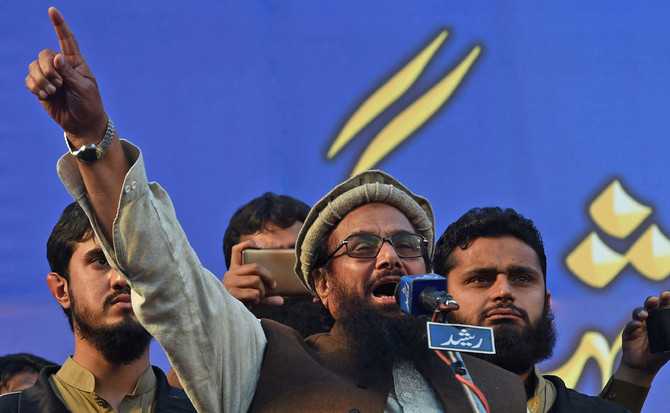
In this file photo, Pakistani head of the Jamaat-ud-Dawa (JuD) organization Hafiz Saeed, center, speaks to protesters as they gather in a rally to mark Kashmir Solidarity Day in Lahore on Feb. 5, 2018. (AFP)
Updated 16 February 2018
Follow

Pakistan seizes assets of terror group Jamaat-ud-Dawa

ISLAMABAD: Punjab Law Minister Rana Sanaullah has confirmed to Arab News that the Punjab Government has seized all assets belonging to Jamaat-ud-Dawa (JuD), including seminaries and medical centers.
JuD is widely regarded as a front for the militant Islamist organization Lashkar-e-Taiba, recognized as a terrorist group by a number of countries.
“JuD is a banned organization and the Punjab government has taken over all its assets,” Sanaullah told Arab News on Thursday.
“We have implemented the law,” he said. “JuD is no longer a legal entity in our province.”
Pakistan had initiated a seize-freeze-and-control operation against JuD and its charity wing, the Falah-e-Insaniat Foundation (FIF), after the Interior Ministry issued a notification against them on Wednesday.
The notification was circulated just two days after President Mamnoon Hussain announced an amended Anti-Terrorism Ordinance, 2018, to include individuals and organizations on the UN Security Council (UNSC) terror list.
Both JuD and FIF are linked to Hafiz Saeed, whom India accuses of masterminding the November 2008 attacks in Mumbai. Saeed has a $10 million bounty on his head.
While Saeed has been put under house arrest several times in the past, his legal team has thus far always managed to clear him due to insufficient evidence.
Pakistan’s decision to seize JuD’s assets comes just ahead of next week’s Paris meeting of the Financial Action Task Force (FATF).
Foreign Ministry spokesman Dr. Mohammed Faisal expressed concerns on Thursday regarding FATF’s motion to place Pakistan on a watch list.
“Such motions are aimed at hampering the economic growth of Pakistan,” he claimed.
Zahid Hussain, a senior analyst, said Pakistan has no choice but to act against such groups before the FATF convenes its meeting next week.
“Pakistan’s reluctance to take action against Saeed was largely due to its fear that his organization could side with other militant factions,” Zahid said.
JuD spokesperson, Yahya Mujahid, said in a written statement that this is a very difficult time, but urged JuD members to be “peaceful and patient.”
“We have already fought a legal battle against the government’s unconstitutional and illegal decisions, and we will claim our right through Islamic law,” he said.
In December last year, the Securities and Exchange Commission (SEC) issued a notification to all corporate entities, urging them to stop funding individuals and organizations banned by the UNSC.
The proscribed groups include Al-Qaeda, Lashkar-e-Jhangvi, Tehreek-e-Taliban, Lashkar-e-Taiba, JuD and FIF.
Staff working for Saeed’s religious and charity organizations will be investigated by a government task force, which will also conduct financial audits to get more information on the funding and expenses of these organizations.
Retired army officer and analyst Brig. Harris Nawaz told Arab News that he believes the government will struggle to uncover financial irregularities in the accounts of JuD and FIF.
He also suggested the government had taken on a heavy burden, since Saeed’s religious and charity organizations operate across Pakistan.
“The government will need a good team to take over Muridke Markaz (the organization’s headquarters) and later run its charity wing, which currently employs 50,000 volunteers and salaried staff,” said Nawaz.


Rising energy prices from the Iran war could help Russia pay for fighting in Ukraine

Updated 8 sec ago
Follow

Rising energy prices from the Iran war could help Russia pay for fighting in Ukraine

  • Prices for Russia’s oil exports have risen from under $40 per barrel as recently as December to about $62 per barrel
  • The halt in production of ship-borne liquefied natural gas, or LNG, by major supplier Qatar will sharply increase global competition for available cargoes — including those from Russia

FRANKFURT: The Iran war’s disruption of Middle East oil and gas supplies and soaring prices are strengthening Russia’s ability to profit from its energy exports, a pillar of the Kremlin’s budget and a key to paying for its own war in Ukraine.
Prices for Russia’s oil exports have risen from under $40 per barrel as recently as December to about $62 per barrel — first on fears of war and then due to interruption of almost all tanker traffic through the Strait of Hormuz, the conduit for some 20 percent of the world’s oil consumption.
Russian oil still trades at a considerable discount to international benchmark Brent crude, which has risen above $82 from the closing price of $72.87 on Friday, the eve of the attack on Iran by the US and Israel. However, Russian crude is now above the benchmark of $59 per barrel that was assumed in the Russian Finance Ministry’s budget plan for 2026. Oil and gas tax revenues account for up to 30 percent of the Russian federal budget.
Additionally, the halt in production of ship-borne liquefied natural gas, or LNG, by major supplier Qatar will sharply increase global competition for available cargoes — including those from Russia.
A change in fortunes
Russia had seen state oil and gas revenue fall to a four-year low of 393 billion rubles ($5 billion) in January and the budget shortfall of 1.7 trillion rubles ($21.8 billion) for that month was the biggest on record, according to Finance Ministry figures.
The lower revenue was due to weaker global prices and to deep discounts fueled by US and European Union hindrance of Russia’s “shadow fleet” of tankers with obscure ownership used sell oil to its biggest customers, China and India, in defiance of a Western-imposed price cap and sanctions on Russia’s two biggest oil companies, Lukoil and Rosneft.
Economic growth has stagnated as massive military spending has leveled off. President Vladimir Putin has resorted to tax increases and increased borrowing from compliant domestic banks to keep state finances on an even keel in the fifth year of the war.
“Russia is a big winner from the war-related energy turmoil,” said Simone Tagliapietra, energy expert at the Bruegel think tank in Brussels. “Higher oil prices mean higher revenues for the government and therefore stronger capability to finance the war in Ukraine.”
Amena Bakr, head of Middle East and OPEC+ insights at data and analytics firm Kpler, writes: “With Middle East barrels facing logistical disruption, both India and China face strong incentives to deepen reliance on Russian supply.”
Additionally, the price of future delivery of natural gas has skyrocketed in Europe, raising questions about EU plans to put an end to imports of Russian LNG by 2027 — reviving bad memories of a 2022 energy crunch after Moscow cut off most supplies of pipeline gas due to the war.
Length of strait’s closure is the key factor
Much depends on how long the Strait of Hormuz remains closed to most ship traffic, said Alexandra Prokopenko, an expert on the Russian economy at the Carnegie Russia Eurasia Center in Berlin.
A quick exit from the conflict would return Brent prices to roughly $65 per barrel and “a short-lived spike would not fundamentally change” Russia’s budget picture, she said. A middle scenario in which some shipping resumes and oil stabilizes at around $80 per barrel would give Russia “some fiscal relief,” depending on how long the higher prices last.
A long-term closure with Iranian strikes damaging refineries and pipelines could send oil to $108 per barrel, accelerate inflation and push Europe to the edge of recession. “This scenario would bring the largest windfall to Russia,” she said.
Even several weeks of interruption in Gulf LNG could lead to calls in Europe to suspend plans to ban new Russian supply contracts after April 25, said Chris Weafer, CEO of Macro-Advisory Ltd. consultancy.
“The EU is under even more pressure to work with the US to find a solution to the Ukraine conflict and, very likely, to consider easing the plan for a total block for Russian oil and gas imports,” he said. “Countries such as Hungary and Slovakia and those who have been big buyers of Russian LNG, will press for that review.”
In any case “the Russian federal budget will have a much better result in March,” Weafer said, due to lower discounts on Russian oil and “because there are eager buyers of Russian oil and oil products.”
Putin says European leaders have only themselves to blame
Putin said European governments were to blame for their energy predicament.
“What is happening today on the European markets, is, of course, above all the result of the mistaken policies of European governments in the energy sphere,” Putin said Wednesday on state TV.
He said that “maybe it would be more beneficial for us to halt (gas) supplies now to the European market, and leave for the markets that are opening and get established there,” adding that “it’s not a decision, but in this case what’s called ‘thinking out loud.’”
Putin said he would have the government to look into the issue.
Russia’s Deputy Prime Minister Alexander Novak said Wednesday that Russian oil was “in demand” and that Russia was ready to increase supplies to China and India, the Tass news agency reported.
The head of Russia’s sovereign wealth fund, Kirill Dmitriev, took a dig at European Commission President Ursula von der Leyen and EU foreign policy chief Kaja Kallas, writing on X that “surely the wise Ursula and Kaja have a backup LNG plan. Or maybe not.”
Belgium, France, the Netherlands and Spain have continued to import around 2 billion cubic meters of Russian LNG per month, and on top of that Hungary imports 2 billion cubic meters a month through the Turkstream pipeline across the Black Sea, Tagliapietra said. That would amount to 45 billion cubic meters in 2026, 15 percent of total gas demand for this year.
It’s “not easy to replace this in case the LNG market gets tighter with continued shutdowns in Qatar,” he said.