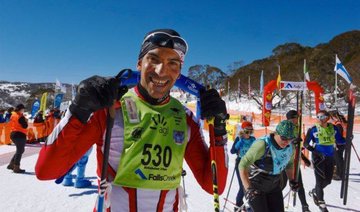
LONDON: Samir Azzimani will make history on Friday when he becomes the Arab world’s first dual-sport Olympian.
The Moroccan competed in alpine skiing at the 2010 Winter Olympics in Vancouver and returns to sport’s grandest stage when he races in men’s cross-country skiing in Pyeongchang on Friday afternoon.
Azzimani was born 40 years ago on the outskirts of Paris to Moroccan parents.
His father was a mechanic and his mother a cleaner. When he was 5, with his mother struggling to care for the family, he was taken to a home for underprivileged children.
It was there, while on a winter holiday camp, he first experienced skiing. It was not love at first sight.
“To be honest, it wasn’t really exciting to go there because I was ill-equipped, without proper gloves and other suitable skiwear,” he told Arab News this week from Pyeongchang.
“Also, skis are heavy and, for a child, walking with ski boots was awful.”
His enthusiasm grew, though, and despite the expensive nature of the sport a social program allowed him to continue visiting the slopes.
Soon he was addicted, trying to improve, until one day, while sitting on a chairlift, he saw a ski race below.
“My heart started to beat faster. I started to dream that one day I would be a ski champion.”
When the social program ended, Azzimani’s dalliance with the slopes did, too — at least temporarily.
Ten years passed before he would return to the snow, prompted by watching the Morocco flag enter the Théâtre des Cérémonies at the 1992 Winter Olympics in Albertville.
In 2010, his dream became reality when, as his country’s sole representative in Vancouver, he acted as flagbearer for Morocco en route to finishing 44th in the regular slalom.
A series of injuries soon followed, however, and Azzimani was forced to undergo surgery, ruling him out of the 2014 Games in Sochi. Taking time off from his job as a ski instructor in France and trying to regain his fitness, he completed endurance training in Morocco. He adapted to his surroundings by descending sand dunes with skis and poles and using wheeled-skis on the burning asphalt roads that scythe through the Sahara Desert.
Such improvization would prove another critical point of his sporting career. He revelled in the interest of bewildered bystanders and the occasional bedouin.
“I’ve been training in Morocco since 2013 and it’s become a kind of tradition for me,” said Azzimani, who was his country’s flagbearer again at last Friday’s Opening Ceremony.

Samir Azzimani was once again his country's flagbearer at the Pyeongchang Winter Olympics, having had the honor during the 2010 Games in Vancounver. (AFP)
“The people are really curious regarding what I have on my feet. They’ve never seen a roller-skier in their life, so they usually stop on the side of the road to take video or photos. Then they ask what the sport is all about and why I do it.
“It gives me a lot of satisfaction to enjoy this different environment and different culture. It’s very different to the Nordic one — and it also gives me a lot of vitamin D from the sun too.”
Azzimani’s change of discipline has been far from easy.
While plenty of Olympians have competed in more than one sport, few have done so in two events so unalike.
Not only did he have to shed several kilograms, he had to totally rewire his muscles, switching from explosive strength to cardiovascular, and alter his mindset.
“Most dual-athletes choose sports that utilize similar skillsets, making the cross-over that bit easier. What I am doing is totally in opposition to my original sport, so my body had to be transformed. I also had to start being patient, focus more on saving my energy, while also lowering my level of arrogance,” he said, adding jokingly, “It was really tough, but I managed it.”
Now, with the training complete and the sand swapped for snow, the hour has arrived for Azzimani to return to center stage. His expectations ahead of today’s event, which starts on Friday morning KSA time, are realistic.
Once known as the “Couscous Rocket”, he accepts his new discipline is “not really spectacular to watch”, yet hopes he can win a few new fans if nothing else.
“To be honest it feels as if I have never done the Olympics before,” he said. “I have the same excitement and same feeling of adventure, but this time with a little more experience.
“I hope the Arab community will get behind me and enjoy learning a little about a sport they likely don’t know much about,” he added. “Arab countries taking part in the Winter Games are not common so, for this reason, I feel incredibly proud to represent not only Morocco but the entire Arab World. For me, representing is not enough: I have to give the best I have. My goal here in Pyeongchang is to be within 12 minutes of the Olympic champion. And, of course, not to be last over the line.”