LONDON: Islamophobia in France is being fueled by state-backed efforts to encourage secularism, according to a new book that puts the country at the heart of a growing intolerance toward Muslims in Western societies.
In “Republic of Islamophobia: The Rise of Respectable Racism in France,” Jim Wolfreys, a British academic and author, argues that French politicians have given discrimination and racism a veneer of respectability in their response to a wave of Daesh attacks that hit French towns and cities in the last three years.
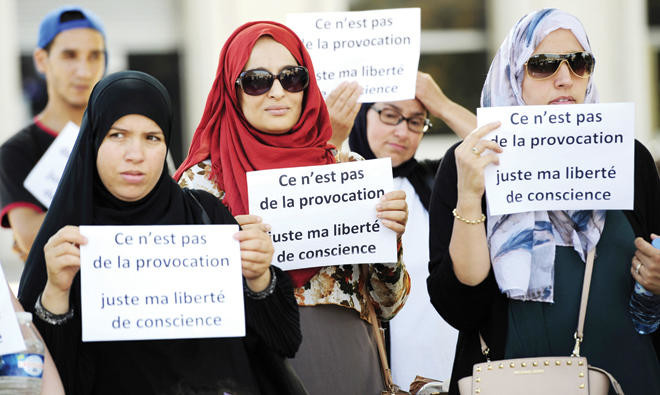
The bloodshed has left innocent Muslims facing unprecedented scrutiny of what they wear, eat and say in a society polarized by inequality, he claims.
Wolfreys, a senior lecturer in French and European Politics at King’s College London, told Arab News there is a “danger of confusing understandable fear of terrorism with fear of Muslims.”
France is home to Europe’s largest Muslim community, with estimates of its size ranging from 2.1 million to about 6 million, out of a total population of 66.9 million. Many of these Muslims can trace their roots back to the country’s colonial rule in North and sub-saharan Africa during the 19th and 20th centuries.
Secularism is one of the guiding principles of the French political and legal systems and questions around immigration and integration have long been a subject of debate in the country. But rhetoric once considered taboo has entered mainstream political discourse in recent years, according to Wolfreys.
In 2011, even before the recent wave of militant attacks, France became the first European nation to ban women from wearing full-face veils in public.
Then, as gun battles and suicide bombings rocked the country in a series of attacks claimed by Daesh, local authorities in several towns outlawed women from wearing burkini swimwear. Officials said the clothing, which covers the female head and body in keeping with conservative Islamic custom, was a security threat and flouted the nation’s secular principles.
France’s highest administrative court subsequently overturned the restriction imposed by one resort, with three judges ruling that it was “clearly illegal” and in violation of “fundamental liberties,” but the ban heightened concerns among many Muslims that they were being made scapegoats for the Daesh-inspired violence.
Islam and immigration went on to become two of the central issues in the 2017 presidential election, when Marine Le Pen, leader of the far-right National Front party, won almost 11 million votes in the second round of polling.
Le Pen campaigned on an openly Islamophobic ticket, denouncing mosques for allowing worshippers to pray in the streets and warning of the danger of living “under the yoke of the threat of Islamic fundamentalism.”
She lost convincingly to her liberal rival, Emmanuel Macron, but mainstream political concerns about Islam have not gone away.
On Sunday, President Macron told the French weekly newspaper “Le Journal du Dimanche” that he planned to reorganize the structure of Islam in France to help “preserve national cohesion.” He provided no details about how he hoped to do this.
Wolfreys’ book, “Republic of Islamophobia: The Rise of Respectable Racism in France,” looks in detail at the causes and consequences of state-fueled discrimination.
He reports the results of an opinion poll conducted by a French human rights institute that found 45 percent of National Front supporters do not consider “dirty Arab” a reprehensible phrase. In the same survey, nearly three-quarters of respondents said they do not regard Muslims as fully French.
However, Wolfreys accuses mainstream parties from both the right and left of the political spectrum of adopting increasingly intolerant interpretations of secularism.
He writes that the problem became particularly acute after two masked gunmen attacked the Paris offices of the satirical magazine “Charlie Hebdo” on Jan. 7, 2015, in retaliation for a series of cartoons defaming the Prophet Muhammad. Twelve people were killed, with Al-Qaeda in Yemen and Daesh issuing contrasting claims of responsibility for the carnage.
On Nov. 13 that year, Daesh militants also carried out a coordinated assault across the French capital, with three suicide bombers blowing themselves up outside the Stade de France and gunmen killing 89 people attending a rock concert at the Bataclan theatre.
This was followed in July 2016 by an attack in the southern city of Nice, in which a cargo truck was driven into a crowd of revelers celebrating Bastille Day, killing more than 80 people.
Wolfreys’ book warns that the French government’s response to the bloodshed has been disproportionate and risks further marginalizing innocent Muslims, pushing them into the arms of extremists.
“The renewed emphasis since the 2015 Paris attacks on inculcating respect for ‘republican values’ in schools, punishing those alleged to defy them, fast-tracking those accused of ‘apology for terrorism’ through the courts, and increasing surveillance and ‘vigilance’ is unlikely to prevent such atrocities from happening again,” he writes.


New book puts France at center of anti-Muslim backlash
New book puts France at center of anti-Muslim backlash


Lawsuit challenges Trump administration’s ending of protections for Somalis
- The lawsuit cites a series of statements Trump has made describing Somalis as “garbage” and “low IQ people” who “contribute nothing.”
BOSTON: Immigrant rights advocates filed a lawsuit on Monday seeking to stop US President Donald Trump’s administration from next week ending legal protections that allow nearly 1,100 Somalis to live and work in the United States. The lawsuit, brought by four Somalis and two advocacy groups, challenges the US Department of Homeland Security’s decision to end Temporary Protected Status for Somali immigrants, whom Trump has derided in public remarks. Outgoing Homeland Security Secretary Kristi Noem in January announced that TPS for Somalis would end on March 17, arguing that Somalia’s conditions had improved, despite fighting continuing between Somali forces and Al-Shabab militants. The plaintiffs, who include the groups African Communities Together and Partnership for the Advancement of New Americans, in the lawsuit filed in Boston federal court argue the move was procedurally flawed and driven by a discriminatory, predetermined agenda.
The lawsuit cites a series of statements Trump has made describing Somalis as “garbage” and “low IQ people” who “contribute nothing.”
The plaintiffs said the administration is ending TPS for Somalia and other countries due to unconstitutional bias against non-white immigrants, not based on objective assessments of country conditions.
“The termination of TPS for Somalia is racism masking as immigration policy,” Omar Farah, executive director at the legal group Muslim Advocates, said in a statement.
DHS did not respond to a request for comment. It has previously said TPS was “never intended to be a de facto amnesty program.”
TPS is a form of humanitarian immigration protection that shields eligible migrants from deportation and allows them to work. Under Noem, DHS has moved to end TPS for a dozen countries, sparking legal challenges. The administration on Saturday announced plans to pursue an appeal at the US Supreme Court in order to end TPS for over 350,000 Haitians. It also wants the high court to allow it to end TPS for about 6,000 Syrians.
SOMALI COMMUNITY TARGETED
Somalia was first designated for TPS in 1991, with its latest extension in 2024. About 1,082 Somalis currently hold TPS, and 1,383 more have pending applications, according to DHS. Somalis in Minnesota in recent months had become a target of Trump’s immigration crackdown, with officials pointing to a fraud scandal in which many people charged come from the state’s large Somali community. The Trump administration cited those fraud allegations as a basis for a months-long immigration enforcement surge in Democratic-led Minnesota, during which about 3,000 immigration agents were deployed, spurring protests and leading to the killing of two US citizens by federal agents.
In November, Trump announced he would end TPS for Somalis in Minnesota, and a month later said he wanted them sent “back to where they came from.”
The US Department of State advises against traveling to Somalia, citing crime and civil unrest among numerous factors.