Punjab government says no to Basant Festival

1 / 10
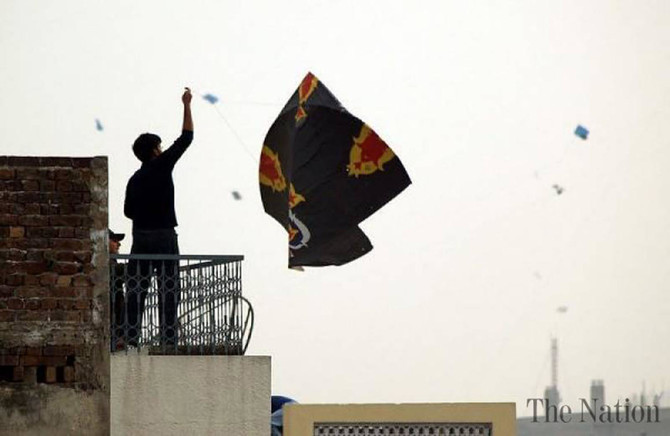
A man raising his kite up in the sky in the Old City, Lahore. (AN photo by Shafiq Malik)
2 / 10
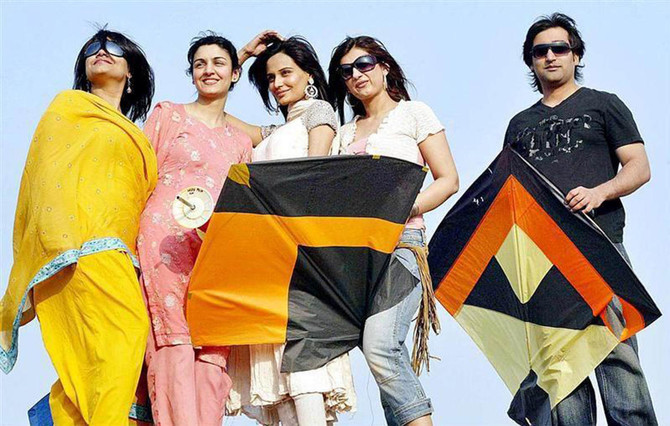
Kite-fliers hoping to celebrate Basant Festival 2018. (AN photo by Shafiq Malik)
3 / 10
Basant celebrations on a rooftop with a huge kite; designs, colors and sizes add to the price of a kite. (AN photo by Shafiq Malik)
4 / 10
A local shop in Lahore packed with kites. (AN photo by Shafiq Malik)
5 / 10
A kite-seller. (AN photo by Shafiq Malik)
6 / 10
Another kite shop with its colorful display. (AN photo by Shafiq Malik)
7 / 10
A group of kite-fliers. (AN photo by Shafiq Malik)
8 / 10
Colorful kites for sale. (AN photo by Shafiq Malik)
9 / 10
Kite manufacturers giving finishing touches to hand-made kites. (AN photo by Shafiq Malik)
10 / 10
City roof-tops packed with people as they raise their kites high. (AN photo by Shafiq Malik)
Updated 13 February 2018
Follow

Punjab government says no to Basant Festival

LAHORE: The government of Punjab will not relax its ban on the Hindu spring festival of Basant Panchami and its related kite-flying festival this year, according to official spokesperson Malik Mohammed Ahmad Khan.
“There is a complete ban on ‘Basant’ and Chief Minister Mian Shahbaz Sharif has categorically stated that any violation will not be tolerated. If it is flouted in any part of the province, the police in that area would be taken to task,” Khan told Arab News.
Basant is celebrated in many parts of the country. Punjab, in particular, both in Pakistan and India, has a long tradition of marking the commencement of spring in a festive manner. Colorful homemade kites are raised high in the sky, and streets and rooftops are covered with the bright colors of kite flyers dressed in traditional attire.
The Pakistani government’s website describes Basant as “not only a kite flying event, but a cultural festival of traditional food, dresses, dances and music.”
However, due to several fatalities linked to the use of chemical-coated metal twine on the kites, the Supreme Court of Pakistan banned the activity in 2004.
That ban has been lifted twice in the years since. However, there were further deaths and a complete ban has been imposed across the province since 2007.
There have been several protests demanding permission to celebrate Basant in 2018, but authorities show no sign of offering any concessions.
Khawaja Nadeem Waien, president of the Kite Flying Association of Pakistan, told Arab News: “It is a cultural event that has observed for centuries in India and Pakistan. It is a festival to welcome spring. Kite flying is our culture and the government must allow us to observe this event.”
The festival was traditionally a useful source of income for Lahore.
People traveled from other cities or even from abroad to attend. The city’s hotels, guest houses and private lodges were packed with visitors. Some five-star hotels would arrange their own events on their rooftops, with live music and lavish dinners.
Now, residents say the ban has left a large chunk of the community unemployed.
“Several shops have shut down; kite-makers and string-makers went out of work due to the ban on kite flying,” Ali Mohammed, a veteran of the kite business, told Arab News. “Almost 25,000 people related to this business are suffering from the ban.”
“The government must lift the ban and allow us to earn bread and butter for our families,” he said.
Punjab Minister for Law and Parliamentary Affairs, Rana Sanaullah, said: “The government can allow Basant if the (Kite Flying) Association takes responsibility for the precious lives of the masses. If a life is lost because of the chemical-coated string, the association’s office bearers would be booked under the law.”
Shehbaz Sharif recently backed up Malik Khan’s claim that district police would take the blame for any violations of the band when he tweeted: “Complete BAN on Basant. No one can be allowed to play with the lives of ppl.. concerned DPO will b responsible for any violation of ban.”


Pakistan terms climate change, demographic pressures as ‘pressing existential risks’

Updated 4 sec ago
Follow

Pakistan terms climate change, demographic pressures as ‘pressing existential risks’

  • Pakistan has suffered frequent climate change-induced disasters, including floods this year that killed over 1,000
  • Pakistan finmin highlights stabilization measures at Doha Forum, discusses economic cooperation with Qatar 

ISLAMABAD: Pakistan’s Finance Minister Muhammad Aurangzeb on Saturday described climate change and demographic pressures as “pressing existential risks” facing the country, calling for urgent climate financing. 

The finance minister was speaking as a member of a high-level panel at the 23rd edition of the Doha Forum, which is being held from Dec. 6–7 in the Qatari capital. Aurangzeb was invited as a speaker on the discussion titled: ‘Global Trade Tensions: Economic Impact and Policy Responses in MENA.’

“He reaffirmed that while Pakistan remained vigilant in the face of geopolitical uncertainty, the more pressing existential risks were climate change and demographic pressures,” the Finance Division said. 

Pakistan has suffered repeated climate disasters in recent years, most notably the 2022 super-floods that submerged one-third of the country, displaced millions and caused an estimated $30 billion in losses. 

This year’s floods killed over 1,000 people and caused at least $2.9 billion in damages to agriculture and infrastructure. Scientists say Pakistan remains among the world’s most climate-vulnerable nations despite contributing less than 1 percent of global greenhouse-gas emissions.

Aurangzeb has previously said climate change and Pakistan’s fast-rising population are the only two factors that can hinder the South Asian country’s efforts to become a $3 trillion economy in the future. 

The finance minister noted that this year’s floods in Pakistan had shaved at least 0.5 percent off GDP growth, calling for urgent climate financing and investment in resilient infrastructure. 

When asked about Pakistan’s fiscal resilience and capability to absorb external shocks, Aurangzeb said Islamabad had rebuilt fiscal buffers. He pointed out that both the primary fiscal balance and current account had returned to surplus, supported significantly by strong remittance inflows of $18–20 billion annually from the Middle East and North Africa (MENA) and Gulf Cooperation Council (GCC) regions. 

Separately, Aurangzeb met his Qatari counterpart Ali Bin Ahmed Al Kuwari to discuss bilateral cooperation. 

“Both sides reaffirmed their commitment to strengthening economic ties, particularly by maximizing opportunities created through the newly concluded GCC–Pakistan Free Trade Agreement, expanding trade flows, and deepening energy cooperation, including long-term LNG collaboration,” the finance ministry said. 

The two also discussed collaboration on digital infrastructure, skills development and regulatory reform. They agreed to establish structured mechanisms to continue joint work in trade diversification, technology, climate resilience, and investment facilitation, the finance ministry said.