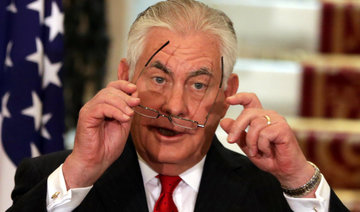
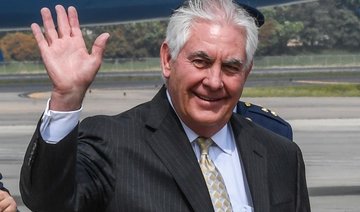
KUWAIT CITY: The US will lend Iraq $3 billion to help rebuild the country, Secretary of State Rex Tillerson said on Tuesday as international companies and governments were invited to invest in projects in a nation decimated by the war with Daesh.
Speaking at a conference hosted by Kuwait, Tillerson called on members of the international coalition fighting the extremist group to contribute to reconstruction costs to help stop its return.
Cities and towns in the north and west of Iraq suffered severe damage after they were stormed in a Daesh offensive in 2014 and then liberated by Iraqi forces supported by the coalition. Victory was declared in December.
Rebuilding the country will cost more than $88 billion, Iraqi officials told the conference, with $22.9 billion needed in the short term.
“Doing business in Iraq can be complicated, but the market has potential,” Tillerson told hundreds of businessmen and officials. “Investment opportunities presented today are just a fraction of what is possible.”
Tillerson said the government-run Export-Import Bank of the United States signed a $3 billion memorandum of understanding with Iraq’s Finance Ministry “that will set a stage for future cooperation.”
US businesses have already been “successfully” operating in Iraq in the past few months, and several commercial agreements have been signed to supply the country with $2 billion worth of agricultural products, electricity equipment and renewable energy technologies, he added.
Iraqi Prime Minister Haider Abadi called the conference “a genuine invitation to invest” in his country.
Iraq is fertile soil for investments following Daesh’s defeat, said Oil Minister Jabbar Al-Luaibi. Iraq says it needs $7 billion to repair its oil and gas fields.
Al-Luaibi called for investment in the energy sector, and said Iraq has begun a new stage of rebuilding a state on a “solid, civilized basis.”
He added: “The doors are open. If you are Iraqi, you are welcome… I myself give priority to Iraqis, not only investors but also contractors.”
Iraq is working to relaunch the Baiji oil refinery, which was destroyed by Daesh. There are 73 discovered oil fields, 30 percent of them under development, Al-Luaibi said.
Ali Al-Ghanim, chairman of the Kuwait Chamber of Commerce and Industry (KCCI), which organized the event, said it signals the “beginning of a phase of security and stability in the region.”
He added: “Iraq is fertile soil for investments. The environment is more receptive than anywhere in the world… Iraq has potential. It has natural and human resources.”
Hafeth Ghanem, vice president of the World Bank for the Middle East and North Africa, said Iraq’s reconstruction is a goal for the international community, and will contribute to regional stability and security.
Kuwait is also interested in contributing to the Iraqi market with its private sector. Ghanem said several meetings took place with representatives of Kuwaiti private firms to discuss the contribution.
The US is hoping other Arab Gulf countries will invest in Iraq, particularly after relations between Riyadh and Baghdad improved last year with a series of high-level meetings.
Ghanem said the World Bank’s work in Iraq will involve financial and social projects, and rebuilding hospitals and schools in areas liberated from Daesh.
There was much emphasis on the importance of involving the private sector in Iraq’s reconstruction.
The oil minister said the government wants to involve the private sector in producing petrol and building gas stations.
The International Finance Corp. (IFC), the private lending arm of the World Bank Group, is working with the government to push the Iraqi private sector to invest and manage some aspects of the oil and gas sector.
According to the Central Bank of Iraq (CBI), 64 of the banks operating in the country are private, 17 are foreign and seven are public.
International non-governmental organizations pledged $330.1 million on the first day of the three-day conference.