LONDON: She has just turned 17, but already she is a media darling. With her mane of curly hair and defiant expression, Ahed Tamimi has reawakened the world to the plight of Palestinians living under Israeli occupation.
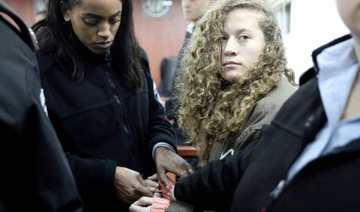
Tamimi is due to go on trial on Tuesday in an Israeli military court, accused of slapping and kicking an Israeli soldier. The incident, which happened on Dec.15, might have remained below the radar as one of many such altercations in the occupied territories had Tamimi’s mother, Nariman, not filmed it and posted footage on social media, where it went viral.
The case has created a global media storm, with many references to David and Goliath helping to revive interest in the broader Palestinian struggle.
Tamimi was arrested along with her mother and cousin Nour, and despite her youth (she was 16 at the time and, indeed, is still a minor now), she was denied bail and has been in custody since.
Her trial was set first for Jan. 31 — coincidentally, her 17th birthday — then Feb. 6 and now, Feb. 13.
She has been hailed a hero for bravely standing up to the occupying forces in Nabi Saleh, the West Bank village squeezed between an Israeli settlement and an Israeli military checkpoint which is home to the Tamimi family.
The UN office of the High Commissioner for Human Rights has criticized Israeli authorities for their handling of the case, while the EU has expressed concern over the detention of minors. Tamimi is one of an estimated 300 underage inmates in Israeli detention — an often-forgotten statistic until her case was highlighted by the media.
More than 1.7 million people have signed an online petition demanding her release and Tamimi’s father, Bassem, said he has welcomed “hundreds” of observers and supporters from as far away as Sweden, Switzerland, the UK, Argentina and Colombia.
He tells his daughter’s story, explains the reality of living under occupation and states his own political views, which include his preference for a single, bi-national state with equal rights for Israelis and Palestinians.
But to suggest that Palestinians are exploiting Tamimi’s story would be wrong, said Rosemary Hollis, professor of Middle East Policy Studies at City University in London and former director of the Olive Tree Scholarship Programme for Palestinians.
“To be sell-able and grab attention on social media, there has to be an element of appeal above and beyond the plain story of conflict, But there is no proof that this (Tamimi’s case) is being manipulated in a propaganda effort,” she said.
“This is a story that has been going on since 1967. There is a perception that people are fed up with it, especially when there is Syria, where the suffering is of another order.
“The media needs a hook because it gives people access to the broader story, but that doesn’t make this a conspiracy.
“In the past two years, the situation for Palestinians has worsened. The Israelis require the Palestinian police force to prevent acts of violence by any Palestinian against all Israelis, but they don’t trust them to do the job. So the Israelis conduct their own security raids and Palestinians live in constant fear of them.”
It was in just such a middle-of-the-night raid at her home that Tamimi was arrested in December.
She is accused of assault and incitement — offenses that could see her jailed for years. Yaakov Amidror, a former national security adviser to Israeli Prime Minister Benjamin Netanyahu, denies the high profile attained by the case will harm Israel.
“Those who are against Israel will be against it if she is brought to court or if she is not,” he said.
He also played down the findings of a recent Pew poll that indicated younger, liberal Americans are less supportive of Israel’s narrative than older generations. He portrayed young liberals as naive and said he expects their views to change as they get older, but added that Israel needs to work “very, very hard not to lose these people.”
However, the Israelis are sufficiently worried about this emerging new “poster girl” for the Palestinian cause that one official recently revealed that there had been a parliamentary investigation into whether Ahed and her equally fair-haired, blue-eyed Tamimi relatives were from a “real” Palestinian family.
Ahed’s gender is another factor. Hollis sees similarities with how Israel has regarded Palestinian women, particularly since the second intifada, when women began to take part in suicide bombings.
“The Israelis said the women must have shamed themselves in some way — had an affair or got pregnant, so that a martyr’s death was preferable. A woman could not be a fighter.”


![]()
![]()

Tamimi trial revives global interest in ‘David and Goliath’ narrative

Tamimi trial revives global interest in ‘David and Goliath’ narrative
Latest updates


Recommended


© 2026 SAUDI RESEARCH & PUBLISHING COMPANY, All Rights Reserved And subject to Terms of Use Agreement.