LAHORE: On a cold November morning, a group of people carrying placards gathered in front of the Press Club to register their protest. Many of them were shouting “Punjabi Bachao” — or save Punjabi language — even as the din of the passing traffic was drowning out their voices.
The protesters, including academics, writers, poets and civil society activists, were urging the Punjab government to preserve the province’s 2,500-year-old vernacular by making it a compulsory school subject.
It was not their first rally. Led by the Punjabi Parchaar and Punjab Adabi (literary) Board, the demonstrators had previously voiced their concerns through street protests, letter-writing campaigns, seminars and roundtable conferences with policymakers. After failing to make an impact, they had also filed two legal petitions in the Lahore High Court.
“The government refuses to take the issue seriously,” Parveen Malik, chairperson of the Punjabi Adabi Board, told Arab News. “Ever since the 18th amendment and the devolution of the educational policy to provinces, no effective research or study has been conducted as a forerunner to develop new curricula in Punjab. There was a series of consultative meetings arranged for this purpose in 2009. However, no impact on the teaching of Punjabi in schools ever came out of the exercise.”
The current census in Pakistan estimates the population of Punjab at about 110 million people. According to the Pakistan Bureau of Statistics, more than 75 percent of the province’s population speaks “Punjabi,” implying that this issue impacts almost 80 million people.
Rana Tariq, a representative of the Punjab Curriculum and Textbook Board (PCTB), responded to Malik’s statement by admitting that the government was “using the research conducted on the federal level in 2006 to develop and publish textbooks.” However, he also added that the curriculum was “updated on a yearly basis to ensure continuing relevance and quality.”
At present, Punjabi language is taught at various education institutes as an optional subject. However, Article 251, Section 3, of the Constitution of Pakistan clearly states that provincial governments are required to guarantee the teaching, promotion and preservation of regional languages.
Dr. Farrukh Khan, professor of communications at the Lahore University of Management Sciences, believes many people have a condescending attitude toward the Punjabi language.
“Punjabi has always been seen as the language of have-nots,” he said. “This is such a shame. A society cannot hope to understand the origins of its own culture or its logical progression without knowing its own language.”
According to Malik, the treatment of the Punjabi language by the provincial authorities stands in stark contrast to other provinces, such as Khyber Pakhtunkhwa and Sindh, which have made significant efforts to promote their regional languages.
The apathy toward Punjabi, she said, is a continuation of colonial policy: “It took the British over 90 years to conquer Punjab.”
“They knew that this would always be a problematic area to control. Therefore, they developed a policy to undermine the Punjabi identity in order to forestall any future rebellion.”
Malik said: “Propagating disdain for the Punjabi language was a measured strategy to achieve this end. And it is this trend that has continued to a point where, today, parents actively try to keep Punjabi a language foreign to their children.”
The Punjab Government, however, maintained that its failure to meet its constitutional demands stemmed not from a lack of will but from administrative delays.
“The provincial government does not have the required structures in place to enact a meaningful policy or create the kind of curriculum change required to introduce Punjabi as a compulsory subject,” a Punjab Curriculum and Textbook Board official told Arab News.
Dr. Farrukh Khan, who is familiar with the organization’s inner workings, agrees. He believes that the bureaucratic nature of the state structure precludes a timely response to sensitive social issues. “But inaction will only lead society further toward the precipice,” he said.


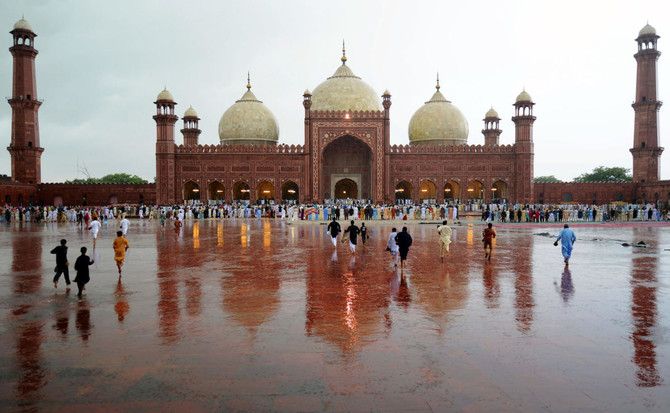
Call to save Punjabi language
Call to save Punjabi language

Pakistani, Bangladeshi officials discuss trade, investment and aviation as ties thaw
- Pakistan and Bangladesh were once one nation, but they split in 1971 as a result of a bloody civil war
- Ties between Pakistan, Bangladesh have warmed up since last year and both nations have resumed sea trade
ISLAMABAD: Pakistan's High Commissioner to Bangladesh Imran Haider on Sunday met Chief Adviser Muhammad Yunus in Dhaka, the latter's office said on, with the two figures discussing trade, investment and aviation.
Pakistan and Bangladesh were once one nation, but they split in 1971 as a result of a bloody civil war, which saw the part previously referred to as East Pakistan seceding to form the independent nation of Bangladesh.
Ties between Pakistan and Bangladesh have warmed up since former prime minister Sheikh Hasina’s ouster as a result of a student-led uprising in August 2024. Relations remain frosty between Dhaka and New Delhi over India’s decision to grant asylum to Hasina.
Pakistan has attempted to forge closer ties with Bangladesh in recent months and both South Asian nations last year began sea trade, followed by efforts to expand government-to-government commerce.
"During the meeting, both sides discussed ways to expand cooperation in trade, investment, and aviation as well as scaling up cultural, educational and medical exchanges to further strengthen bilateral relations between the two South Asian nations," Yunus's office said in a statement on X.
In 2023-24 Pakistan exported goods worth $661 million to Bangladesh, while its imports were only $57 million, according to the Trade Development Authority of Pakistan. In Aug. this year, the Pakistani and Bangladeshi commerce ministries signed a memorandum of understanding to establish a Joint Working Group on Trade, aiming to raise their bilateral trade volume to $1 billion in the financial year that began in July.
The Pakistani high commissioner noted that bilateral trade has recorded a 20 percent growth compared to last year, with business communities from both countries actively exploring new investment opportunities, according to the statement.
He highlighted a significant increase in cultural exchanges, adding that Bangladeshi students have shown strong interest in higher education opportunities in Pakistan, particularly in medical sciences, nanotechnology, and artificial intelligence. Haider also said that Dhaka-Karachi direct flights are expected to start in January.
"Chief Adviser Professor Muhammad Yunus welcomed the growing interactions between the two countries and emphasized the importance of increased visits as well as cultural, educational and people-to-people exchanges among SAARC (South Asian Association for Regional Cooperation) member states," the statement read.
"Professor Yunus also underscored the need to further boost Bangladesh–Pakistan trade and expressed hope that during Mr. Haider’s tenure, both countries would explore new avenues for investment and joint venture businesses."


