

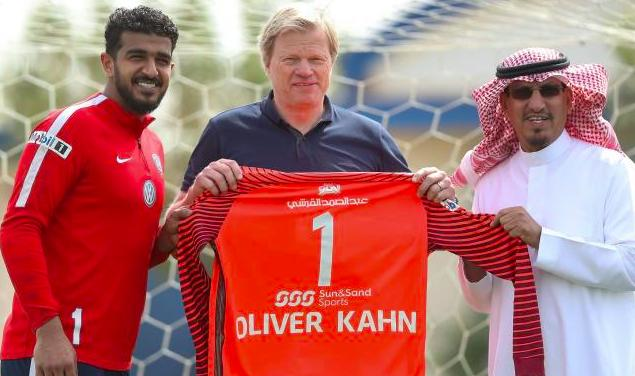
Germany legend Oliver Kahn watches Al-Hilal train ahead of crunch AFC Champions League clash

Updated 11 February 2018
Follow

Germany legend Oliver Kahn watches Al-Hilal train ahead of crunch AFC Champions League clash

Al-Hilal were given a boost ahead of their mouthwatering AFC Champions League tie with Al-Ain this weekend when German great Oliver Kahn popped in to observe training and offer moral support.

Kahn dropped in at the King Saud University Stadium and watched Al-Hilal coach Ramon Diaz put his team through their paces in the build-up to Tuesday's Group D match in the Kingdom with Al-Ain.

The 48-year-old, who won the UEFA Champions League in 2001, paid particular attention to the work of Saudi Arabia goalkeeper Abdullah Al-Mayouf who was being put through a series of drills by Dan Zdranca, Al-Hilal's Romanian goalkeeping coach. Kahn was then presented with a club jersey and memorial shield by vice-president Abdulrahman Al-Nimer to mark his visit to the club.

Kahn, who retired from playing in 2008, already has an association with Saudi Arabia. He runs his own company, GoalPlay, with business partner Moritz Mattes and signed a partnership agreement with the Saudi Arabia Football Federation to help improve the level of goalkeeping in the Kingdom with one eye on this summer’s World Cup.

"We as GoalPlay are working together with the Saudi national team to try to help improve them before the World Cup in Russia,” Kahn told Arab News in an interview in November “It’s our job to bring them up to the best possible level of goalkeeping. This is day one essentially. We start now.”


Libya’s Ramadan celebrations tempered by economic woes

Updated 6 sec ago
Follow

Libya’s Ramadan celebrations tempered by economic woes

  • Libya’s other economic problems included the absence of a unified national budget, in light of its political divide, as well as uncoordinated public spending due to parallel state institutions, Tetteh said
  • Refills of gas cylinders, officially priced at 1.5 dinars ($0.24) but often unavailable through state-run distributors, now sell for 75 dinars ($11.85) on the black market and at times more

TRIPOLI: Libyans have been enjoying Ramadan with feasts and fireworks — but soaring prices, a devalued currency and political divisions have left many with little to celebrate.
Fifteen years on from the fall of longtime leader Muammar Qaddafi, the country remains split between east and west, while shortages of goods, including fuel, disrupt daily life, despite Libya sitting atop vast oil and gas reserves.
During the Muslim holy month of Ramadan, shoppers stock up on treats, as families gather for lavish meals before and after the daytime fast that stretches from sunrise to sunset.
But this year supermarkets have been rationing their goods, while many petrol stations are short of gas. In the capital Tripoli, most ATMs were out of cash this week.
Firas Zreeg, 37, told AFP while weaving through a crowded supermarket that the economy was deteriorating, blaming currency speculators for the fall in the dinar, “which has negative repercussions on our daily lives.”
The price of cooking oil has doubled in recent weeks, while meat and poultry prices rose by half.
Refills of gas cylinders, officially priced at 1.5 dinars ($0.24) but often unavailable through state-run distributors, now sell for 75 dinars ($11.85) on the black market and at times more.

- ‘Burden on citizens’ -

Libya has struggled to recover from the chaos that erupted following the 2011 Arab Spring uprising that toppled Qaddafi.
It remains divided between a UN-recognized government based in Tripoli and an eastern administration backed by military strongman Khalifa Haftar.
The country has largely been stable in recent years although there have been bouts of deadly violence, including the killing of Qaddafi’s son and heir apparent Seif Al-Islam this month.
With security holding, many Libyans are more focused on their livelihoods.
Last month, the central bank in the western territory devalued the dinar — the second time in less than a year — by nearly 15 percent, “aimed at preserving financial and monetary stability and ensuring the sustainability of public resources.”
In an address this week, Prime Minister Abdulhamid Dbeibah acknowledged that the devaluation had once again “put the burden on citizens.”
Hanna Tetteh, head of the United Nations Support Mission in Libya, warned on Wednesday that “poverty and pressure on society [are] increasing.”
“The situation, in addition to the fragile security landscape, should be a matter for concern as such conditions can lead to unexpected political and security challenges,” she told the UN Security Council.
Libya’s other economic problems included the absence of a unified national budget, in light of its political divide, as well as uncoordinated public spending due to parallel state institutions, Tetteh said.
Revenues from the oil industry were also declining, she added, while the central bank has said public spending is growing at an unsustainable pace.
On Tuesday, Libya marked 15 years since the start of the uprising that eventually toppled Qaddafi, with fireworks lighting up the sky in Tripoli, but for many Libyans life remains a struggle.
“Minor improvements in security were made over the past three years,” Zreeg told AFP, but Libyans are still faced with huge economic challenges.