Pakistan army condemns seven ‘hardcore’ militants to death

A statement issued by the military’s Inter Services Public Relations (ISPR) gave few details of the assaults each suspect was convicted of, but said that in total the attacks caused the deaths of 85 people and injured 109 others. (AFP)
Updated 10 February 2018
Follow

Pakistan army condemns seven ‘hardcore’ militants to death

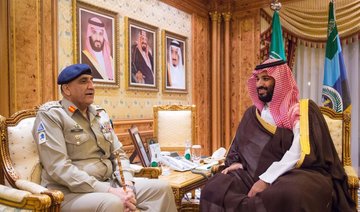
RAWALPINDI: Pakistan military courts have sentenced seven “hardcore” militants to death over various attacks on security forces that left dozens dead, including civilians, the country’s army chief said Friday.
A statement issued by the military’s Inter Services Public Relations (ISPR) gave few details of the assaults each suspect was convicted of, but said that in total the attacks caused the deaths of 85 people and injured 109 others.
Referring to the detainees as “hardcore terrorists,” the statement said they were “involved in heinous offenses related to terrorism, including killing of innocent civilians, attacking Law Enforcement Agencies and Armed Forces of Pakistan.”
It did not specify which organizations the suspects were thought to belong to.
Pakistan’s military courts were established in the wake of a December 2014 Taliban massacre at an army-run school in Peshawar that killed over 150 people, mostly schoolchildren.
Following that attack the government lifted the moratorium on the death penalty. Scores of militants have since been condemned to death.


In war-weary Kyiv, wounded Ukrainian veterans turn epic poetry into living testimony

Updated 2 sec ago
Follow

In war-weary Kyiv, wounded Ukrainian veterans turn epic poetry into living testimony

KYIV: Sitting in a circle the day before opening night, Ukrainian war veterans and drama students took turns reading their lines from a script that traveled centuries to reach them.
At the center was Olha Semioshkina, directing the group through her adaptation of “Eneida” by Ivan Kotliarevskyi — an 18th-century Ukrainian reimagining of Virgil’s “Aeneid.” This production, though, had a modern-day message about resilience in the face of the war that’s nearing its fourth year since Russia’s full-scale invasion of Ukraine.
The actors — men and women in their 20s to 60s — included Ukrainian military veterans who had returned from the front with amputations, severe burns and sight loss. Others had endured war on the homefront. Many had never set foot on a stage before this play.
It took more than a year to prepare for Thursday’s premiere at Kyiv’s National Academic Molodyy Theatre.
“We knew the guys had just come back from rehabilitation, and we had to start from the very beginning,” Semioshkina said.
“We spent about four months simply learning to communicate, to fall, to group, to roll, to get together,” she said. “Then we began developing the body, taking off prosthetics and learning to exist without them.”
The 51-year-old director’s concept was simple: “Every man on stage is Aeneas. Every woman on stage is Dido.”
In Virgil’s epic, Aeneas wanders after the fall of Troy, searching for a new homeland. In Kotliarevskyi’s satirical adaptation, the Trojan hero becomes a Cossack, rowdy and earthy.
On Kyiv’s stage, Aeneas wears prosthetic limbs and bears scars from the war that began with Russia’s Feb. 24, 2022, invasion of Ukraine.
“Aeneas is a hero who goes through a lot in search for his land,” Semioshkina said. “He preserves humor, passion, he falls, he goes through horrors, drinks and parties. But he is a human, and he has a goal — to find his place and preserve his family.”
She draws parallels between the veterans who endured combat and the character they play on stage. “Aeneas is the one who went to war. Yes, he returned mutilated, broken,” she said, but the actors bringing this adaptation to life “are learning to live” again.
Where myth and reality converge
During rehearsal, Yehor Babenko, a veteran of Ukraine’s Border Service who suffered severe burns early in the Russian invasion, delivered a line with a grin: “Feeling burned out at work? We have a lot in common.”
Later in the play, his monologue also hit close to home as he spoke about fire taking his hands, ears and nose. “I won’t be able to show children a trick with a missing finger,” he says. “Maybe the one when all 10 fingers disappear.”
The opportunity to perform onstage, Babenko said, has been a healing journey.
“For me, theater is both psychological and physical rehabilitation. I’ve noticed I feel my body better, feel more confident in public, express my thoughts better.”
For Babenko, the story of Aeneas resonates beyond the stage. “It’s about searching for your land,” he said. “And for our country, that’s very relevant now.”
Breaking character to tell their own stories
The play’s final act departed from epic poetry altogether as the actors stepped forward to tell their own stories — about combat injuries, lost brothers in arms, displacement and life under occupation.
One veteran described losing his leg in a drone strike and using a machine gun as a crutch to reach cover. A female actor recounted living under Russian occupation with her two daughters.
Another, who volunteered as a medic, first in 2014 when Russia illegally annexed Crimea and pro-Russian forces captured parts of Ukraine’s Donetsk and Luhansk regions, and again after the 2022 Russian invasion, spoke of returning to war in her 60s.
Andrii Onopriienko, who lost his sight in a Russian artillery strike near Avdiivka, in the Donetsk region, in 2023, narrated much of the performance in a deep, resonant voice. At one point he sang: “Let our enemies dig up holes, install crosses, and lie down on their own,” as the rest of the cast joined in.
Onopriienko initially refused to join the project. “I didn’t understand what I would do on stage blind,” he said. He later was persuaded that there would be a role for him.
“It’s positivity, laughter, support,” he said of rehearsals. “No matter what mood you come in, you leave with a big smile; Here you distract yourself from the present. You enter another world.”
Despite war, the show must go on
Onstage, prosthetic legs and arms were removed and put back on as part of the play’s visual language. Long metal rods doubled as swords, oars and crutches — used as both an artistic instrument and a tool to help actors with amputations keep balance.
The war intruded even before the curtain rose on Thursday. An announcement asked the audience to follow the usual theater protocol and silence their phones — then warned that in case of an air raid, they should head to the basement shelter. If a blackout occurred, it added, the show would pause for the backup power generators to be turned on.
As Babenko delivered his monologue minutes before the performance ended, the power did go out.
Semioshkina stepped onto the stage with a flashlight, followed by others holding flashlights. Babenko delivered his lines in the beam of the improvised spotlight. The audience, some quietly weeping, some laughing through tears, stayed.
When the last monologue ended and the curtain fell and rose again, the cast was met with a standing ovation. As they bowed a second time, the electricity returned, and the applause swelled.
For Semioshkina, the message of veterans on stage extends beyond epic poetry and the theater walls.
“I would like to send a message to all veterans who are sitting at home: Come out,” she said. “Come out. You can do something. Live. Don’t close yourself off. Live every single minute.”