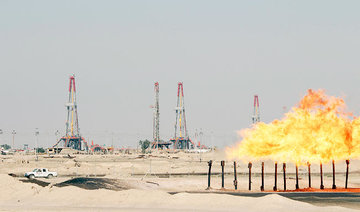
TOKYO: Oil prices fell for a sixth day on Friday after Iran announced plans to boost production and US crude output hit record highs, adding to concerns about a sharp rise in global supplies.
The falls come amid a rout in global share markets as inflation fears grip investors.
Brent futures were down 44 cents or 0.7 percent, at $64.37 a barrel by around 0700 GMT. On Thursday, Brent fell 1.1 percent to its lowest close since Dec. 20.
US West Texas Intermediate (WTI) crude was down 62 cents, or 1 percent, at $60.53 a barrel, having settled down 1 percent in the previous session at its lowest close since Jan. 2.
Both contracts have fallen more than 9 percent from this year’s high point in late January.
“Bets on further rising oil and metals prices, for example by hedge funds, have climbed to excessively bullish levels,” said Carsten Menke, commodities research analyst at Swiss Bank Julius Baer.
“We see oil prices dropping toward and below $60 per barrel,” he said.
OPEC member Iran on Thursday announced plans to increase production within the next four years by at least 700,000 barrels a day.
Meanwhile, the US Energy Information Administration (EIA) this week said crude production last week rose to a record high of 10.25 million barrels per day (bpd).
At that level, US production would overtake the current output in Saudi Arabia, the biggest producer in the Organization of the Petroleum Exporting Countries (OPEC).
OPEC and other producers, including Russia, have cut production since January 2017 to force down global inventories, but these cuts have been offset by rising US oil production.
China plans to launch its long-awaited crude oil futures contract on March 26, two sources familiar with the situation said on Friday, a move that will potentially shake up the pricing of the world’s largest commodity market.
The launch next month will mark the end of a push to create Asia’s first oil futures benchmark, which would give China more clout in pricing crude in the region and a share of the trillions of dollars in the oil futures trade.

Oil falls for sixth day as supply fears mount
PIF’s Humain invests $3bn in Elon Musk’s xAI prior to SpaceX acquisition
JEDDAH: Humain, an artificial intelligence company owned by Saudi Arabia’s Public Investment Fund, invested $3 billion in Elon Musk’s xAI shortly before the startup was acquired by SpaceX.
As part of xAI’s Series E round, Humain acquired a significant minority stake in the company, which was subsequently converted into shares of SpaceX, according to a press release.
The transaction reflects PIF’s broader push to position Saudi Arabia as a central hub in the global AI ecosystem, as part of its Vision 2030 diversification strategy.
Through Humain, the fund is seeking to combine capital deployment with infrastructure buildout, partnerships with leading technology firms, and domestic capacity development to reduce reliance on oil revenues and expand into advanced industries.
The $3 billion commitment offers potential for long-term capital gains while reinforcing the company’s role as a strategic, scaled investor in transformative technologies.
CEO Tareq Amin said: “This investment reflects Humain’s conviction in transformational AI and our ability to deploy meaningful capital behind exceptional opportunities where long-term vision, technical excellence, and execution converge, xAI’s trajectory, further strengthened by its acquisition by SpaceX, one of the largest technology mergers on record, represents the kind of high-impact platform we seek to support with significant capital.”
The deal builds on a large-scale collaboration announced in November at the US-Saudi Investment Forum, where Humain and xAI committed to developing over 500 megawatts of next-generation AI data center and computing infrastructure, alongside deploying xAI’s “Grok” models in the Kingdom.
In a post on his X handle, Amin said: “I’m proud to share that Humain has invested $3 billion into xAI’s Series E round, just prior to its historic acquisition by SpaceX. Through this transaction, Humain became a significant minority shareholder in xAI.”
He added: “The investment builds on our previously announced 500MW AI infrastructure partnership with xAI in Saudi Arabia, reinforcing Humain’s role as both a strategic development partner and a scaled global investor in frontier AI.”
He noted that xAI’s trajectory, further strengthened by SpaceX’s acquisition, exemplifies the high-impact platforms Humain aims to support through strategic investments.
Earlier in February, SpaceX completed the acquisition of xAI, reflecting Elon Musk’s strategy to integrate AI with space exploration.
The combined entity, valued at $1.25 trillion, aims to build a vertically integrated innovation ecosystem spanning AI, space launch technology, and satellite internet, as well as direct-to-device communications and real-time information platforms, according to Bloomberg.
Humain, founded in August, consolidates Saudi Arabia’s AI initiatives under a single entity. From the outset, its vision has extended beyond domestic markets, participating across the global AI value chain from infrastructure to applications.
The company represents a strategic initiative by PIF to diversify the Kingdom’s economy and reduce oil dependence by investing in knowledge-based and advanced technologies.