Egypt army launches major operation against ‘terrorists’ in Sinai and Nile Delta

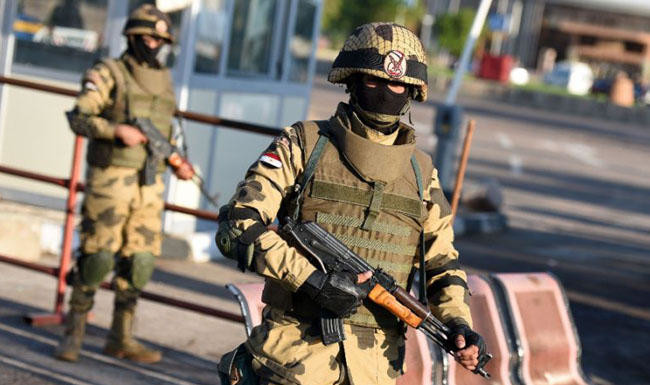
Egyptian security forces have been conducting operations in the Sinai Peninsula involving the army, air force and police to defeat a persistent Daesh insurgency. (AFP)
Updated 09 February 2018
Follow

Egypt army launches major operation against ‘terrorists’ in Sinai and Nile Delta

CAIRO: Egypt on Friday launched a major security operation involving the army and police against “terrorist and criminal elements and organizations” across the country, the army spokesman said.
The army spokesman said the operation covers areas in Sinai, the Delta and the Western Desert and it follows a three-month deadline set by President Abdel Fattah El-Sisi to crush a years-long Islamist insurgency.
“The law enforcement forces began this morning implementing the comprehensive confrontation against the terrorist and criminal elements and organizations in northern and central Sinai,” an army spokesman said in a televised statement.
The army spokesman said the operation will involve operational and training maneuvers to tighten state control on the country’s crossing points with neighboring countries, and urged full cooperation with the law enforcement forces involved in the operation.
Residents reported hearing extensive air activities above the Suez Canal city of Ismailia, which is close to the area of operations in northern and central Sinai.
Security forces have for years battled a Daesh insurgency in North Sinai that has killed hundreds of soldiers and police. The militants have expanded their targets to include civilians over the last year or so.


How succession works in Iran and who will be the country’s next supreme leader?

Updated 58 min 38 sec ago
Follow

How succession works in Iran and who will be the country’s next supreme leader?

  • An 88-member panel called the Assembly of Experts “must, as soon as possible” pick a new supreme leader under Iranian law

DUBAI: The death of Iran’s Supreme Leader Ayatollah Ali Khamenei after almost 37 years in power raises paramount questions about the country’s future. The contours of a complex succession process began to take shape the morning after Khamenei’s assassination.
Here is what to know:
A temporary leadership council assumes duties
As outlined in its constitution, Iran on Sunday formed a council to assume leadership duties and govern the country.
The council is made up of Iran’s sitting president, the head of the country’s judiciary and a member of the Guardian Council chosen by Iran’s Expediency Council, which advises the supreme leader and settles disputes with parliament.
Iran’s reformist President Masoud Pezeshkian and hard-line judiciary chief Gholamhossein Mohseni Ejei are its members who will step in and “temporarily assume all the duties of leadership.”
A panel of clerics selects a new supreme leader
Though the leadership council will govern in the interim, an 88-member panel called the Assembly of Experts “must, as soon as possible” pick a new supreme leader under Iranian law.
The panel consists entirely of Shiite clerics who are popularly elected every eight years and whose candidacies are approved by the Guardian Council, Iran’s constitutional watchdog. That body is known for disqualifying candidates in various elections in Iran and the Assembly of Experts is no different. The Guardian Council barred former Iranian President Hassan Rouhani, a relative moderate whose administration struck the 2015 nuclear deal with world powers, from election for the Assembly of Experts in March 2024.
Khamenei’s son could be a possible contender
Clerical deliberations about succession and machinations over it take place far from the public eye, making it hard to gauge who may be a top contender.
Previously, it was thought Khamenei’s protégé, hard-line President Ebrahim Raisi, may try to take the mantle. However, he was killed in a May 2024 helicopter crash. That has left one of Khamenei’s sons, Mojtaba, a 56-year-old Shiite cleric, as a potential candidate, though he has never held government office. But a father-to-son transfer in the case of a supreme leader could spark anger, not only among Iranians already critical of clerical rule, but also among supporters of the system. Some may see it as un-Islamic and in line with creating a new, religious dynasty after the 1979 collapse of the US-backed Shah Mohammad Reza Pahlavi’s government.
A transition like this has happened only once before
There has been only one other transfer of power in the office of supreme leader of Iran, the paramount decision-maker since the country’s 1979 Islamic Revolution.
In 1989, Grand Ayatollah Ruhollah Khomeini died at age 86 after being the figurehead of the revolution and leading Iran through its bloody eight-year war with Iraq. This transition now comes after Israel launched a 12-day war against Iran in June 2025 as well.
The vast powers of a supreme leader
The supreme leader is at the heart of Iran’s complex power-sharing Shiite theocracy and has final say over all matters of state.
He also serves as the commander-in-chief of the country’s military and the powerful Revolutionary Guard, a paramilitary force that the United States designated a terrorist organization in 2019 and which Khamenei empowered during his rule. The Guard, which has led the self-described “Axis of Resistance,” a series of militant groups and allies across the Middle East meant to counter the US and Israel, also has extensive wealth and holdings in Iran.