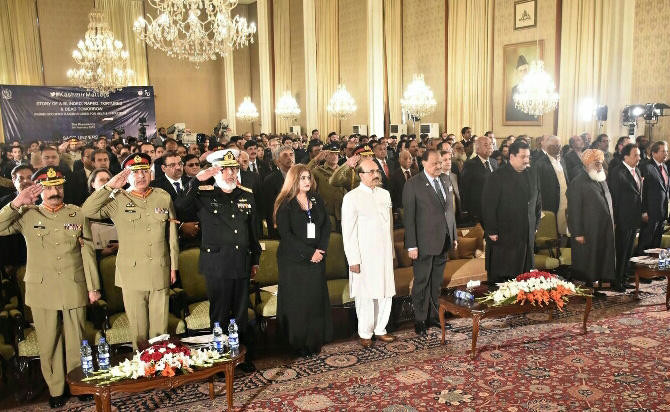
ISLAMABAD: “Indian atrocities” were condemned and Kashmir described as “the biggest prison of humanity on earth” when a major ceremony was held at the Presidency to commemorate Kashmir Solidarity Day on Monday.
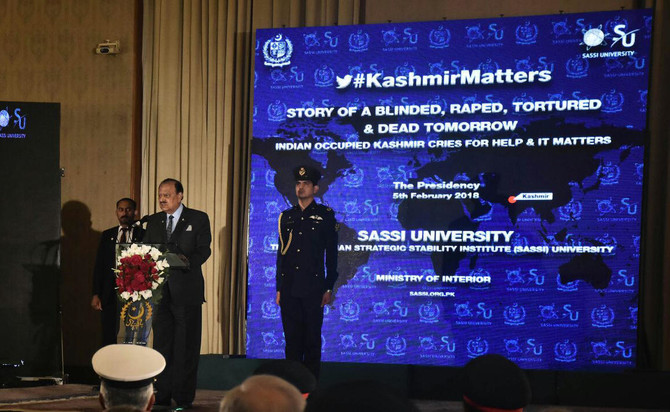
Addressing the audience, Pakistan President Mamnoon Hussain paid tribute and promised unflinching support to the people of Kashmir.
“The freedom struggle of the brave and valiant people of Kashmir is a unique movement in the world. They have faced persecution for the last 70 years. Despite this severe repression, they have been heroically facing subjugation,” he said.
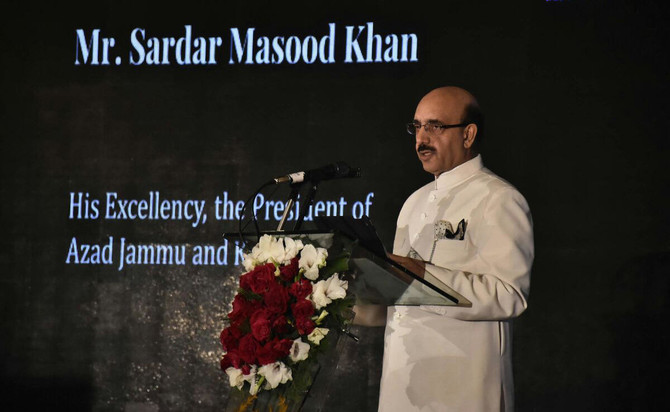
President of Azad Jammu and Kashmir Sardar Masood Khan also attended the event and condemned “Indian atrocities.” He said political and human rights activists were killed in Indian-administered Kashmir since “they raise their voices against Indian brutalities and seek a plebiscite.” He added that India was in gross violation of a UN resolution and claimed it was not possible for anyone to stop the people of Kashmir from getting their birth right.
Several ministers, parliamentarians, government functionaries, Kashmiri leaders and other high-profile public figures were also present at the gathering.
Other participants described Kashmir as “the biggest prison of humanity on earth” and criticized the UN in a video documentary for its inability to implement the UN resolution calling for a free and impartial plebiscite for the people of Kashmir.
Kashmir Solidarity Day is annually observed on Feb. 5 as a national holiday in Pakistan to support the struggle of the people of Indian-administered Kashmir and remember those who have lost their lives in the conflict.
A number of speakers lashed out at New Delhi, claiming that it was trying to reduce “the disputed Muslim-majority state to a Muslim-minority state through rape, torture, extrajudicial killings, and use of pellets.”
Talking to Arab News, Defense Minister Khurram Dastgir Khan said there had been a more than 600 percent increase in casualities along the disputed border that separates the two South Asian nuclear rivals between 2016 and 2017.
“Kashmir matters because peace in South Asia matters,” said Dastgir.
Since 2014, border skirmishes along the Line of Control and working boundary between Pakistan and India have greatly increased.
Pakistan blamed India for more than 1,800 cease-fire violations in 2017, though a 2003 cease-fire accord signed by both countries theoretically remains in effect. According to official statistics, more than 300 violations have been committed by India since the beginning of this year, leading to the deaths of many innocent civilians.
The ceremony at the Presidency was organized by South Asian Strategic Stability Institute (SASSI), an independent think-tank dedicated to promoting peace and stability in South Asia.
SASSI launched today #KashmirMatters campaign, during Monday’s ceremony.
“Escalation dynamics can’t be controlled by Pakistan or India which can lead to a nuclear conflict – the skirmishes remain low-intensity but have the potential of escalating to a point of no return,” Dr. Maria Sultan, chairperson and president of SASSI and its university, told Arab News.
“Kashmir is a nuclear flashpoint” and can spell disaster for the region if not resolved, she added.


![]()
![]()
![]()
![]()
![]()

Kashmir is a nuclear flashpoint, warns Pakistani expert

Kashmir is a nuclear flashpoint, warns Pakistani expert
Latest updates


Recommended


© 2026 SAUDI RESEARCH & PUBLISHING COMPANY, All Rights Reserved And subject to Terms of Use Agreement.