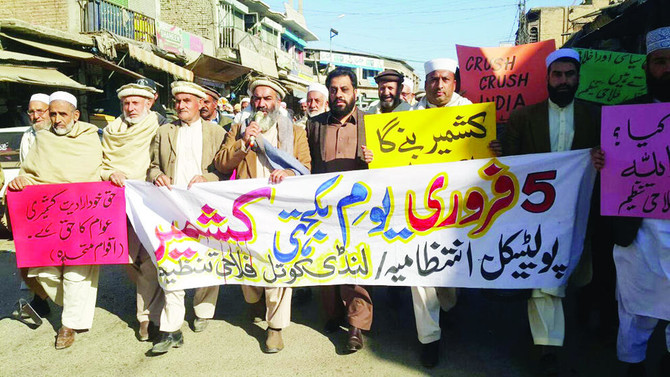
PESHAWAR: Residents of Khyber Pakhtunkhwa (KPK) and the Federally Administered Tribal Areas (FATA) held ceremonies on Monday to observe Kashmir Solidarity Day.
There was greater enthusiasm for the celebrations this year due to the continuing rebellion against Indian forces in the disputed region.
“Compared to previous years, the number of Kashmir Day ceremonies has escalated quite significantly,” Mohammed Muazzam Butt, who manages a Peshawar-based think tank, the Jammu and Kashmir Council, told Arab News.
“People are not only expressing solidarity with the indigenous independence movement in Kashmir but are also protesting Indian brutalities over there,” he said.
He said that the intensity of Kashmir-related events would increase as the issue was “getting international attention due to the human rights violations committed by Indian forces.”
“Our think tank seeks to project the Kashmir cause,” he said. “This requires us to highlight the realities in Indian-administered Kashmir within the context of various provisions of international law.”
Pakistan observes Kashmir Solidarity Day on Feb. 5 each year. The tradition has continued for many decades since the armed uprising first began in the northernmost region of the subcontinent.
Qaiser Alam, KPK’s information secretary, told Arab News that various provincial departments had also arranged Kashmir Day programs.
“We have also brought out special newspaper supplements to underscore the freedom struggle by the people of Indian-occupied Kashmir,” he said.
One of KPK’s official Kashmir Day events attracted members of the province’s ruling coalition. Organized by KPK’s Directorate of Culture, the ceremony was designed to emphasize the Kashmir people’s right to self-determination. Participants carried banners with slogans supporting Kashmir’s struggle for freedom.
The residents of the country’s northwestern tribal territories also observed the occasion with enthusiasm.
In Khyber Agency, Landi Kotal Falahi Tanzeem held a walk to express solidarity with the people of Kashmir. Akhtar Ali, the Tanzeem’s president, said that tribal people wanted a permanent solution to the Kashmir issue.
“The fundamental objective of our demonstration is to raise awareness among people and urge the international community to resolve the issue in accordance with the wishes of Kashmiri people,” he said. “Other than that, it is important to bring an end to Indian aggression as well.”
Professor Zahid Anwar, an academic from the University of Peshawar, described the Kashmir dispute as “the unfinished agenda of Partition,” claiming that it had resulted in numerous casualties and much violence due to the “illegal Indian occupation of the region.”
“Despite the presence of the Indian army in large numbers, Kashmiris hoist Pakistan’s national flag everywhere. This should open the eyes of the international community, which must prevent human rights violations over there.”
He said that it was important to observe Feb. 5 as Kashmir Solidarity Day as it highlighted the significance of resolving the Kashmir dispute, which would “ensure peace in the region and avoid any confrontation between Pakistan and India, the two South Asian nuclear-weapon states.”
However, Professor Sarfaraz Khan, who teaches international relations at the University of Peshawar, said that Pakistan- and Indian-administered Kashmir had their own constitutions, and the two countries should try to promote peace in the region.
“The people of both countries are suffering because of the Kashmir issue,” he said. “Both states are spending substantial resources on weapons. This is not good for their citizens whose well-being is usually ignored.”


![]()
Kashmir Day observed in Pakistan’s KPP province with greater enthusiasm this year
Kashmir Day observed in Pakistan’s KPP province with greater enthusiasm this year
Related
Latest updates


© 2026 SAUDI RESEARCH & PUBLISHING COMPANY, All Rights Reserved And subject to Terms of Use Agreement.