Israel ‘legalizing’ rogue settlement in response to murder: Netanyahu

1 / 2
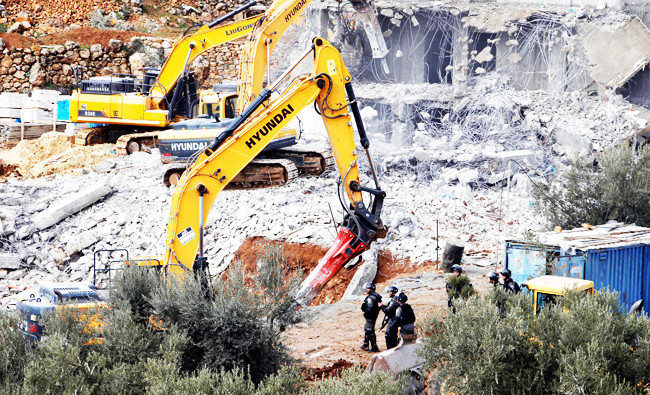
Israeli machineries demolish two under-construction Palestinian residential buildings in the West Bank town of Biet Jala, near Bethlehem on Sunday. (Reuters)
2 / 2
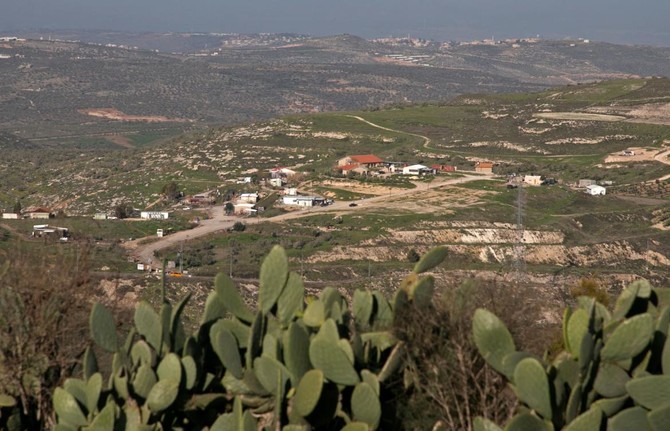
A picture taken from the outskirts of the Palestinian city of Nablus shows a view of the wildcat Jewish settlement outpost of Havat Gilad on February 2, 2018. (AFP)
Updated 05 February 2018
Follow

Israel ‘legalizing’ rogue settlement in response to murder: Netanyahu

JERUSALEM: Israel’s Prime Minister Benjamin Netanyahu said ministers would grant formal authorization Sunday to a rogue West Bank settlement in response to last month’s murder of a rabbi who lived there.
The move comes with European nations voicing increasing concern over settlement growth in the occupied Palestinian territory, but with US President Donald Trump largely refraining from such criticism — what many Israelis view as a green light.
Israeli authorities have advanced plans for thousands of new settlement homes in recent months. Cabinet votes to authorize a pre-existing outpost such as Sunday’s are relatively rare.
“The government will today regularise the status of Havat Gilad to allow the continuance of normal life there,” Netanyahu said at the start of the weekly cabinet meeting, referring to the wildcat settlement.
The official cabinet agenda says ministers will hear a motion to designate the 15-year-old outpost as a “new community” which will have the necessary building permits and a state budget.
It says that about 40 families live in the outpost, but envisages its enlargement.
Rabbi Raziel Shevach was shot dead near Havat Gilad, where he lived, on January 9.
The following week, Israeli troops searching for his attackers shot dead what they described as a Palestinian suspect in the city of Jenin in the northern West Bank, about 35 kilometers (22 miles) north of Havat Gilad.
However, they did not catch the man considered to have led the attack on Shevach, 22-year-old Ahmed Jarrar.
The manhunt continued on Saturday with a raid on the village of Burqin. In clashes that erupted there, soldiers shot dead a teenager identified by the Palestinian health ministry as Ahmad Abu Obeid, 19.
“Yesterday our forces were again in action in an effort to apprehend the last of the assassins and their accomplices in the murder of Rabbi Shevach,” Netanyahu told cabinet ministers and media.
“We will not rest until we bring them to justice,” he pledged. “And we shall bring them all to justice.”
At Shevach’s funeral, there were calls for “revenge” during a speech by Education Minister Naftali Bennett of the far-right Jewish Home party.
Bennett responded by saying that the only revenge should be in building more settlements, and Netanyahu said Sunday that was one of the planks of his policy.
“Anyone who thinks that through the abominable murder of a resident of Havat Gilad, a father of six, they would break our spirits and weaken us is making a bitter mistake,” he said.
Settlement watchdog Peace Now, however, said that retroactively granting legal status to Havat Gilad, built without submitting development plans or obtaining construction permits, was “cynical exploitation” of Shevach’s death.
Israeli settlements are seen as illegal under international law and major obstacles to peace as they are built on land the Palestinians see as part of their future state.
But Israel differentiates between settlements it has approved and those it has not.
Those without approval are referred to as outposts and tend to be populated by hard-line religious nationalists who see the entire West Bank as part of Israel.
Past attempts by Israeli authorities to dismantle Havat Gilad have led to clashes with settlers there.
Israel has several times given retroactive approval to outposts, and last year work began on the first completely new government-sanctioned settlement built in the Palestinian territories in some 25 years.
Israel faced sharp criticism from the administration of former US president Barack Obama over settlement construction, but that has not been the case with Trump’s White House and Israeli officials have sought to take advantage of this.
European nations and the United Nations maintain their strong opposition to settlement building.


Alexandria bids farewell to historic tram in latest urban upheaval

Updated 7 sec ago
Follow

Alexandria bids farewell to historic tram in latest urban upheaval

  • For over 160 years, the tram has cut through Alexandria’s heart, in an 11-kilometer stretch that includes many of the city’s schools and main universities

ALEXANDRIA, Egypt: Along Egypt’s Mediterranean coast, the oldest tram in Africa and the Middle East rumbles for a final few weeks before its removal — the latest urban upheaval Alexandrians say is hollowing out their city’s identity.
Government plans to replace the colorful streetcars on one of the city’s routes with a partially elevated light rail line have angered Alexandrians, for whom the 163-year-old track is “heritage, not just a means of transport,” local urban researcher Nahla Saleh told AFP.
Inaugurated in 1863, the tram is one of the world’s oldest, and among only a few to operate double-decker cars.
In the 19th and 20th centuries, it helped the city become a bustling metropolis, home to sizable European diasporas and a distinct cosmopolitan culture.
Now, Egyptians young and old have flocked for farewell rides, before the streetcars come to a halt in April.
As one locomotive screeches into the old El-Raml Station, commuters and visitors crane their necks out of giant windows at the historic neo-Venetian buildings overhead.
“We’re not against progress,” psychologist and writer on culture Mona Lamloum told AFP.
She and other Alexandrians agree the tramway needs work: inside the hand-calligraphied blue exterior, grime covers every surface. Underfoot, the rubber flooring is torn and strewn with trash.
“We just have bad experiences of everything they call ‘progress’ becoming synonymous with destruction,” Lamloum said.
In recent years, development projects in Egypt’s second city have razed historic parks and — most egregiously to locals — privatised and obstructed much of its Mediterranean coastline.

- Heart of Alexandria -

For over 160 years, the tram has cut through Alexandria’s heart, in an 11-kilometer stretch that includes many of the city’s schools and main universities.
The new project, led by Egyptian and international companies including Systra, Hyundai and Hitachi, promises to double speed and triple capacity.
Over half of it will be elevated — a major concern for Alexandrians who fear the tree-lined track will be replaced by eyesore concrete stilts.
Ahead of the first phase of suspension, the transport ministry said the new project was the “only solution to the city’s traffic problems.”
Locals like Saleh and Lamloum disagree, saying government plans are making the city more car-dependent and worsening traffic.
Already, because so many students rely on the tram, the city has staggered school and university hours to pick up the slack of the partial shutdown.
“Traffic’s getting worse, people can’t get anywhere, when we’ve already lost the inner-city train,” said Saleh, referring to another project under construction for the past two years, the new Alexandria Metro Line.
“Besides, it being slow was always an advantage,” she added, making it safe for “the most vulnerable in society: children and the elderly.”
Retired science teacher Hisham Abdelwahab, 64, has been riding the tram since he was a child.
“I don’t want it to go fast, I like watching the world go by,” he told AFP on a station bench.
“Our parents never thought twice about sending us out on the tram alone. Now I have a car, I just like leaving it parked to come ride the tram.”
When the next streetcar rolls in, the upper deck fills with a gaggle of schoolgirls, squabbling over who gets the window seat closest to the sea breeze.

- The old tram and the sea -

“This tram is our heritage,” Abdelwahab said, his sentiment shared by those several decades younger.
Engineering student Mahmoud Bassam, 24, has visited Alexandria just to ride the streetcar “since our tram in Cairo was removed,” he told AFP.
With a controversial slew of bridges and widened streets completed in 2020, Cairo’s historic Heliopolis neighborhood lost its last tram tracks, along with many of its trees.
“Now the same is happening here,” Bassam lamented.
Many Alexandrians are feeling the loss, intermingled with their other most treasured heritage.
“It’s like the sea. We used to go for long scenic drives on the corniche, but now we’re losing both the sea and the tram,” Abdelwahab said.
Parallel to the tramway, much of Alexandria’s iconic corniche is now hidden behind overpasses, private businesses and beachside food courts.
By 2024, over half of the city’s Mediterranean coastline had disappeared from view, according to a study by the Human and the City for Social Research center.
Four-lane highways now dominate long stretches of the seaside, where the landmark sight of fishermen perched over the waves grows ever-rarer.
For many, the waterfront that Lebanese singer Fairouz immortalized in 1961 — crooning about “the coast of Alexandria, coast of love” — is no more.
“Now all you see is concrete,” said Lamloum.
Saleh calls it “short-sighted” that the city could lose its charm to sprawling concrete.
“Tourists used to love coming to see the tram and sit by the sea, why take away both?“