Del Toro wins top DGA prize for ‘The Shape of Water’

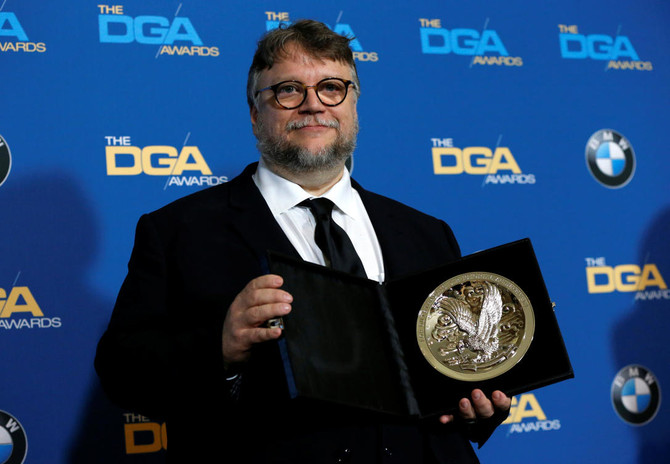
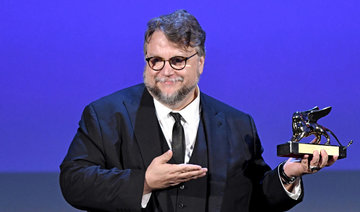
Director Guillermo del Toro holds his nominee plaque for Outstanding Directorial Achievement in Feature Film for “The Shape of Water” at the 70th Annual DGA Awards in Beverly Hills, California, US, February 3, 2018. (Reuters)
Updated 04 February 2018
Follow

Del Toro wins top DGA prize for ‘The Shape of Water’

LOS ANGELES: Guillermo del Toro’s bid for Oscars glory was boosted Saturday as he took top prize at the Directors Guild of America honors — a key predictor for the Academy Awards.
The Mexican filmmaker was crowned best director for his Cold War-era fantasy romance “The Shape of Water,” a month ahead of the glittering culmination of Hollywood’s annual awards season.
The 53-year-old has already scooped a Golden Globe for directing the movie, starring Sally Hawkins as a janitor in a top secret government laboratory who falls in love with a mysterious merman-like sea creature.
“This movie particularly took me to do things I was very afraid of,” Del Toro told fellow filmmakers at the Beverly Hilton in Beverly Hills.
“It was a movie that was full of many reasons why it shouldn’t work, and those are the reasons why it works.”
An emotional Del Toro’s voice trembled as he dedicated the award to his mother and to his father, who was recently taken ill.
“While they are still with me, and they can still hear me say this, thank you dad, thank you mom. You believe in me and my monsters all the time.”
Del Toro edged out Christopher Nolan, nominated for World War II thriller “Dunkirk” — another film seen as a top contender for Oscar glory on March 4.
“The Shape of Water” was nominated for seven Golden Globes in January, eventually taking home two, and was awarded best picture by the Producers Guild. It is up for 13 Oscars.
The DGA Awards are seen as a reliable bellwether of Academy Awards success — particularly the best director prize, as 13 of the last 14 winners went on to win the Oscar for best director.
Presenters at Saturday’s star-studded event for 1,600 guests included Sam Rockwell, Amy Schumer, Saoirse Ronan, Kevin Bacon, Allison Janney and Damien Chazelle, who won the top prize at the last ceremony.
The other nominees for best director were Greta Gerwig for coming-of-age story “Lady Bird,” Martin McDonagh for dark crime comedy “Three Billboards Outside Ebbing, Missouri,” and Jordan Peele for racial satire “Get Out.”
Peele walked away with a medallion for best first-time feature, and said the reaction to the movie had made for “the best year of my life, hands down.”


How science is reshaping early years education 

Updated 27 December 2025
Follow

How science is reshaping early years education 

DUBAI: As early years education comes under renewed scrutiny worldwide, one UAE-based provider is making the case that nurseries must align more closely with science.

Blossom Nursery & Preschool, which operates 32 locations across the UAE, is championing a science-backed model designed to close what it sees as a long-standing gap between research and classroom practice.

“For decades, early years education has been undervalued globally — even though science shows the first five years are the most critical for brain development,” said Lama Bechara-Jakins, CEO for the Middle East at Babilou Family and a founding figure behind Blossom’s regional growth, in an interview with Arab News.

Lama Bechara-Jakins is the CEO for the Middle East at Babilou Family and a founding figure behind Blossom’s regional growth. (Supplied)

She explained that the Sustainable Education Approach was created to address “a fundamental gap between what we know from science and what actually happens in nurseries.”

Developed by Babilou Family, the approach draws on independent analysis of research in neuroscience, epigenetics, and cognitive and social sciences, alongside established educational philosophies and feedback from educators and families across 10 countries. The result is a framework built around six pillars; emotional and physical security, natural curiosity, nature-based learning, inclusion, child rhythms, and partnering with parents.

Two research insights, Bechara-Jakins says, were particularly transformative. “Neuroscience shows that young children cannot learn until they feel safe,” she said, adding that stress and inconsistent caregiving can “literally alter the architecture of the developing brain.” 

Equally significant was evidence around child rhythms, which confirmed that “pushing children academically too early is not just unhelpful — it can be counterproductive.”

Feedback from families and educators reinforced these findings. Across regions, common concerns emerged around pressure on young children, limited outdoor time and weak emotional connections in classrooms. What surprised her most was that “parents all sensed that something was missing, even if they couldn’t articulate the science behind it.”

At classroom level, the strongest body of evidence centres on secure relationships. Research shows that “secure attachments drive healthy brain development” and that children learn through trusted adults. At Blossom, this translates into practices such as assigning each child “one primary educator,” prioritising calm environments, and viewing behaviour through “a neuroscience lens — as stress signals, not misbehaviour.”

Bechara-Jakins believes curiosity and nature remain overlooked in many early years settings, despite strong evidence that both accelerate learning and reduce stress. In urban centres such as Dubai, she argues, nature-based learning is “not a luxury. It is a developmental need.” 

For Blossom, this means daily outdoor time, natural materials, gardening, and sensory play — intentional choices aimed at giving children what science says they need to thrive.