MOSUL: Literary cafes, poetry readings and pavement bookstalls — Mosul’s cultural scene is back in business, months after Iraqi forces ousted Daesh from the city following three years of terrorist rule.
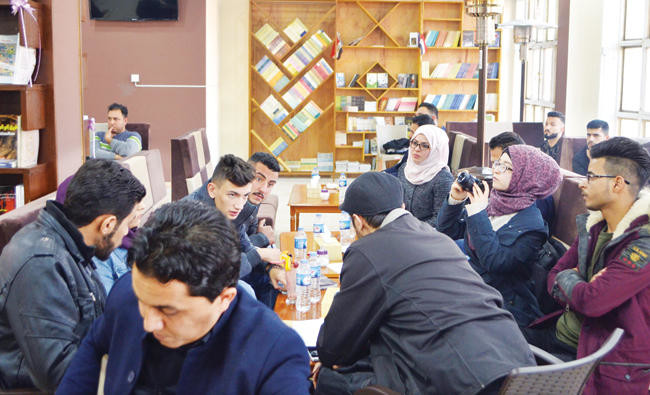
At the “Book Forum” cafe, men and women, young and old, sit passionately debating literature, music, politics and history.
Drinking tea, coffee and juice, some smoke nargileh water pipes while an oud player takes the stage to accompany a poet about to read from his work.
Opposite, the only wall not covered with bookshelves is instead host to a gallery of portraits — medieval Iraqi poet Al-Mutanabbi is pictured alongside Palestinian Mahmoud Darwish and a series of abstract paintings.
A few months ago, opening a mixed-gender literary cafe in Iraq’s second city would have been unthinkable — punishable by flogging or death under Daesh rule.
But with the terrorists gone, Fahd Sabah and his partner have set about realizing their dream.
“While we lived under the yoke of IS (Daesh), I told myself that it was an absolute must to open this place,” Sabah said. “There was a need to inform people, to enlighten minds, to bring new ideas.”
Like many young graduates in Iraq, the 30-year-old engineer had few prospects of finding employment.
So as soon as the terrorists were driven out of Mosul, he set about finding a venue and preparing to open a cafe, putting his savings into the venture. Within a month, it was up and running.
It was worth the sacrifice, he said. His project aims to create “a new consciousness to overcome this terrible period and the damage left by the war.”
Iraqis are renowned in the Arab world for their literary culture. Mosul, capital of Nineveh province and sitting at a crossroads of ancient trading routes, long boasted a parade of booksellers along its famous Al-Nujaifi Street.
But Daesh methodically destroyed and burned books and destroyed libraries.
After the terrorists were evicted six months ago, a handful of activists set up the “Book Pavement” market outside the city’s battle-scarred university.
Ali Najam, 23, comes every Friday to scour the stalls of second-hand booksellers next to the concrete carcass of a building disemboweled by bombs.
Today, he has picked up an English edition of “Love in the Age of Cholera” by Colombian Nobel Laureate Gabriel Garcia Marquez.
“People badly need culture and to build their consciousness after the hardships they went through,” Najam said. “There’s a need to rebuild people’s spirits, which is even more important than rebuilding the houses and the city.”
Yunis Mohammed, a 33-year-old writer, said that despite the destruction, “Mosul will be rebuilt thanks to the brains of its young people, its intellectuals.”
Abdelmonim Al-Amir, head of Nineveh province’s writers’ union, said he wants the world, which associates Mosul with “blood, destruction and desolation,” to know that the city has another face.
“Inhabitants and artists must make the human, cultural and academic dimensions of Mosul shine,” he said.
So far, everything is being done on limited means, in a city devastated by war, crippled by unemployment and held back by the slow pace of reconstruction.
“The public authorities in charge of culture must now do their duty,” said writer Hamed Al-Zubaidi.
Hind Ahmed, a 31-year-old engineer, said the mission was important to Iraq, which in December announced the “liberation” of the country and the “end of the war” against Daesh.
“Now the land has been liberated we must free minds and ideas,” she said, dressed in a white veil dotted with butterflies over a beige coat.
Iraqis must “give everyone the opportunity to participate,” she added. “Men and women.”


![]()
Mosul embraces book culture in post-Daesh Iraq
Mosul embraces book culture in post-Daesh Iraq


Latest updates


© 2026 SAUDI RESEARCH & PUBLISHING COMPANY, All Rights Reserved And subject to Terms of Use Agreement.