ANKARA: An explosion rocked the Turkish capital late Thursday, injuring three people and causing extensive damage to a building in the district of Cukurambar, close to the Turkish Parliament.
The blast was originally believed to have originated in the boiler room of a tax office, but new evidence from security footage apparently shows a man placing a bag of explosives at the building entrance.
Eight people were detained in connection with the attack, while the ninth — and main — suspect, who reportedly entered Turkey illegally and is believed to have trained by a branch of the Syrian-Kurdish People’s Protection Units (YPG) militia, was killed during the operation.
The suspects were found in southern and southeastern provinces of Turkey on Friday.
The YPG is considered by Ankara to be the Syrian offshoot of the outlawed Kurdistan Workers’ Party (PKK), which has waged a violent insurgency against the Turkish state for more than three decades.
Turkey’s military offensive into Syria’s northwestern province of Afrin, Operation Olive Branch, entered its third week on Saturday. The operation aims to clear Kurdish militias from areas near Turkey’s border with Syria. Thursday’s bomb has raised fears that Operation Olive Branch may have domestic security repercussions, as the YPG suffers significant losses in both territory and personnel.
Kadir Ertac Celik, a security adviser at Ankara-based think tank ANKASAM, believes Thursday’s act of sabotage is directly linked to Turkey’s current Middle East policy. Experts have warned against the potential re-emergence of terrorist sleeper cells inside Turkey.
“The YPG is the youth auxiliary of the PKK in Syria,” Celik said. “Therefore, (Operation) Olive Branch will bring some risks and threats, as the main motive of this operation is to prevent activities that are intended to harm Turkey.
“The main aim of attacks (such as Thursday’s) is not to create many casualties, but rather to undermine and influence the motivation and the will of the public opinion and decision-makers,” Celik said.
“Such attacks reveal the need to strengthen the psychological side of the anti-terror struggle in Turkey with an increased domestic consensus, while using hard power in the military offensive,” he added.
According to Celik, Thursday’s attack on the capital was meant to deliver the message that Turkey is vulnerable and that the terror group has the ability to strike one of the most secure places in the country.
“However, Turkey will keep itself unharmed by such asymmetrical warfare in the upcoming period, and the Turkish public is likely to support the government’s security policy,” he added.
The PKK has been active recently. On February 1, three Turkish soldiers were killed and seven injured in the eastern province of Hakkari in cross-border attacks carried out from northern Iraq.
“The YPG poses a serious security threat to Turkey, with dozens of rockets fired across the border,” Sertac Canalp Korkmaz, a security studies researcher at ORSAM, another think tank in Ankara, told Arab News.
“This latest attack might be revenge for the swathes of territory it lost recently in Syria,” he noted.
It is estimated that five people have been killed and at least 88 injured in cross-border attacks by the PKK/YPG on Turkey’s border towns in the last two weeks.
“The YPG acts on the ground in coordination with its affiliate PKK and the security raids by Turkish counter-terrorism teams on PKK cells in Turkey show that the group has already acquired weapons provided by the Pentagon to the YPG in Syria,” Korkmaz said.
The existence of thousands of foreign fighters in Syria and the fact that their potential route home involves passing through Turkey is also a security concern.
“Recently a group of foreign terrorist fighters released a statement targeting Turkey, so in the upcoming period a serious threat against Turkey may come from this group of local and international volunteers,” Korkmaz said.
On Saturday, Turkish counter-terrorism police arrested 82 suspects in an anti-Daesh operation in Istanbul, 77 of them were foreign fighters.


![]()
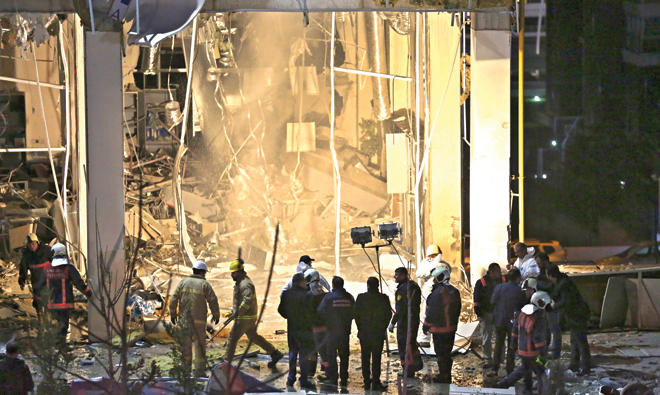
8 held in connection with Ankara blast
8 held in connection with Ankara blast
Latest updates


© 2026 SAUDI RESEARCH & PUBLISHING COMPANY, All Rights Reserved And subject to Terms of Use Agreement.