LONDON: It is a freezing morning in east London, but in the street outside St. Stephen’s primary school, a heated debate rages.
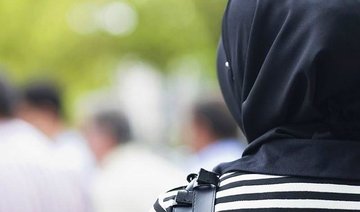
The school, last year named the best primary in Britain, made headlines after its principal, Neena Lall, imposed a ban on girls younger than eight wearing the hijab, only to rescind her decision after a vociferous campaign by parents and community leaders.
Lall had the support of the chairman of the school governors and of the chief inspector of Ofsted, Amanda Spielman, who visited the school and spoke in praise of the headteacher in an address to the Church of England Foundation for Education Leadership on Thursday.
But Lall was forced to backtrack following a community backlash that included a petition with 20,000 signatures and a spoof film circling on social media which portrayed her as Adolf Hitler. On Jan. 19, the school’s chairman of governors, Arif Qawi, announced he was stepping down.
The row has simmered on for two weeks, fueled by comments from many quarters, including members of the local Newham council, and Muslim groups and activists.
But from one group there has been remarkably little public comment, yet they are arguably those with the strongest investment in the continuing good standing of a school: The parents who send their children to be educated there.
And despite all efforts to defuse the row, it seems they have plenty to say on the subject.
“Whether a girl wears the hijab or not is a choice for her parents or for the girl herself. This is a free country,” said garage owner Amir Rafik, 46, who was dropping off his 11-year-old daughter, along with his wife, Nosheen, 42.
“Yes, it’s a school and schools have to have rules, but if you are going to impose rules about clothing, it should be one rule for everyone. I don’t see anyone banning Sikh boys from wearing turbans from any age.”
The Rafiks are of Pakistani origin. Their daughter does not wear a hijab and neither does Mrs. Rafik.
“That is my choice, but I totally support the parents who do want their girls to wear a hijab,” she said. “(The principal) was wrong to say what she did and a lot of parents were very upset.”
Among the reasons Lall gave for banning the hijab for young girls was her belief that it hampered integration and made pupils feel less British.
Nonsense, said the Rafiks. “We don’t need the school to tell us we’re British. We live here, we know the rules,” said Mr. Rafik.
As the furore grew, Lall called a meeting for parents two weeks ago and apologized.
“We accepted her apology as long as it doesn’t happen again and she assured us it won’t,” said Mrs. Rafik. However, her husband was less impressed by the gesture.
“The meeting lasted one hour and she spoke for 45 minutes. That didn’t leave much time for parents to ask questions. She should have listened more,” he said.
Most pupils at St. Stephen’s, like the principal herself, come from families with origins in the subcontinent. Upton Park, the area in which the school is located, also has a large Indian, Pakistani and Bangladeshi population. Here, fast food means pakoras as much as burgers, and women in hijabs and niqabs are as numerous as women in Western clothing.
Samira, 21, often walks her 4-year-old sister to St. Stephen’s before continuing on to the University of East London, where she is studying computer science.
“I’ve worn a hijab since I was 6 because I loved it, but my sister doesn’t wear one, though sometimes she’d like to just to copy me,” she said. “Isn’t that what all kids want — to be like their older siblings or schoolfriends? Sometimes it’s not purely about religion but about a little girl just wanting to fit in.”
Some parents protested against the hijab ban at St. Stephen’s because they feared it could be a first step toward banning the headwear in all schools.
“You make a rule for one school and it can spread,” said Sidra Anwar, 34, a mother-of-three with a 7-year-old daughter at St. Stephen’s.
“We follow other school policies, like only black shoes allowed and everyone has to have school dinners. We respect the school and the staff. St. Stephen’s is fantastic and we love it, but any school is more than a school. It’s also a part of the community and it can’t ignore the rest of the community.”
As 8:55 a.m. approached — the time when all pupils must be inside school — a man and a woman, both parents, were having an increasingly heated discussion outside the school gates. As voices rose, the woman, who was wearing a hijab and abaya, stomped off.
The man introduced himself himself as Edward Andrews, 38, and of Indian origin with a 7-year-old daughter at St. Stephen’s. The hijab ban was neither here nor there, he said. What had incensed him was the backlash from parents and others.
"Why are we talking about this? The school is here to provide education, that’s all we should be focusing on,” he said. “Is this school the No. 1 primary school in Britain because of us parents? No, it’s because of the headteacher and the staff and their methods and policies. If you don’t trust them to educate your child, then go to another school or teach your child yourself at home.
“A school is an institution, and while kids are inside that building the school is responsible for their safety and we, the parents, as well as the pupils, must respect the rules.”


![]()

What UK school’s hijab ‘ban’ can teach us
What UK school’s hijab ‘ban’ can teach us

Latest updates






© 2026 SAUDI RESEARCH & PUBLISHING COMPANY, All Rights Reserved And subject to Terms of Use Agreement.