NEW YORK: Advance ticket sales to Marvel’s “Black Panther” were outpacing all superhero movies on Fandango.
The online ticket service said that “Black Panther” was outselling its previous record-holder for presale, 2016’s “Batman v Superman.”
Following gushing early reaction from Monday night’s premiere, Ryan Coogler’s film is the top daily ticket-seller on Fandango.
“Black Panther” doesn’t open until Feb. 16, but anticipation is especially strong for the first superhero movie in years starring a black lead character.
The premiere in Los Angeles was attended by the film’s cast decked in regal African-themed attire. Analysts are forecasting a President’s Day weekend debut for “Black Panther” of at least $100 million in North America.
On Tuesday, “Black Panther” star Chadwick Boseman revealed that doubters had tried to convince him not to give the superhero an African accent — and how proud he was to prove them wrong.
Boseman was speaking at a Beverly Hills news conference along with director Coogler, co-stars Michael B Jordan, Lupita Nyong’o and Danai Gurira and the rest of the cast the morning after Monday’s glittering Hollywood premiere.
The 41-year-old American stars in the titular role in the 18th movie in the Marvel Cinematic Universe — the first black superhero to get his own standalone movie.
“There was a time period where people would ask me questions about whether or not an audience could sit through a movie with a lead character that spoke with that accent,” Boseman said of the east African inflection he gives the superhero — alias King T’Challa.
“I became adamant about the fact that it’s not true,” he added, stressing that none of the naysayers had come from Marvel itself.
“The intonations and melodies inside an African accent are just as classical as a British one or a European one.”
The actor got his break after a decade as an obscure television and indie film actor when Marvel came calling in 2014 with a lucrative five-picture deal to play Black Panther.
His appearance in “Captain America: Civil War” (2016) brought Boseman his first taste of real fame and his celebrity looks set to skyrocket when “Black Panther” opens this month, followed in May by “Avengers: Infinity War.”
T’Challa, king and protector of the technologically advanced fictional African nation of Wakanda, has been characterized as the first black superhero, which is partly true.
Around 30 black characters have donned the lycra for the big screen since the early 1990s, including Marvel’s Falcon (Anthony Mackie since 2014), Wesley Snipes’s titular vampire hunter in “Blade” (1998) and Halle Berry’s Kenyan princess Storm in four “X-men” movies.
The Wakandan royal can claim to be the first black superhero to land a standalone movie in the MCU and the first in mainstream American comics, having been featured in “The Fantastic Four” in 1966.
Critical and celebrity reactions to “Black Panther” after Monday’s premiere were about as good as could be expected, with reviewers hailing the movie as “iconic” and “astonishing.”
Donald Glover, who is due to star as Lando Calrissian in the upcoming “Solo: A Star Wars Story,” called it “beautiful” while “Ant-Man” director Peyton Reed said it was “soulful, thoughtful and of the moment.”
Marvel Studios president Kevin Feige, who produces every MCU movie, agreed that the messages of the movie — which posits Wakanda taking in refugees and extending its culture and technology to poorer nations — were particularly topical, but added that most of the script was written 18 months ago.
Coogler and the producers came in for particular praise at the news conference for their decision to feature a clique of powerful female characters — dubbed “the badass women of Wakanda” front and center.
“I was so pleased that this story... that it supported that. In African culture, they feel as if there is no king without a queen and this story, it highlights the queen, the warrior, the general, the young sister,” said Angela Bassett, who plays T’Challa’s mother Ramonda.
“I was so proud to have my daughter and my son there last night, because in their faces, in their spirit, they were feeling themselves. They stood taller after last night.”
Gurira (“The Walking Dead“) spoke of her trepidation over having her head shaved to play Okoye, the head of Wakanda’s Dora Milaje special forces, but how she saw it as “subversive in the right way.”
“In theory, it sounded amazing, and then the day came... It happened. Then you walk into the restroom to wash your hands, look up like, ‘What the?’
“It took a few days... Then the pride started to grow, there’s pride around it, and the embracing of this symbol of power and these women.”


![]()
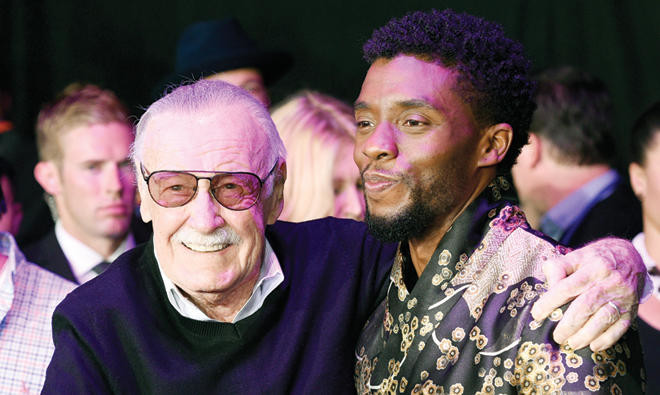
‘Black Panther’ presales outpacing previous superhero movies
‘Black Panther’ presales outpacing previous superhero movies
Latest updates


© 2026 SAUDI RESEARCH & PUBLISHING COMPANY, All Rights Reserved And subject to Terms of Use Agreement.