Israel sends arrested Palestinian girl from West Bank to Gaza

A Palestinian teenager from the West Bank arrested by Israel was sent to the Gaza Strip despite never having been there in her life. (AFP)
Updated 31 January 2018
Follow

Israel sends arrested Palestinian girl from West Bank to Gaza

JERUSALEM: A Palestinian teenager from the West Bank arrested by Israel was sent to the Gaza Strip despite never having been there in her life, an NGO said Wednesday.
Israeli rights group HaMoked said the 14-year-old girl, named only as Ghada, was arrested in Jerusalem on January 13 without a permit while visiting the Israeli-controlled city.
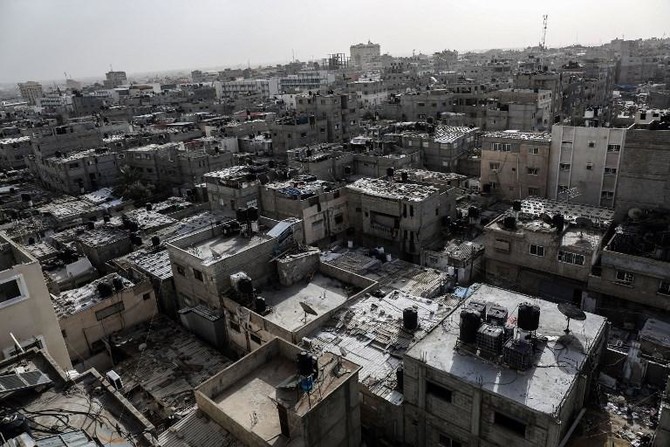
While she is from a-Ram a few kilometers (miles) north of Jerusalem, her father is originally from Gaza, the Palestinian territory about 80 kilometers (some 50 miles) away that is hermetically sealed off by Israel.
HaMoked said the girl was told she would be dropped off at a checkpoint near her home but on her release on January 16 instead was taken to the Erez crossing into Gaza.
Abir Joubran-Dakwar, HaMoked’s lawyer dealing with the case, said they had not yet received a response from Israel about when she could return.
She said Ghada had never been in Gaza before and did not know anyone there, though she was now staying with members of her extended family.
“No one told her anything — they told her they would send her to Qalandia (checkpoint near her home) but they sent her to Erez.”
She said Ghada has epilepsy and was concerned the stress could affect her condition.
A spokesman for the Israel Prison Service said they were examining the case, stressing however that according to official records the girl was a Gaza resident.
Twenty-seven Palestinians living in the Israeli-occupied West Bank were forcibly sent to Gaza last year, according to military data gathered by HaMoked.
Joubran-Dakwar said it was the first time she had heard of someone as young as 14 being sent there.
Israel has maintained a blockade on Gaza for more than a decade which it says is necessary to isolate the strip’s Islamist rulers Hamas, with whom it has fought three wars.
It is extremely difficult for Palestinians from the West Bank to obtain Israeli permission to visit the strip.


High-level Turkish team to visit Damascus on Monday for talks on SDF integration

Updated 22 December 2025
Follow

High-level Turkish team to visit Damascus on Monday for talks on SDF integration

  • The visit by Turkiye’s foreign and defense ministers and its intelligence chief comes amid efforts by Syrian, Kurdish and US officials to show some progress with the deal

ANKARA: A high-level Turkish delegation will visit Damascus on Monday to discuss bilateral ties and the implementation of a deal for integrating the Kurdish-led Syrian Democratic Forces (SDF) into ​Syria’s state apparatus, a Turkish Foreign Ministry source said.
The visit by Turkiye’s foreign and defense ministers and its intelligence chief comes amid efforts by Syrian, Kurdish and US officials to show some progress with the deal. But Ankara accuses the SDF of stalling ahead of a year-end deadline.
Turkiye views the US-backed SDF, which controls swathes ‌of northeastern Syria, as ‌a terrorist organization and has ‌warned of ⁠military ​action ‌if the group does not honor the agreement.
Last week Foreign Minister Hakan Fidan said Ankara hoped to avoid resorting to military action against the SDF but that its patience was running out.
The Foreign Ministry source said Fidan, Defense Minister Yasar Guler and the head of Turkiye’s MIT intelligence agency, Ibrahim Kalin, ⁠would attend the talks in Damascus, a year after the fall of ‌former President Bashar Assad.

TURKEY SAYS ITS ‍NATIONAL SECURITY IS AT ‍STAKE
The source said the integration deal “closely concerned Turkiye’s national ‍security priorities” and the delegation would discuss its implementation. Turkiye has said integration must ensure that the SDF’s chain of command is broken.
Sources have previously told Reuters that Damascus sent a proposal to ​the SDF expressing openness to reorganizing the group’s roughly 50,000 fighters into three main divisions and smaller ⁠brigades as long as it cedes some chains of command and opens its territory to other Syrian army units.
Turkiye sees the SDF as an extension of the outlawed Kurdistan Workers Party (PKK) militant group and says it too must disarm and dissolve itself, in line with a disarmament process now underway between the Turkish state and the PKK.
Ankara has conducted cross-border military operations against the SDF in the past. It accuses the group of wanting to circumvent the integration deal ‌and says this poses a threat to both Turkiye and the unity of Syria.