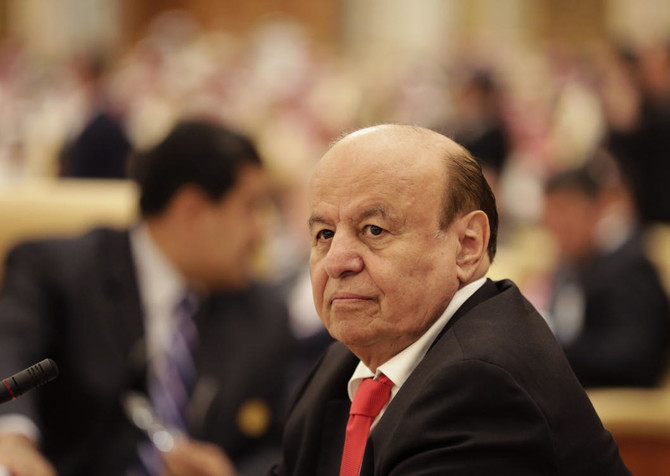
ADEN: Southern Yemeni separatists took control of the port city of Aden after two days of fighting, residents said on Tuesday, confining the internationally recognized government of President Abdrabbuh Mansour Hadi to the presidential palace.
Fighting between southern separatists, backed by the United Arab Emirates (UAE), against forces loyal to Saudi-based president Hadi, risk crippling their once united campaign against the Iran-aligned Houthi movement in Yemen’s north.
The UAE is a major component of a Saudi-led military coalition of Arab states that has supported Hadi’s government since the Houthis seized much of the country, including the capital Sanaa, three years ago. Hadi’s government operates out of Aden, while he lives in Saudi Arabia.
Residents said forces loyal to the Southern Transitional Council (STC), formed last year to push for the revival of the former independent state of South Yemen, seized the last stronghold of Hadi’s Presidential Protection Forces in the Dar Saad area of northern Aden, in battles that at times involved heavy artillery and tank fire.
Activists shared photos on social media of the flag of the former independent Southern Yemen state flying over the base’s gate. Southern Yemen was united with Northern Yemen in 1990.
Aden residents said STC fighters had earlier overrun Presidential Protection forces outposts in central Aden’s Crater and Tawahi districts.
They stopped outside the Al-Maasheeq palace, where Prime Minister Ahmed bin Daghr’s cabinet is based, they said.
Witnesses said hundreds of people danced and sang as they celebrated the STC victory with fireworks that lit the night skies over Aden. The crowd chanted slogans demanding restoration of the southern state.
Mosques also mixed their calls for prayers with victory claims in Crater, residents said.
The government-run Saba news agency put the death toll in two days of fighting at 16 and the number of wounded at 141. An official at the International Committee of the Red Cross (ICRC) said at least 36 were killed and 185 were wounded.
The fighting began on Sunday after a deadline set last week by the STC for Hadi to dismiss bin Daghr’s government, which the STC accused of corruption and mismanagement. The government denies the allegation.
Sources at the STC said negotiations were underway to allow bin Daghr’s government to leave the city safely, but a government source said bin Daghr had no intention of leaving Aden.
STC head Aydaroos Al-Zubaydi, in his first public comments since the fighting began, said the separatists were still committed to the coalition’s goals of driving the Houthis out of Sanaa, but he declined to say whether he intended to set up a separate administration in Aden.
“We have tasks alongside the Arab coalition and its Decisive Storm (operation). But the people of the South have the right to their own state when the international community is ready for that,” Zubaydi said in an interview with the Arabic channel of France 24 TV.
The Saudi-led coalition, which intervened in Yemen’s civil war in 2015 to restore Hadi’s government after the Houthis forced him into exile, called in a statement on Tuesday on both parties to cease hostilities.
“The coalition will take all the measures it deems necessary to restore stability and security in Aden,” it said.
Although Hadi remains in exile in Saudi Arabia, his administration and local allies nominally control about four-fifths of Yemen’s territory, although most population centers are in the hands of the Houthis.
The factional fighting in the south compounds the misery of Yemenis whose country has been torn apart by three years of conflict between Hadi’s forces and the Houthis, which has also opened the way for Islamist militants to widen their influence.
In the southern Shabwa province, at least 12 soldiers from another local forces trained and backed by the UAE were killed in a bomb and gun attack on their outpost, residents and officials said.
While no one claimed responsibility for the attack, it mirrored previous operations by Al Qaeda in the Arabian Peninsula (AQAP).


![]()
Yemen separatists capture Aden, government confined to palace
Yemen separatists capture Aden, government confined to palace

Latest updates







© 2026 SAUDI RESEARCH & PUBLISHING COMPANY, All Rights Reserved And subject to Terms of Use Agreement.