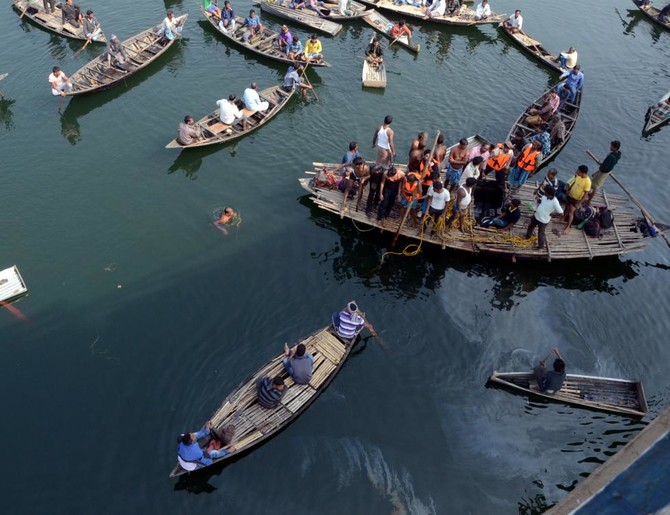
KOLKATA: At least 36 people were killed in eastern India’s West Bengal state early Monday after a speeding passenger bus swerved off a bridge and plunged into a river, police said.
Initial investigations and eye witness accounts said the bus driver, who also died in the accident, lost control while trying to overtake another vehicle on the bridge.
The bus crashed into the bridge’s side railing before plummeting 12 meters (40 feet) into the local Bhairav river.
“Rescuers have retrieved 36 bodies so far. Nine passengers have been hospitalized,” state’s transport minister Subhendu Adhikari told AFP.
Rescue workers believe that there were more than 50 passengers on the bus at the time of the accident.
The rescue work at the accident site in Murshidabad district, around 187 miles (300 kilometers) from the state capital Kolkata, was ongoing late Monday evening.
“We fear that some of the passengers were swept away as glass windows of the vehicle broke (on impact),” Adhikari said.
The victims include at-least nine women and four children.
The bus lay submerged on the riverbed till emergency workers dragged it to a riverbank.
The rescue workers then used steel cutters to cut open the mangled vehicle and retrieve victims’ bodies.
At least 32 people were killed in another road accident after a bus plunged into a river in western Rajasthan state this December.
India has some of the world’s deadliest roads.
More than 150,000 people are killed each year with most accidents blamed on poor roads, badly maintained vehicles and reckless driving.

At least 36 dead as bus plunges off bridge in eastern India
India accelerates free trade agreements against backdrop of US tariffs
- India signed a CEPA with Oman on Thursday and a CETA with the UK in July
- Delhi is also in advanced talks for trade pacts with the EU, New Zealand, Chile
NEW DELHI: India has accelerated discussions to finalize free trade agreements with several nations, as New Delhi seeks to offset the impact of steep US import tariffs and widen export destinations amid uncertainties in global trade.
India signed a Comprehensive Economic Partnership Agreement with Oman on Thursday, which allows India to export most of its goods without paying tariffs, covering 98 percent of the total value of India’s exports to the Gulf nation.
The deal comes less than five months after a multibillion-dollar trade agreement with the UK, which cut tariffs on goods from cars to alcohol, and as Indian trade negotiators are in advanced talks with New Zealand, the EU and Chile for similar partnerships.
They are part of India’s “ongoing efforts to expand its trade network and liberalize its trade,” said Anupam Manur, professor of economics at the Takshashila Institution.
“The renewed efforts to sign bilateral FTAs are partly an after-effect of New Delhi realizing the importance of diversifying trade partners, especially after India’s biggest export market, the US, levied tariff rates of up to 50 percent on India.”
Indian exporters have been hit hard by the hefty tariffs that went into effect in August.
Months of negotiations with Washington have not clarified when a trade deal to bring down the tariffs would be signed, while the levies have weighed on sectors such as textiles, auto components, metals and labor-intensive manufacturing.
The FTAs with other nations will “help partially in mitigating the effects of US tariffs,” Manur said.
In particular, Oman can “act as a gateway to other Gulf countries and even parts of Eastern Europe, Central Asia, and Africa,” and the free trade deal will most likely benefit “labor-intensive sectors in India,” he added.
The chances of concluding a deal with Washington “will prove to be difficult,” said Arun Kumar, a retired economics professor at the Jawaharlal Nehru University.
“With the US, the chances of coming to (an agreement) are a bit difficult, because they want to get our agriculture market open, which we cannot do. They want us to reduce trade with Russia. That’s also difficult for India to do,” he told Arab News.
US President Donald Trump has threatened sanctions over India’s historic ties with Moscow and its imports of Russian oil, which Washington says help fund Moscow’s ongoing war with Ukraine.
“President Trump is constantly creating new problems, like with H-1B visa and so on now. So some difficulty or the other is expected. That’s why India is trying to build relationships with other nations,” Kumar said, referring to increased vetting and delays under the Trump administration for foreign workers, who include a large number of Indian nationals.
“Substituting for the US market is going to be tough. So certainly, I think India should do what it can do in terms of promoting trade with other countries.”
India has free trade agreements with more than 10 countries, including comprehensive economic partnership agreements with South Korea, Japan, and the UAE.
It is in talks with the EU to conclude an FTA, amid new negotiations launched this year for trade agreements, including with New Zealand and Chile.
India’s approach to trade partnerships has been “totally transformed,” Commerce and Industry Minister Piyush Goyal said in a press briefing following the signing of the CEPA with Oman, which Indian officials aim to enter into force in three months.
“Now we don’t do FTAs with other developing nations; our focus is on the developed world, with whom we don’t compete,” he said. “We complement and therefore open up huge opportunities for our industry, for our manufactured goods, for our services.”