SYDNEY: Prime Minister Malcolm Turnbull said on Monday Australian military equipment manufacturers will be offered government-backed loans as part of a A$3.8 billion (SR11.54 billion) package to become one of the world’s top 10 defense exporters.
Australia said in 2016 it would boost defense spending by A$30 billion by 2021, purchasing frigates, armored personnel carriers, strike fighter jets, drones and a fleet of new submarines — many of which would be built at home.
The defense industry has struggled to obtain finance from traditional lenders that have been unwilling to fund the arms industry, so Australia has created a A$3.8 billion loan scheme for companies seeking finance to export military equipment.
“Australia is around the 20th largest exporter. Given the size of our defense budget we should be higher up the scale than that,” Turnbull told reporters in Sydney.
“The goal is to get into the top 10,” he said.
Christopher Pyne, the minister for the defense industry, said Australia would target sales to the US, Canada, Britain and New Zealand.
Australia’s annual defense budget was worth A$34.6 billion this year.
The scheme is also meant to arrest a slide in Australia’s manufacturing sector and provide some support for its economy, which has been hampered by record-low wage growth.
Australia saw a record number of jobs created in 2017 but its manufacturing sector has shrunk significantly following the end of domestic car manufacturing.
Employment in manufacturing peaked in mid-1989 at roughly 1.17 million, or 15 percent of the entire workforce. That shrank to 877,000, or 7 percent, late last year.
Australia has seen a wave of new jobs but companies are not keen on paying employees more, leaving wage growth near record lows in an unwelcome drag on consumer spending and inflation.
Australia’s expansion plans come amid increased global demand for military hardware, led by China and Middle East nations, prompting criticism of Canberra from aid agencies who argue Australia could make human rights violations worse if weapons were sold to the wrong buyers.
Analysts said Australia would need to significantly expand sales beyond its traditional partners to have any chance of fulfilling its ambition.
“There are possibilities, but I doubt US interest especially will go beyond niche capabilities,” said Euan Graham, director of the international security program at Australian think tank the Lowy Institute.


![]()
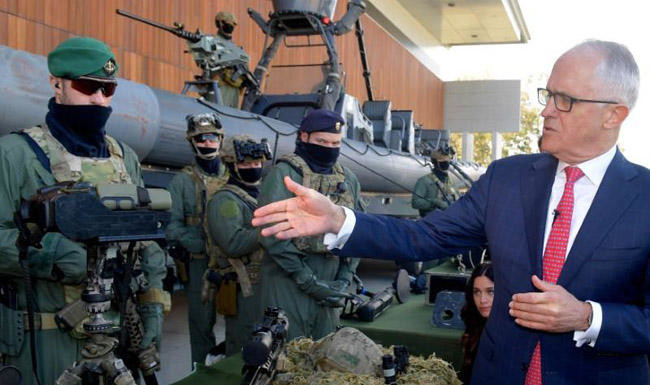
Australia to spend A$3.8 billion to increase stake in global arms exports
Australia to spend A$3.8 billion to increase stake in global arms exports


Latest updates


Recommended


© 2026 SAUDI RESEARCH & PUBLISHING COMPANY, All Rights Reserved And subject to Terms of Use Agreement.