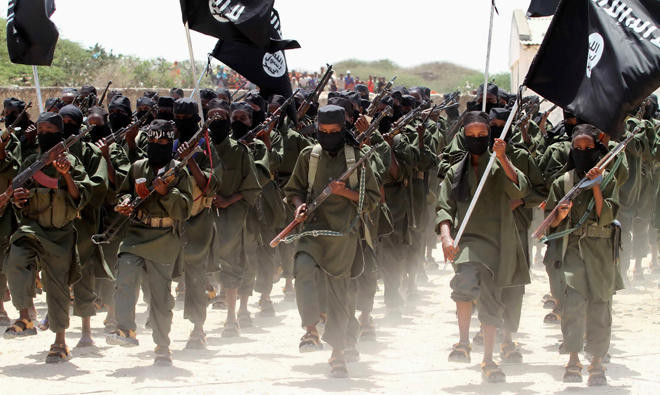
ADDIS ABABA: Drone strikes by the US military are “wiping out” Shabab militants in Somalia, the head of the African Union mission in the country said in an interview.
The US has stepped up its operations in the war-torn Horn of Africa nation, targeting the Al-Qaeda linked Al-Shabab, which has fought for the last decade to topple Somalia’s internationally backed government, and a separate self-proclaimed branch of Daesh.
“These drone attacks and others are wiping out Al-Shabab in good numbers. And that is good to finish with the terrorism,” said Francisco Madeira, the chief of the 22,000-strong African Union Mission in Somalia (AMISOM) on the sidelines of the AU’s summit in the Ethiopian capital.
In recent months, US special forces and the Somali national army have killed scores in air strikes and ground assaults targeting Shabab, including a Christmas Eve strike that left 13 dead.
The surge in activity comes after President Donald Trump last year loosened constraints on the US military in Somalia, allowing commanders to take action against suspected terrorists when they judge it is needed, without seeking specific White House approval.
The US Africa Command has had to defend itself against allegations that its forces have killed civilians, issuing a statement in November that said no civilians died in a raid three months prior despite media reports to the contrary.
Madeira said only that if soldiers were accused of unlawfully killing civilians they would be taken to court. He said that when deaths did occur AMISOM did not have the money to pay reparations to bereaved families.
“We do not have money to pay for this. We have been sharing this with a number of partners, but so far the response has been very, very, very minimal, almost non-existent,” he said.
While AMISOM is scheduled to depart Somalia by December 2020, Madeira said an extension of the force’s mandate was not out of the question.
“The formation of a fully-fledged, functioning... Somali National Army, it might take a bit longer than that. But we can already have some critical mass of forces that can do the work,” he said.
The once 22,000-strong AMISOM force began pulling troops out of Somalia at the end of last year, and Madeira has previously highlighted the need for more support to enable the national army to take over.
Currently, the bloated and largely ineffective Somali army is more a collection of clan militias, with various international militaries providing poorly-coordinated training to different units.
The Al-Shabab lost its foothold in Mogadishu in 2011, but has continued its fight, and was blamed for the country’s worst ever attack in which a truck bombing left over 500 dead in October last year.

US drones ‘wiping out’ Al-Shabab in Somalia: AU mission head
WHO says Dubai global emergency logistics hub ‘resuming operations’
- Hanan Balkhy, WHO’s Eastern Mediterranean regional chief, says more than 50 emergency supply requests across 25 countries are affected by the pause
- The hub stopped work this week after Iran launched waves of missile and drone attacks across the Gulf
GENEVA: The World Health Organization said its global health emergencies logistics hub in Dubai was resuming operations on Friday after a pause caused by the war in the Middle East.
“One of our most immediate concerns is the disruption of humanitarian health supply chains,” Hanan Balkhy, the UN health agency’s Eastern Mediterranean regional chief, told a press conference in Geneva.
“After a temporary pause, WHO’s Hub for Global Health Emergencies Logistics is today resuming operations,” she said, speaking from Cairo.
She said the UAE, in coordination with the UN’s World Food Programme, had confirmed that it stood ready to facilitate urgent humanitarian shipments.
“More than 50 emergency supply requests across 25 countries are currently affected,” said Balkhy.
“These pending requests — which will benefit more than 1.5 million people — include WHO supplies for Lebanon, Gaza, Yemen, and Somalia, as well as polio laboratory supplies for global detection and eradication activities across a number of countries.”
She said the WHO would be working in the coming days to process urgent new shipments and clear priority backlogs.
Balkhy noted that even before the escalation of hostilities in the Middle East, health systems in many countries were already operating at full capacity.
“WHO has pre-positioned trauma supplies and essential medicines at our warehouse in Tehran and is closely monitoring the situation — including potential mass casualty needs, disruptions to essential health services, and possible displacement,” she said.
“One of our most immediate concerns is the disruption of humanitarian health supply chains,” Hanan Balkhy, the UN health agency’s Eastern Mediterranean regional chief, told a press conference in Geneva.
“After a temporary pause, WHO’s Hub for Global Health Emergencies Logistics is today resuming operations,” she said, speaking from Cairo.
She said the UAE, in coordination with the UN’s World Food Programme, had confirmed that it stood ready to facilitate urgent humanitarian shipments.
“More than 50 emergency supply requests across 25 countries are currently affected,” said Balkhy.
“These pending requests — which will benefit more than 1.5 million people — include WHO supplies for Lebanon, Gaza, Yemen, and Somalia, as well as polio laboratory supplies for global detection and eradication activities across a number of countries.”
She said the WHO would be working in the coming days to process urgent new shipments and clear priority backlogs.
Balkhy noted that even before the escalation of hostilities in the Middle East, health systems in many countries were already operating at full capacity.
“WHO has pre-positioned trauma supplies and essential medicines at our warehouse in Tehran and is closely monitoring the situation — including potential mass casualty needs, disruptions to essential health services, and possible displacement,” she said.
© 2026 SAUDI RESEARCH & PUBLISHING COMPANY, All Rights Reserved And subject to Terms of Use Agreement.