Yemeni officials say heavy fighting in Taiz kills 48

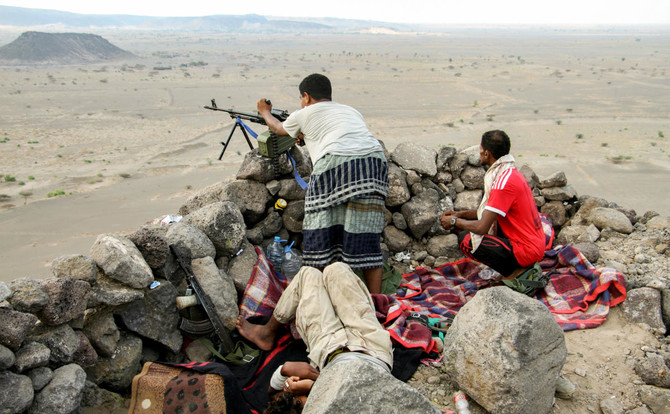
Yemeni fighters loyal to the Yemeni president hold a hill-top position northwest of the central city of Taiz, on April 20, 2017. (AFP)
Updated 26 January 2018
Follow

Yemeni officials say heavy fighting in Taiz kills 48

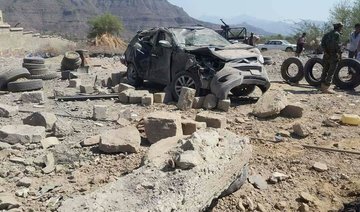
SANAA: Yemeni security officials and witnesses say fighting between Houthi militia and forces loyal to Yemen’s internationally recognized government in the southwestern city of Taiz has killed at least 48 people on both sides.
They said Friday that fighting intensified earlier this week when forces loyal to President Abed Rabbo Mansour Hadi attempted regain full control over the city and expel Houthi militia surrounding it.
They also said that Arab Coalition forces backing Hadi carried out several airstrikes on Houthi-controlled bases. The officials spoke on condition of anonymity because they were not authorized to brief the media, while the witnesses did so for fear of reprisals.
The coalition has been at war with the Iran-backed Houthis since March 2015 to reinstate Hadi’s government.


Iraq PM candidate Al-Maliki meets senior US diplomat

Updated 5 sec ago
Follow

Iraq PM candidate Al-Maliki meets senior US diplomat

  • Last month President Donald Trump intervened in Iraq’s affairs by issuing an ultimatum that if Al-Maliki — a two-time former premier with close ties to Iran — was named Iraq’s next prime minister, the US would no longer help the country

BAGHDAD: The leading candidate to become Iraq’s next prime minister, Nouri Al-Maliki, met with US diplomat Tom Barrack on Friday after refusing to withdraw his nomination despite the US threatening to stop supporting the country if he returns to the post.
Barrack, the US envoy to Syria and ambassador to Turkiye, has recently visited Iraq multiple times to meet with senior officials.
Maliki’s media office said in a short statement that the PM candidate stressed during the meeting “the need to respect Iraq’s sovereignty and the will of its people.”
He also spoke of the “importance of supporting the democratic process and strengthening political stability” in Iraq.
It wasn’t clear what message Barrack conveyed to Maliki.
Last month President Donald Trump intervened in Iraq’s affairs by issuing an ultimatum that if Al-Maliki — a two-time former premier with close ties to Iran — was named Iraq’s next prime minister, the US would no longer help the country.
Trump’s threat left Iraqi leaders at a loss, particularly within the Coordination Framework — a ruling alliance of Shiite groups with varying degrees of links to Iran that nominated Maliki.
Earlier this week, Al-Maliki told AFP he would not withdraw his nomination, while also seeking to allay Washington’s concerns.
“I have absolutely no intention of withdrawing out of respect for my country, its sovereignty, and its will,” Al-Maliki told AFP in an interview.