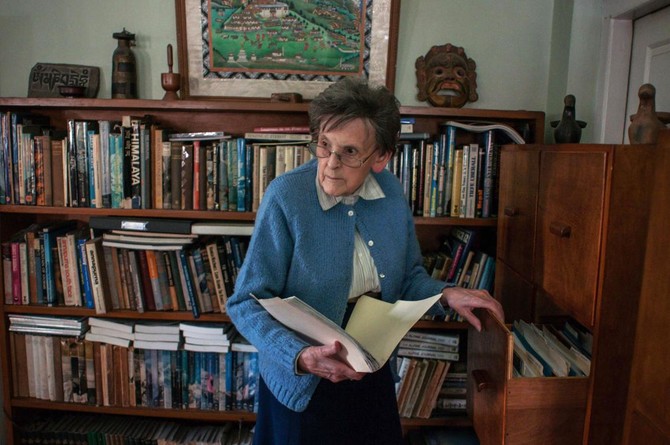
KATMANDU: American journalist Elizabeth Hawley, whose 50 years chronicling summits and tragedies in the Himalayas earned her the moniker “the Sherlock Holmes of the mountaineering world,” died Friday, aged 94.
Hawley built a reputation as one of the most authoritative voices on Himalayan mountaineering after moving to Nepal in 1959 as a journalist, where she continued to live up to her death.
“She had a very peaceful death,” doctor Prativa Pandey, who looked after Hawley at the end of her life, said.
She passed away at a hospital in Nepal’s capital Katmandu in the early hours of Friday, a week after falling ill with a lung infection. She later likely suffered a stroke, Pandey said.
Hawley founded the Himalayan Database, a meticulous archive of all mountaineering expeditions in Nepal that she managed until five years ago.
Known for ferreting out the truth from climbers claiming to set new records, her word on summits in the fabled mountains was considered final, though she never climbed any peaks herself.
Every climbing season Hawley — behind the wheel of her 1965 sky-blue VW Beetle — would drive to mountaineers’ hotels in Katmandu to grill them before and after their expeditions.
“I guess I am quite forceful, I come to the point and if someone thinks they can evade my questions, they can think again,” she said in a 2014 interview.
Billi Bierling, a journalist and climber who took over managing the Himalayan Database in recent years, remembered Hawley as a stickler for accuracy who would keep calling a source until she was satisfied she had the answer.
“The mountaineering world today has lost of its most important pillars. Even though Liz Hawley was never a climber, she never wore crampons, she was interested in the people,” Bierling said.
Tributes for Hawley poured in from mountaineers around the world.
“Katmandu will be a lesser place without her and her original VW beetle,” wrote 12-time Everest summiteer Kenton Cool on Twitter, describing her as the “Oracle of Himalayan climbing.”
Elizabeth Ann Hawley was born on November 9, 1923 to a Chicago-based chartered accountant and a suffragist.
She attended university in Michigan and promptly moved to Manhattan after graduation in 1946, landing a job as a researcher with Fortune magazine.
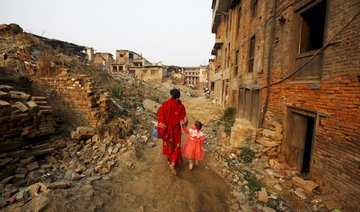
The job bored her and she took off to see the world in 1957, finally ending up in Nepal in February 1959, then a Hindu kingdom which had only recently opened its gates to foreign visitors.
Hawley eventually became a correspondent for the Reuters news agency in Nepal and landed her first major scoop during the 1963 US expedition to Everest.
The American military attaché offered her access to secret radio communication between Everest base camp and the embassy, enabling her to be the first to file when they reached the summit.
In 2014, Nepal named a 6,182-meter mountain in her honor: Peak Hawley in the country’s northwest.
“I retire when I die. It might be the same thing,” Hawley said in her book “The Nepal Scene,” a collection of monthly dispatches she wrote until 2007.

‘Sherlock Holmes’ of Nepal’s Himalayas dies at 94
Judge declares 4 men wrongly accused of 1991 Austin yogurt shop murders innocent
- The declaration was aimed at closing a dark chapter for the men and their families
- Investigators chased thousands of leads and several false confessions before the four men were arrested in late 1999
TEXAS, USA: A Texas judge on Thursday declared four men who were wrongfully accused of the 1991 Austin yogurt shop murders innocent, formally clearing their names in a courtroom for the first time since the killings of four teenage girls that haunted the city for decades.
“You are innocent,” state District Judge Dayna Blazey said during a hearing in a packed Austin courtroom.
The declaration was aimed at closing a dark chapter for the men and their families, and for a city that was shaken by the brutality of the crime and investigators’ inability to solve it for decades. Blazey called her order “an obligation to the rule of law and the obligation to the dignity of the individual.”
Cold case detectives announced last year that they had connected the killings to a suspect who died in a 1999 standoff with police in Missouri.
Two of the original four suspects, Michael Scott and Forrest Welborn, were in the packed courtroom with family members to hear prosecutors tell the judge that they are innocent. Robert Springsteen, who was initially convicted and spent several years on death row, did not attend. Maurice Pierce died in 2010.
“Over 25 years ago, the state prosecuted four innocent men ... (for) one of the worst crimes Austin has ever seen,” Travis County First Assistant District Attorney Trudy Strassburger said at the opening of the hearing. “We could not have been more wrong.”
A declaration of “actual innocence” would also be a key step for the men and their families to seek financial compensation for years they spent in jail or in prison.
“All four lived under the specter of the yogurt shop murders. These four never had the chance to live normal lives,” Strassburger said.
The murders shocked Austin and confounded investigators for years
Amy Ayers, 13; Eliza Thomas, 17; and sisters Jennifer and Sarah Harbison, ages 17 and 15, were bound, gagged and shot in the head at the “I Can’t Believe It’s Yogurt” store where two of them worked. The building was set on fire.
Investigators chased thousands of leads and several false confessions before the four men were arrested in late 1999.
Springsteen and Scott were convicted based largely on confessions they insisted were coerced by police. Both convictions were overturned in the mid-2000s.
Welborn was charged but never tried after two grand juries refused to indict him. Pierce spent three years in jail before the charges were dismissed and he was released.
Prosecutors wanted to try Springsteen and Scott again, but a judge ordered the charges dismissed in 2009 when new DNA tests that were unavailable in 1991 had revealed another male suspect.
“Let us not forgot that Robert Springsteen could be dead right now, executed at the hands of the state of Texas,” Springsteen attorney Amber Farrelly said at the hearing.
Connection to a new suspect revealed
The case effectively went cold until 2025. It got new public attention when an HBO documentary series explored the unsolved crime.
Investigators announced in September that new evidence and reviews of old evidence pointed to Robert Eugene Brashers as the killer.
Since 2018, authorities had used advanced DNA evidence to link Brashers to the strangulation death of a South Carolina woman in 1990, the 1997 rape of a 14-year-old girl in Tennessee and the shooting of a mother and daughter in Missouri in 1998.
The link to the Austin case came when a DNA sample taken from under Ayers’ fingernail came back as a match to Brashers from the 1990 murder in South Carolina.
Austin investigators also found that Brashers had been arrested at a border checkpoint near El Paso two days after the yogurt shop killings. In his stolen car was a pistol that matched the same caliber used to kill one of the girls in Austin.
Police also noted similarities in the yogurt shop case to Brashers’ other crimes: The victims were tied up with their own clothing, sexually assaulted and some crime scenes were set on fire.
Brashers died in 1999 when he shot himself during an hourslong standoff with police at a motel in Kennett, Missouri.