Oil hits $71 for first time since 2014 on tighter supply and weak dollar

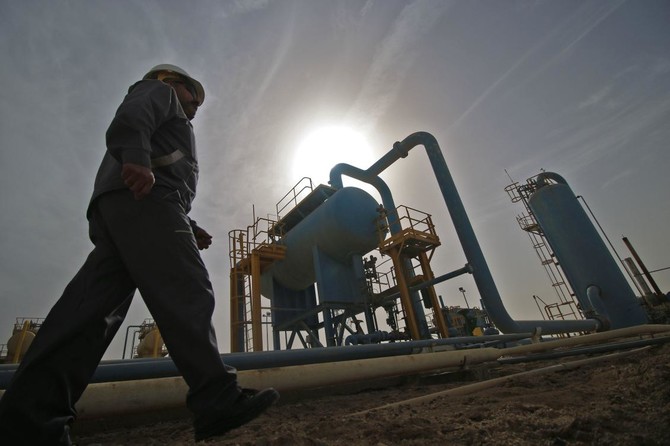
An Iraqi oil technician walks past a gas extraction installation at the Nahr Bin Omar natural gas field, north of the southern Iraqi port of Basra on January 22, 2018. (AFP)
Updated 25 January 2018
Follow

Oil hits $71 for first time since 2014 on tighter supply and weak dollar

LONDON: Oil hit $71 a barrel on Thursday for the first time since 2014, supported by OPEC-led supply curbs, a record-breaking run of declines in US crude inventories and a weaker US dollar.
The Organization of the Petroleum Exporting Countries and its allies including Russia began reining in supplies in January 2017. An involuntary drop in Venezuela’s output in recent months has deepened the impact of those cuts.
Brent crude, the international oil benchmark, hit $71.20 a barrel, the highest since early December 2014. At 1320 GMT, Brent eased to $71.00 but still up 47 cents.
US crude climbed to $66.44, also the highest since early December 2014, before dipping to $66.35, up 74 cents.
“The continuous fall in US oil inventories and the prolonged weakness in the US dollar have done the trick,” said Tamas Varga of broker PVM, referring to oil hitting a new high.
Brent had traded above $110 a barrel in mid-2014 but in December 2014 it tumbled below $60 as the fall accelerated after OPEC’s landmark decision in November of that year to end output restraint.
Prices had crashed to almost $27 by early 2016, prompting OPEC to change tack and forge a deal with Russia and others to curb output. Cuts began at the start of 2017 and will run to the end of 2018.
In a further sign the glut is clearing, US crude inventories fell for a record 10th straight week to the lowest since February 2015, official figures showed on Wednesday.
Also supporting oil, the US dollar hit its lowest since December 2014 against a basket of other currencies. US Treasury Secretary Steven Mnuchin said on Wednesday a weaker dollar was “good for us.”
A weaker dollar makes dollar-denominated commodities cheaper for holders of other currencies and tends to support oil prices.
“The depreciation of the US dollar is also allowing oil prices to make further gains,” said Carsten Fritsch, analyst at Commerzbank. “Almost every commodity class is being driven up by this extended dollar fall.”
However, rising US shale oil output has cast a shadow over the oil rally, as higher prices encourage more investment in expanding supplies.
US crude oil production is expected to surpass 10 million barrels per day (bpd) in February, on the way to a record ahead of previous forecasts, according to the US Energy Information Administration.


Closing Bell: Saudi stocks slip as Tadawul falls 1% amid broad market weakness

Updated 30 December 2025
Follow

Closing Bell: Saudi stocks slip as Tadawul falls 1% amid broad market weakness

RIYADH: Saudi stocks fell sharply on Tuesday, with the Tadawul All Share Index closing down 108.14 points, or 1.03 percent, at 10,381.51.

The broader decline was reflected across major indices. The MSCI Tadawul 30 Index slipped 0.78 percent to 1,378.00, while Nomu, the parallel market index, fell 1 percent to 23,040.79.

Market breadth was strongly negative on the main board, with 237 stocks falling compared to just 24 gainers. Trading activity remained robust, with 164.7 million shares changing hands and a total traded value of SR3.19 billion ($850.6 million).

Among the gainers, SEDCO Capital REIT Fund led, rising 2.73 percent to SR6.77, followed by Chubb Arabia Cooperative Insurance Co., which gained 2.69 percent to SR20.20.

National Medical Care Co. added 1.72 percent to close at SR141.60, while Alyamamah Steel Industries Co. and Thimar Advertising, Public Relations and Marketing Co. advanced 1.57 percent and 1.13 percent, respectively.

Losses were led by Al Masar Al Shamil Education Co., which tumbled 8.36 percent to SR24.65. Raoom Trading Co.fell 6.75 percent to SR64.20, while Alkhaleej Training and Education Co. dropped 6.60 percent to SR18.12 and Naqi Water Co. declined 5.51 percent to SR54.00. Gulf General Cooperative Insurance Co. closed 5.44 percent lower at SR3.65.

On the announcement front, Chubb Arabia Cooperative Insurance Co. signed a multiyear insurance agreement with Saudi Electricity Co. to provide various coverages, expected to positively impact its financial results over the 2025–2026 period. The deal will run for three years and two months and is within the company’s normal course of business.

Meanwhile, Bupa Arabia for Cooperative Insurance Co. announced a one-year health insurance contract with Saudi National Bank, valued at SR330.2 million, covering the bank’s employees and their families from January 2026. Despite the sizable contract, Bupa Arabia shares fell 0.8 percent to close at SR137, weighed down by the broader market weakness.

In contrast, United Cooperative Assurance Co. revealed an extension of its engineering insurance agreement with Saudi Binladin Group for the Grand Mosque expansion in Makkah. The contract value exceeds 20 percent of the company’s gross written premiums based on its latest audited financials and is expected to support results through 2026. However, the stock came under selling pressure, ending the session down 4.51 percent at SR3.39.