Trump’s Jerusalem move boosts Palestinian support for ‘armed struggle’: Poll

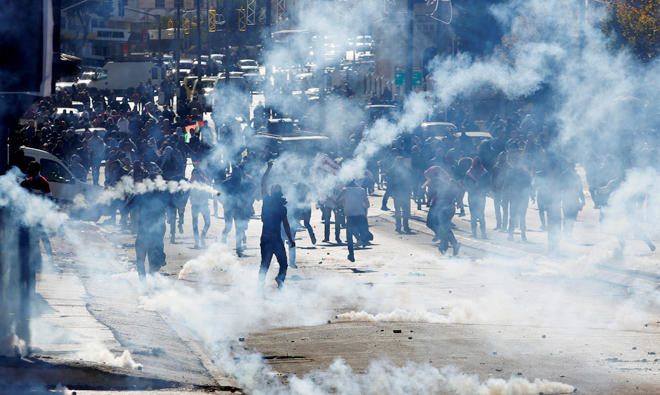
FILE PHOTO: Palestinian demonstrators react to tear gas fired by Israeli troops during clashes at a protest against U.S. President Donald Trump's decision to recognize Jerusalem as the capital of Israel, in the West Bank city of Bethlehem December 9, 2017. REUTERS/Mussa Qawasma/File Photo
Updated 25 January 2018
Follow

Trump’s Jerusalem move boosts Palestinian support for ‘armed struggle’: Poll

JERUSALEM: US President Donald Trump’s controversial recognition of Jerusalem as Israel’s capital led to a spike in Palestinian support for “armed struggle,” a poll suggested Thursday.
Nearly twice as many Palestinians said they supported “armed struggle” against Israel compared with an identical survey six months previously, while there was also a fall in support for the two-state solution, the joint Israeli and Palestinian poll found.
The poll of 1,270 Palestinians across east Jerusalem, the West Bank and Gaza was conducted in the days after Trump’s December 6 declaration that he would move the US embassy from Tel Aviv to Jerusalem and recognize the city as Israel’s capital.
Palestinians see at least the east of the city as the capital of their future state, and the announcement set off street protests and diplomatic fury.
Given four options for their preference for the next step for Palestinian-Israeli relations, 38.4 percent of Palestinians favored waging an armed struggle, the most popular single answer and compared with only 26.2 percent who called for reaching a peace agreement.
The same poll in June found 21 percent support for armed struggle, while 45 percent backed a peace agreement.
Khalil Shikaki, from the Palestinian Center for Policy and Survey Research and one of the report’s authors, said there had also been significant declines in Palestinian support for a peace process and compromise as well as in the popularity of Palestinian President Mahmoud Abbas.
“There is absolutely no doubt that the Trump statement was the fundamental cause.”
Dahlia Scheindlin from the Tami Steinmetz Center at Tel Aviv University, another report author, said that she expected the support for militancy could fall in the coming months if tension subsides.


Iran unrest persists, top judge warns protesters

Updated 08 January 2026
Follow

Iran unrest persists, top judge warns protesters

  • Demonstrations sparked by soaring inflation
  • Western provinces worst affected

DUBAI: Iran’s top judge warned protesters on Wednesday there would be “no ​leniency for those who help the enemy against the Islamic Republic,” while accusing Israel and the US of pursuing hybrid methods to disrupt the country.
The current protests, the biggest wave of dissent in three years, began last month in Tehran’s Grand Bazaar by shopkeepers condemning the currency’s free fall. 
Unrest has since spread nationwide amid deepening distress over economic hardships, including rocketing inflation driven by mismanagement and Western sanctions, and curbs on political and ‌social freedoms.
“Following announcements ‌by Israel and the US president, there is no excuse for those coming ‌to the ​streets for ‌riots and unrest, chief justice Gholamhossein Mohseni Ejei, the head of Iran’s judiciary, was quoted as saying by state media.
“From now on, there will be no leniency for whoever helps the enemy against the Islamic Republic and the calm of the people,” Ejei said.
Iranian authorities have not given ‌a death toll for protesters, but have said at least two members of the security services have died and more than a dozen have been injured.
Iran’s western provinces have witnessed the most violent protests.
“During the funeral of two people ​in Malekshahi on Tuesday, a number of attendees began chanting harsh, anti-system slogans,” said Iran’s Fars, news agency.
After the funeral, Fars said, “about 100 mourners went into the city and trashed three banks ... Some started shooting at the police trying to disperse them.”
The semi-official Mehr news agency said protesters stormed a food store and emptied bags of rice, which has been affected by galloping inflation that has made ordinary staples increasingly unaffordable for many Iranians.