Surat, INDIA: A plan to bring migrant workers off the pavements and into apartments in Bhuj could be a blueprint for other Indian cities in the country struggling to accommodate tens of thousands who arrive daily in search of jobs.
Most travel from their villages to find work for months at a time in the booming construction industry, which is India’s largest employer after agriculture.
They build the gleaming office towers, malls and luxury apartments that are rising in the country’s bustling cities.
The workers themselves live on pavements and under flyovers, or rent squalid rooms, often with their families. Others cram into slums, or erect flimsy shelters from tarpaulin and plywood on work sites.
Despite Prime Minister Narendra Modi’s pledge to provide housing for all by 2022, private developers have shied away from building low-cost rental homes that could house migrants.
Now, the city of Bhuj in western Gujarat state has tapped into a federally-funded program to construct affordable housing. It could be a potential model for other cities across the country, experts say.
Some migrant workers in Bhuj may be able to move into about 600 low-rise homes as early as next year. The development will include amenities like kitchens and play areas for children.
“Anyone who comes to the city looking for work deserves a decent place to live,” said Mahavir Acharya of the Hunnarshala Foundation, which is designing the housing project.
“But because they are migrants from another city or state, no one wants to take responsibility for their well-being.”
Most of the tens of millions of construction workers in the country are informal. They are mainly migrants from different states, and receive few benefits from employers or the government in the states they end up working in.
Many of them are among an estimated 1.8 million people who remain homeless in India, despite laws aimed at providing them with shelter.
Authorities find it especially easy to ignore people who arrive in their cities for short-term work, because they are “both unorganized labor and migrants,” said Renu Desai of the Center for Urban Equity, at CEPT University in Ahmedabad.
“Seasonal migrant workers contribute significantly to the economy, yet they are not recognized as citizens in the city, and live in dismal conditions,” she said.
India’s Supreme Court in 2010 ordered dozens of cities to provide homeless shelters capable of housing 100 people, with facilities including beds and lockers.
But few states complied.
Three years later, the federal government’s National Urban Livelihoods Mission (NULM) introduced a scheme to improve shelters for the urban homeless, with better locations and facilities to ensure links to health care, education and skills upgrades.
Officials in Surat, a hub for textiles and diamonds, are building five new shelters with NULM funding. They will have dormitory rooms and single rooms for more than 1,300 homeless people, including migrant workers.
Authorities are also considering making some rooms available for short-term rental, said Rajesh Jariwala at the Surat Municipal Corporation’s housing department.
That would mean migrant workers would not be forced to leave the premises every day.
“Our economy is dependent on migrants, but they may not wish to settle here. So we have to give them the option of affordable rental housing,” he told the Thomson Reuters Foundation.
Other options — including a nationwide housing subsidy scheme for construction workers to buy a house in a government-built low-income housing project — have not been effective because of strict conditions and long wait times.
A separate federal program funds pre-fabricated units at construction sites for public projects such as metro systems.
But the one-room units are too small for a family for four, said Desai, who has studied housing for migrant construction workers in Gujarat state, where Bhuj is located.
Few builders provide accommodation, and workers seldom complain because they are not aware of their rights, or because they are afraid to speak up, she said.
With more than 76 million workers expected to be in the construction and real estate industry by 2022, “a more humane approach” toward migrant workers is needed, said Anuj Puri, chairman of ANAROCK Property Consultants in Mumbai.
More than $3 billion collected as a federal tax on construction remains unused, and the money could be used for providing rental accommodation and other services to migrant workers in the industry, he said.
For the time being, however, Bhuj is one of the few cities building low-cost rental homes specifically for migrant workers.
It’s a plan that other cities should consider too, said Desai of CEPT University, because it fills a void in a market that ignores short-term rentals.
“Our focus is on ownership at one end and shelters at the other — there is nothing in between. But shelters cannot be the fix for homelessness or for migrant workers,” she said.
“What we need is an inclusive urbanization.”


Booming Indian cities get creative to house migrant workers
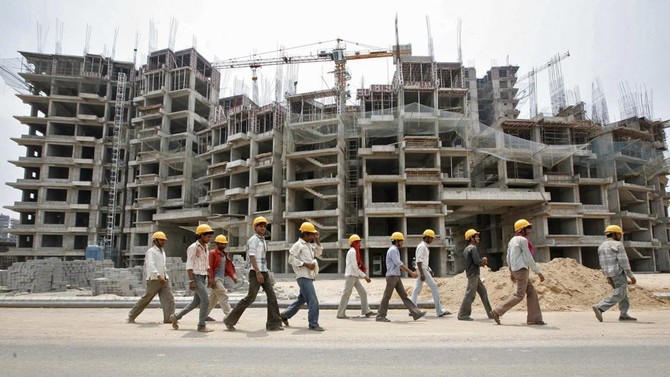
Booming Indian cities get creative to house migrant workers




Closing Bell: Saudi main index climbs to 10,485
RIYADH: Saudi Arabia’s Tadawul All Share Index edged up on Sunday, gaining 34.32 points, or 0.33 percent, to close at 10,484.59.
The total trading turnover of the benchmark index stood at SR2.59 billion ($690 million), with 168 listed stocks advancing and 87 declining.
The Kingdom’s parallel market Nomu also gained 100.37 points to close at 23,454.65.
The MSCI Tadawul Index advanced by 0.13 points to 1,377.44.
The best-performing stock on the main market was Nama Chemicals Co., whose share price increased by 9.98 percent to SR22.38.
The share price of Al Masar Al Shamil Education Co. rose by 9.15 percent to SR23.85.
Saudi Paper Manufacturing Co. also saw its stock price climb by 8.42 percent to SR57.95.
Conversely, the share price of Canadian Medical Center Co. dropped by 6.37 percent to SR6.03.
The stock price of Kingdom Holding Co. also declined by 3.16 percent to SR8.28.
In the parallel market, Alfakhera for Mens Tailoring Co. was the top performer, with its share price advancing by 16.40 percent to SR8.80.
On the announcements front, Theeb Rent a Car Co. said it had signed a long-term vehicle leasing services contract valued at SR110.4 million with Hungerstation Co.
Under the deal, Theeb will lease 2,000 vehicles to HungerStation for a period of four years starting from 2026, according to a Tadawul statement.
The statement added that the vehicles will be delivered in batches within the first six months from the contract start date, taking into consideration global logistical circumstances and procedures beyond the control of both the agents and the company.
The contract is expected to have a positive impact on the company’s financials from the first quarter of 2026.
The share price of Theeb Rent a Car Co. declined by 0.79 percent to SR37.80.