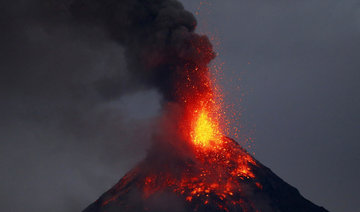
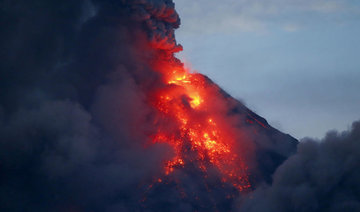
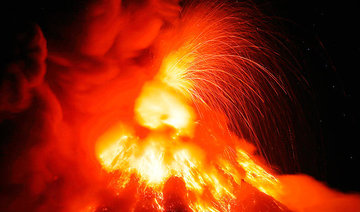
LEGAZPI: An erupting Philippine volcano belched red-hot lava and clouds of ash and debris at least four times Wednesday, prompting the number of displaced villagers to swell to more than 74,000 and causing officials to brace for a humanitarian emergency they fear could last for months.
Mount Mayon has been acting up for more than a week, ejecting ash and lava fountains up to 3 kilometers (1.8 miles) from the crater in a picturesque but increasingly dangerous eruption. There have been no reports of injuries and law enforcers have struggled to keep villagers and tourists from sneaking into danger zones.
Pyroclastic flows — superheated gas and volcanic debris that could incinerate anything in their path — reached 5 kilometers (3 miles) from the crater in one area, the Philippine Institute of Volcanology and Seismology said.
“It’s a logistical nightmare,” Office of Civil Defense regional director Claudio Yucot said of the government’s effort to look after the still-swelling number of evacuees in at least 66 emergency shelters in nine cities and towns in northeastern Albay province, where Mayon lies.
Based on its previous eruptions, Mayon’s restiveness could last from two to four months, prompting Albay and national authorities to take steps to ease the impact on schools, public health and safety, livelihood and law and order, officials said.
Temporary learning centers will be set up in dozens of schools turned into evacuation centers to allow classes to continue, and farm animals will be brought to areas closer to their owners in evacuation camps to prevent more losses to villagers’ livelihoods, Yucot said.
One town in Albay, Camalig, has already set up an area for rescued farm animals, he said.
Authorities have struggled to prevent villagers from sneaking back to check on their homes and farms, with one official recommending that electricity and water supplies be cut in communities within the no-entry danger zones around Mayon to discourage residents from returning.
Although Mayon has erupted about 50 times in the last 500 years, sometimes violently, it has remained popular among climbers and tourists.
In 2013, an ash eruption killed five climbers who had ventured near the summit despite warnings. Its most destructive eruption, in 1814, killed more than 1,200 people and buried the town of Cagsawa in volcanic mud. The belfry of Cagsawa’s stone church still juts from the ground in an eerie reminder of Mayon’s fury.
Scottish tourist Rachel Rae and her son traveled from their home outside Manila to Albay, lured by the dramatic images of Mayon’s eruption that appeared in the news.
“This is a great opportunity to come and see something that we have never seen before, probably may not have a chance again to do,” Rae said in Cagsawa, where she and her son watched Mayon from a distance.
The Philippines, which has about 22 active volcanoes, lies in the “Ring of Fire,” a line of seismic faults surrounding the Pacific Ocean where earthquakes and volcanic activity are common.
In 1991, Mount Pinatubo in the northern Philippines exploded in one of the biggest volcanic eruptions of the 20th century, killing hundreds of people, covering entire towns and cities in ash and prompting the US government to abandon its vast air and naval bases on the main northern Luzon island.


![]()

Philippines braces for long emergency as volcano erupts
Philippines braces for long emergency as volcano erupts
Latest updates


© 2026 SAUDI RESEARCH & PUBLISHING COMPANY, All Rights Reserved And subject to Terms of Use Agreement.