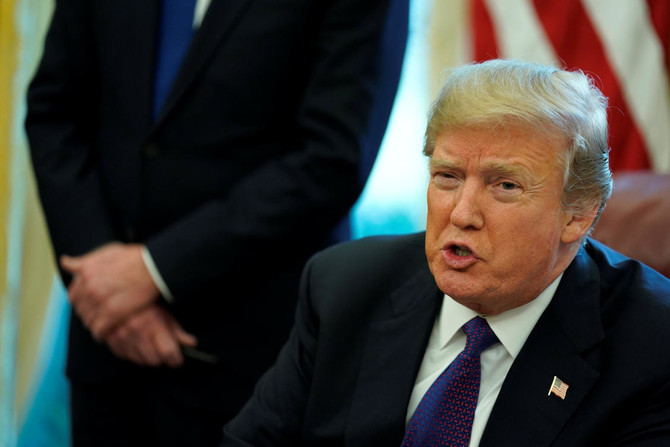
LONDON: The US President Donald Trump will raise the need to address Iran’s mounting influence in the Middle East at the World Economic Forum in Davos, Switzerland this week.
White House officials confirmed that Trump will meet with world leaders, including Israeli Prime Minister Benjamin Netanyahu and British Prime Minister Theresa May when he arrives at the forum on Thursday.
He is also due to deliver a key note speech on Friday before flying back to the US later in the day.
During his meeting with Netanyahu, Trump will “reiterate America’s strong commitment to Israel and efforts to reduce Iran’s influence in the Middle East and ways to achieve lasting peace,” White House national security adviser H.R. McMaster said.
Trump has been outspoken in his criticism of the Iranian regime, tweeting his support for protesters during demonstrations taking place across Iran in December and January.
On Dec 31 he tweeted: “Big protests in Iran. The people are finally getting wise as to how their money and wealth is being stolen and squandered on terrorism. Looks like they will not take it any longer. The USA is watching very closely for human rights violations!”
He is also determined to overturn the Iran nuclear deal and will raise the issue with Theresa May during their meeting at the forum.
Trump believes the nuclear deal, which was the signature foreign policy of the Obama administration, was too lenient and has called for new sanctions to be imposed on Iran.
On Jan 1, the president tweeted: “Iran is failing at every level despite the terrible deal made with them by the Obama Administration. The great Iranian people have been repressed for many years. They are hungry for food & for freedom. Along with human rights, the wealth of Iran is being looted. TIME FOR CHANGE!”
After flying in overnight on Wednesday, Trump will conclude a busy day of meetings by hosting a dinner for European executives on Thursday night.
“The attendees run companies that have sizeable footprints in the United States. They have invested in our economy, we want them to continue to do so and encourage others to join them,” said White House senior economic adviser Gary Cohn.
Part of his focus at the forum, which runs from Jan 23 to 26, will be to promote investment opportunities in the US and encourage global companies to take advantage of the corporate tax cuts he has implemented since taking office a year ago.

Trump to highlight Iranian influence at Davos
Trump Maritime Action Plan eyes levies on China goods to resurrect US shipbuilding
- Maritime prosperity zones proposed to boost investment and workforce training
- Maritime Security Trust Fund to finance shipyard revitalization
WASHINGTON: The Trump administration on Friday released its plan to rebuild US shipbuilding and other maritime businesses, paid for in part by port fees on cargo delivered to the United States on ships made in China — levies the US and China agreed to pause for one year.
The Maritime Action Plan offers a road map for the revival of US shipbuilding, which has shrunk since World War Two and now severely lags China and other nations.
Coming in at more than 30 pages, the plan calls for establishing maritime prosperity zones to bolster investment, reforming workforce training and education, expanding the fleet of US-built and US-flagged commercial ships, establishing a dedicated funding stream through a Maritime Security Trust Fund and reducing regulations.
The Trump administration early last year announced plans to levy fees on China-linked ships to loosen the country’s grip on the global maritime industry and help pay for a US shipbuilding renaissance. The so-called Section 301 penalties followed a US probe that concluded China uses unfair policies and practices to dominate global shipping.
The fees, which sparked intense pushback from the global shipping industry and intensified tensions between the world’s two largest economies, hit on October 14 and were expected to generate an estimated $3.2 billion annually from Chinese-built vessels sailing to US ports.
But China retaliated with its own port fees on US-linked ships and the tit-for-tat fees disrupted global shipping. Soon after, the two sides struck a deal to put the levies on hold for 12 months.
On Friday, Shipyard owners, investors and the bipartisan sponsors of the Shipbuilding and Harbor Infrastructure for Prosperity and Security (SHIPS) for America Act welcomed President Donald Trump’s maritime plan, which landed months later than hoped.
US Senator Todd Young, a Republican from Indiana, said there is substantial overlap between Trump’s vision and the plan in that proposed law, which he reintroduced last year with Democratic Senator Mark Kelly of Arizona and other lawmakers.
Importantly, the SHIPS Act would establish a Maritime Security Trust Fund to reinvest port fee proceeds into maritime security and infrastructure projects such as shipyard revitalization. It has rare backing from both Democratic and Republican lawmakers in Washington, but has not made swift progress.
“The announcement today should serve as a wake-up call for Congress to act quickly on this bill in order to provide the legal authorities and resources necessary to make this plan a reality,” Young said. “It’s time to make American ships again.”
The Maritime Action Plan offers a road map for the revival of US shipbuilding, which has shrunk since World War Two and now severely lags China and other nations.
Coming in at more than 30 pages, the plan calls for establishing maritime prosperity zones to bolster investment, reforming workforce training and education, expanding the fleet of US-built and US-flagged commercial ships, establishing a dedicated funding stream through a Maritime Security Trust Fund and reducing regulations.
The Trump administration early last year announced plans to levy fees on China-linked ships to loosen the country’s grip on the global maritime industry and help pay for a US shipbuilding renaissance. The so-called Section 301 penalties followed a US probe that concluded China uses unfair policies and practices to dominate global shipping.
The fees, which sparked intense pushback from the global shipping industry and intensified tensions between the world’s two largest economies, hit on October 14 and were expected to generate an estimated $3.2 billion annually from Chinese-built vessels sailing to US ports.
But China retaliated with its own port fees on US-linked ships and the tit-for-tat fees disrupted global shipping. Soon after, the two sides struck a deal to put the levies on hold for 12 months.
On Friday, Shipyard owners, investors and the bipartisan sponsors of the Shipbuilding and Harbor Infrastructure for Prosperity and Security (SHIPS) for America Act welcomed President Donald Trump’s maritime plan, which landed months later than hoped.
US Senator Todd Young, a Republican from Indiana, said there is substantial overlap between Trump’s vision and the plan in that proposed law, which he reintroduced last year with Democratic Senator Mark Kelly of Arizona and other lawmakers.
Importantly, the SHIPS Act would establish a Maritime Security Trust Fund to reinvest port fee proceeds into maritime security and infrastructure projects such as shipyard revitalization. It has rare backing from both Democratic and Republican lawmakers in Washington, but has not made swift progress.
“The announcement today should serve as a wake-up call for Congress to act quickly on this bill in order to provide the legal authorities and resources necessary to make this plan a reality,” Young said. “It’s time to make American ships again.”
© 2026 SAUDI RESEARCH & PUBLISHING COMPANY, All Rights Reserved And subject to Terms of Use Agreement.