BRUSSELS: Facebook will make it easier for its more than 2 billion users to manage their own data in response to a tough new European Union law that comes into force in May, the social network’s Chief Operating Officer Sheryl Sandberg said.
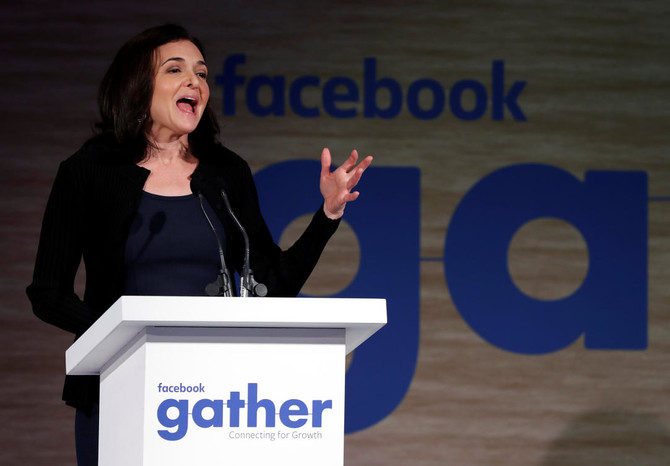
“We’re rolling out a new privacy center globally that will put the core privacy settings for Facebook in one place and make it much easier for people to manage their data,” Sandberg said at a Facebook event in Brussels on Tuesday.
The General Data Protection Regulation (GDPR) is the biggest overhaul of personal data privacy rules since the birth of the Internet and aims to give Europeans more control over their information and how companies use it.
Companies found to be in breach of the law face a maximum penalty of 4 percent of global annual turnover or 20 million euros ($24.50 million), whichever is greater.
“Our apps have long been focused on giving people transparency and control and this gives us a very good foundation to meet all the requirements of the GDPR and to spur us on to continue investing in products and in educational tools to protect privacy,” Sandberg said.
Industries collecting large amount of customer data — from technology companies to insurers and banks — will be affected.
Facebook’s use of customer data and tracking of people’s online activities has already come under investigation from several EU data protection authorities.
CLICK TO MAKE MONEY
Sandberg said Facebook had not done enough to stop the abuse of its platform and would double the number of people working on safety and security to 20,000 by the end of the year.
The EU has put Internet companies on notice that it will legislate if they do not do a better job self-policing their services for extremist propaganda, hate speech and other abuses.
Facebook — which has been criticized for failing to stop Russian-based operatives using its platform to meddle in the 2016 US presidential elections — is focusing on disrupting the economic incentives to spread fake news, Sandberg said.
Moscow denies any interference in the US election.
“People write these headlines to get clicks to make money,” she said. “So if we can prevent people from being part of our ad networks, prevent people from advertising and take away the financial incentive, that is one of the strongest things we can do against false news, and we are very focused on this.”


Facebook to hand privacy controls to users ahead of EU law
Facebook to hand privacy controls to users ahead of EU law



Saudi Arabia strengthens global ranking in 2026 Soft Power Index
- UAE maintains 10th place, Qatar climbs 2 spots
DUBAI: Saudi Arabia climbed three positions to 17th place in this year’s Soft Power Index, released on Tuesday by marketing consultancy Brand Finance.
Other Gulf nations also performed well, with the UAE maintaining its 10th-place ranking and Qatar and Bahrain each climbing two spots to No. 20 and No. 49, respectively, marking a rebound for the region after a softer showing in 2025.
The report indicates that the performance reflects sustained investment in proactive diplomacy, economic diversification and expanded initiatives across culture, tourism and sports.
It also comes at a time when several Western powers are recording declines in their rankings, highlighting the growing influence of Gulf states.
“The UAE remains a clear regional leader, while Saudi Arabia and Qatar have strengthened their global positions through focused economic diplomacy and international engagement,” said Savio D’Souza, managing director for the Middle East and Africa, Brand Finance.
Saudi Arabia and the UAE either maintained or improved their rankings across all key pillars, including familiarity, reputation and influence.
The Kingdom recorded notable gains, with increases of 25 points in the People & Values pillar and 12 points in the Culture & Heritage pillar.
“Although perceptions across some markets remain mixed, renewed upward movement in the rankings suggests that targeted, long-term soft power strategies are beginning to pay off,” D’Souza said.
Globally, the US retained its top position despite recording the steepest overall decline in its score, followed by China in second place. Japan rose to third place, overtaking the UK, which ranked fourth, while Germany placed fifth.
Brand Finance defines “soft power” as a “nation’s ability to influence the preferences and behaviors of various actors in the international arena (states, corporations, communities, publics, etc.) through attraction and persuasion rather than coercion.”
Each nation is assessed across 55 individual metrics, producing an overall score out of 100 and a ranking from first to 193rd.


