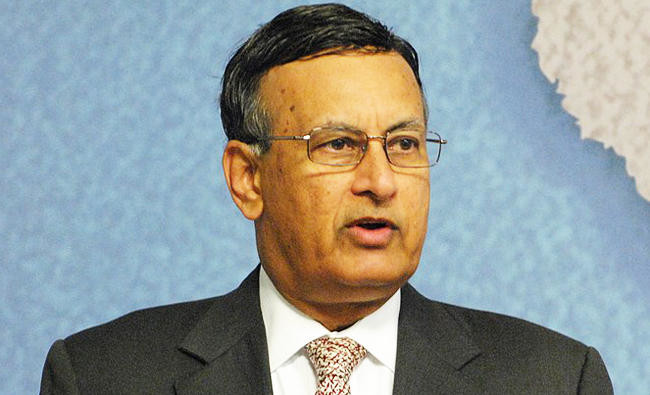
ISLAMABAD: Pakistani diplomat Husain Haqqani, the country’s former ambassador to the US, has dismissed charges of criminal conspiracy brought against him by police last week as “a gimmick.”
“(They are) just a media gimmick and I intend to ignore them as such. No one in the rest of the world will treat them as legitimate either,” Haqqani told Arab News.
Police in Khyber Pakhtunkhwa (KP) province have registered a case against Haqqani, accusing him of criminal conspiracy and “waging a war against Pakistan.”
The First Information Report (FIR) lodged in KP’s Kohat district maintained that Haqqani, who was Pakistan’s ambassador to the US between 2008 and 2011, should be prosecuted for tarnishing the image of Pakistan, since he had written books critical of his country.
The FIR also claims that Haqqani was “responsible for granting visas to CIA agents,” that he “maintained a secret relationship with India,” and that he “indulged in negative propaganda against Pakistan at various international forums.”
If found guilty of the charges mentioned in Sections 120-B and 121-A of the FIR, Haqqani could face life imprisonment, or even the death sentence.
The complainant, Shams ul-Haq, also alleges that Haqqani’s books — “Pakistan: Between Mosque and Military” and “Magnificent Delusions: Pakistan, the United States, and an Epic History of Misunderstanding” — were written with malicious intent.
Referring to the 2011 political crisis in which Haqqani was accused of seeking help from the US to rein in his country’s military and intelligence agencies, Shams ul-Haq said that the diplomat had jeopardized the country’s interests as “the creator of the Memogate scandal.”
Just days after US Navy Seals killed Osama bin Laden in Pakistan, Haqqani is alleged to have written a memo to a US admiral asking for America’s help to avert a military takeover of Pakistan’s then-civilian government. Haqqani has been living in the US since January 2012, when the Supreme Court allowed him to leave the country, although he is still wanted in connection with the 2011 case. He has claimed that all charges against him were fabricated.
In a written response to Arab News, Haqqani similarly played down the charges filed against him last week.
“Pakistan has serious problems and those who do not like my research and solutions should publish theirs,” he continued. “A constant hyper-patriotic media circus at home will not change the impact of my ideas all over the world.”
Asif Ezidi, a former Pakistani diplomat, told Arab News that Haqqani should not have written books criticizing Pakistan.
“The content of Haqqani’s books shows that his loyalty to Pakistan is doubtful,” Ezidi said. “He is a cunning man who is trying to increase his worth by writing controversial books and articles against Pakistan.”
Ezidi suggested the government should extradite Haqqani from the US and prosecute him for “crimes against the state,” under Pakistan’s laws.
Retired General Talat Masood, however, believes the emphasis the Pakistani authorities have placed on Haqqani’s books and other alleged crimes is disproportionate to the diplomat’s actual influence.
“I don’t know why our authorities are giving so much importance to Husain Haqqani, especially at a time when relations between Pakistan and the US are passing through a difficult time,” he said.
“We have not learned any lessons from the past. Every policy that we have made in the past has come back to haunt us, but we are not ready to mend our ways,” he continued. “Considering, after so much media noise, the Supreme Court never even decided the so-called ‘Memogate’ case, I don’t think an FIR filed to generate fresh media noise should be taken seriously.”
Supreme Court Advocate Habibullah Khan said police could take action against Haqqani for circulating books that allegedly contain anti-Pakistan material inside the country.
“Police are now bound to investigate the case and present a detailed report in a court of law,” he said. He explained that law enforcement could ask the government to extradite Haqqani from the US if he failed to appear in court or comply with the investigation.
But Haqqani suggests the police and courts should be focusing their efforts elsewhere.
“Police should pay attention to the crimes — including the rape of children — that go unpunished in Pakistan,” he told Arab News. “And to the internationally recognized terrorists operating freely in the country.”


![]()
Pakistan’s ex-ambassador to US rebuffs accusations of criminal conspiracy
Pakistan’s ex-ambassador to US rebuffs accusations of criminal conspiracy

Latest updates


© 2026 SAUDI RESEARCH & PUBLISHING COMPANY, All Rights Reserved And subject to Terms of Use Agreement.