LONDON: Even if oil consumption reaches a peak and then starts to fall, the world will still need large quantities of oil for many decades to come.
The prediction is contained in a thoughtful paper co-authored by Spencer Dale, chief economist of BP, and Bassam Fattouh, director of the Oxford Institute for Energy Studies.
“Global oil demand is likely to continue growing for a period, driven by rising prosperity in fast-growing developing economies,” they wrote in a paper published on Monday.
“But that pace of growth is likely to slow over time and eventually plateau, as efficiency improvements accelerate.”
The implication is that consumption is likely to reach a maximum at some point and then start to fall, though the timing and magnitude of the peak are highly uncertain and very sensitive to assumptions.
And even once demand has peaked, consumption is unlikely to drop sharply, the authors argue, given the inherent advantages of oil as an energy source, particularly its energy density.
“Peaking oil demand is not expected to trigger a significant discontinuity or sharp fall in demand,” they wrote.
Under most scenarios, the world will still be consuming tens of millions of barrels of oil per day through the middle of the century.
There are sufficient known oil resources to meet all the world’s oil demand through 2050 twice over, according to BP estimates.
But given the natural decline in output from existing fields, substantial investment will be needed to turn those resources into reserves and produce them.
The predicted peaking of consumption, coupled with vast resources, and new production made possible by hydraulic fracturing and horizontal drilling have transformed the long-term outlook for the oil industry.
The dominant narrative, which before 2008 was characterised by fears about future scarcity and oil supplies running out, has been transformed into one about future abundance.
Some now worry that many of those resources will never be needed and may become stranded assets — a welcome development for climate campaigners but a potential problem for oil producers.
Peak oil demand signals “a shift in paradigm: From an age of scarcity to an age of abundance, with potentially profound implications for oil markets,” according to Dale and Fattouh.
In an era of abundance, oil markets are likely to become increasingly competitive, as resource owners compete to secure market share and produce their reserves rather than risk them being left in the ground.
“Faced with the possibility that significant amounts of recoverable oil may never be extracted, low-cost producers have a strong incentive to use their comparative advantage to squeeze out high-cost producers and gain market share.”
Better to have money in the bank than leave oil in the ground.
As the oil market becomes more competitive, low-cost producers will find it more profitable to switch to a high-volume, lower price strategy — in contrast to the old strategy of restricting volumes and raising prices.
The argument applies especially to Saudi Arabia, Kuwait and Abu Dhabi.
The implication is that many producing countries will see revenues and formerly high resource rents decline, to the benefit of consumers.
In theory, competition for market share should drive oil prices down to the marginal cost of extraction, which the authors suggest could be lower than $10 per barrel for the major Middle East producers.
But these countries rely heavily on oil revenues to fund government operations, defense, healthcare, education and social safety nets. They need prices well above the marginal cost of extraction.
To be sustainable, oil prices must be high enough to cover these “social costs” as well as the much lower costs of physical extraction.
The authors cite fiscal breakeven prices as a proxy for social costs and say breakevens for five major Middle Eastern producers averaged $60 per barrel in 2016 compared with a physical cost of production of just $10.
Many low-cost producers recognize the need to diversify their economies away from dependence on oil but experience suggests such transitions take decades to complete.
In the meantime, the authors argue, many low-cost producers will try to resist the shift to a higher-volume, lower-price strategy while they try to make progress with the transition.
The problem with this argument is that it makes oil prices a function of social costs. In reality, it is the other way around — price drives social spending.
Dale and Fattouh argue that “it is likely that many low-cost producers will delay adopting a more competitive strategy until they have made significant progress in reforming their economies. This is likely to slow the speed at which the new competitive oil market emerges.”
“The shift to a more competitive oil market environment won’t just happen on its own accord, it requires a critical mass of low-cost producers both to recognize the need to adopt a more competitive strategy and, more importantly, to have reformed their economies sufficiently for them to be able to adopt such a strategy sustainably.”
If social costs in many low-cost producing countries remain high, according to Dale and Fattouh, that is likely to slow the pace at which a more competitive market takes hold, until they can reduce them.
Fattouh and Dale assume that Saudi Arabia and the other low-cost Middle East oil producers can successfully exercise market power, restricting production to keep prices high.
But they are probably overstating OPEC’s market power.
In the 1980s, OPEC’s market power was broken by the emergence of rival oil supplies from the North Sea as well as Russia, Alaska and China. In the 2010s, its market power was hit by the emergence of US shale, Canadian heavy oil and deepwater projects.
In practice, prices have been driven by the cost of developing and producing alternative supplies outside the major producing economies of the Middle East.
The cost of these alternative supplies is well above the $10 physical extraction cost of the major Middle East fields — but it may or may not be high enough to cover their social costs.
In future, the major oil producers will also have to reckon with increasing competition from other forms of energy.
Dale and Fattouh conclude that social costs and the pace of economic reform in the major oil-producing countries will have a decisive impact on oil prices over the next few decades.
In practice, the opposite is probably true. Oil prices and the degree of competition from other sources of supply, as well as electric vehicles, will have a decisive impact on the producers’ social spending and the rate of diversification.
• John Kemp is a Reuters market analyst. The views expressed are his own.


![]()
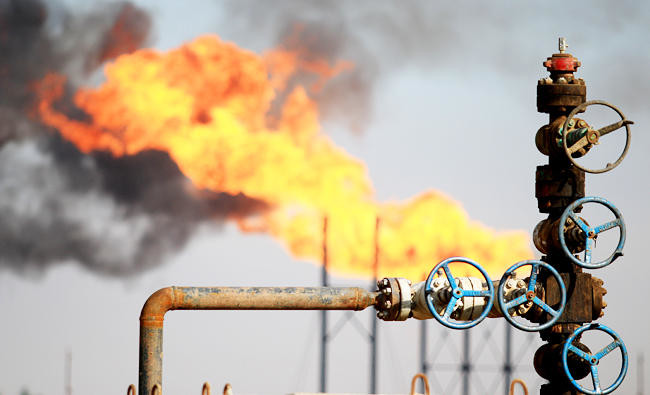
Peak oil demand and its implications for Gulf producers
Peak oil demand and its implications for Gulf producers

Latest updates


© 2026 SAUDI RESEARCH & PUBLISHING COMPANY, All Rights Reserved And subject to Terms of Use Agreement.