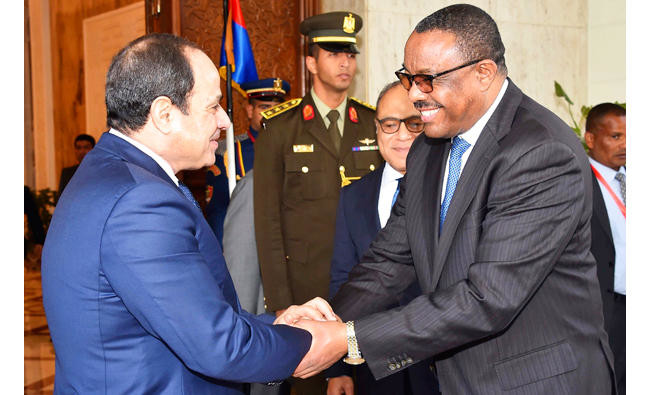
CAIRO: Egypt’s president on Thursday expressed his “extreme concern” to Ethiopia’s visiting prime minister over the lack of progress in talks on the impact of a massive upstream dam that Egypt fears could cut into its vital share of the Nile.
President Abdel Fattah El-Sisi has warned that Egypt’s share of the Nile, which provides nearly all its freshwater, is a red line. But he has also sought to reassure Ethiopia and Sudan that Egypt has no intention of going to war.
El-Sisi was grim-faced during most of a news conference he jointly addressed with Prime Minister Hailemariam Desalegn after the two held talks in Cairo.
El-Sisi said he appreciated Ethiopia’s repeated assurances that the dam, which is about 60 percent complete, would not have a negative impact on Egypt, but he said studies must still be completed and that all sides should abide by their findings.
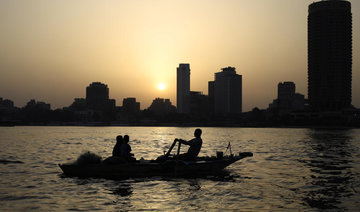
Egypt is a mostly desert country that depends on the Nile for almost all of its water needs. Its 95 million people grow by at least a million every year, further straining its water resources and posing a perpetual challenge to its economic development.
“I expressed our extreme concern over the continuation of the state of stagnation besetting the tripartite technical track,” which is aimed at examining the impact of the dam on Egypt and Sudan, El-Sisi said.
He said cooperation among the Nile basin countries must not be a “zero-sum game.”
Relations have deteriorated between Egypt and Sudan, with Cairo accusing Khartoum of siding with Ethiopia in the dispute over the dam and reviving a long-standing border dispute.
Of special concern to Egypt is the speed at which a planned reservoir is filled behind the dam and the method of its annual replenishment. Egypt fears that a quick fill would drastically reduce the Nile’s flow, with potentially severe effects on its agriculture and other sectors.
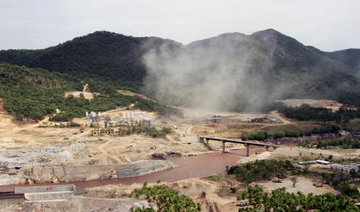
Ethiopia says the $5 billion dam is essential, noting that the vast majority of its population lacks electricity. The dam will generate over 6,400 megawatts, a massive boost to the country’s current production of 4,000 Megawatts.
Egypt recently proposed that World Bank experts be brought in as neutral arbitrators. El-Sisi said Sudan and Ethiopia are still studying the proposal, but that Desalegn wanted a different team of experts.

El-Sisi shows ‘extreme concern’ over Nile dam to Ethiopian PM
Hundreds flee to government-held areas in north Syria ahead of possible offensive
- Many of the civilians who fled used side roads to reach government-held areas
- Men, women and children arrived in cars and pickup trucks that were packed with bags of clothes
DEIR HAFER, Syria: Scores of people carrying their belongings arrived in government-held areas in northern Syria on Friday ahead a possible attack by Syrian troops on territory held by Kurdish-led fighters east of the city of Aleppo.
Many of the civilians who fled used side roads to reach government-held areas because the main highway was blocked with barriers at a checkpoint that previously was controlled by the Kurdish-led and US-backed Syrian Democratic Forces, Associated Press journalists observed.
The Syrian army said late Wednesday that civilians would be able to evacuate through the “humanitarian corridor” from 9 a.m. to 5 p.m. Thursday. The announcement appeared to signal plans for an offensive against the SDF in the area east of Aleppo.
There were limited exchanges of fire between the two sides.
Men, women and children arrived in cars and pickup trucks that were packed with bags of clothes, mattresses and other belongings. They were met by local officials who directed them to shelters.
In other areas, people crossed canals on small boats and crossed a heavily damaged pedestrian bridge to reach the side held by government forces.
The SDF closed the main highway but about 4,000 people were still able to reach government-held areas on other roads, Syrian state TV reported.
A US military convoy arrived in Deir Hafer in the early afternoon but it was not immediately clear whether those personnel will remain. The US has good relations with both sides and has urged calm.
Inside Deir Hafer, many shops were closed and people stayed home.
“When I saw people leaving I came here,” said Umm Talal, who arrived in the government-held area with her husband and children. She added that the road appeared safe and her husband plans to return to their home.
Abu Mohammed said he came from the town of Maskana after hearing the government had opened a safe corridor, “only to be surprised when we arrived at Deir Hafer and found it closed.”
SDF fighters were preventing people from crossing through Syria’s main east-west highway and forcing them to take a side road, he said.
The tensions in the Deir Hafer area come after several days of intense clashes last week in Aleppo, previously Syria’s largest city and commercial center, that ended with the evacuation of Kurdish fighters from three neighborhoods north of the city that were then taken over by government forces.
The fighting broke out as negotiations stalled between Damascus and the SDF over an agreement reached in March to integrate their forces and for the central government to take control of institutions including border crossings and oil fields in the northeast.
The US special envoy to Syria, Tom Barrack, posted on X Friday that Washington remains in close contact with all parties in Syria, “working around the clock to lower the temperature, prevent escalation, and return to integration talks between the Syrian government and the SDF.”
The SDF for years has been the main US partner in Syria in fighting against the Daesh group, but Turkiye considers the SDF a terrorist organization because of its association with Kurdish separatist insurgents in Turkiye.