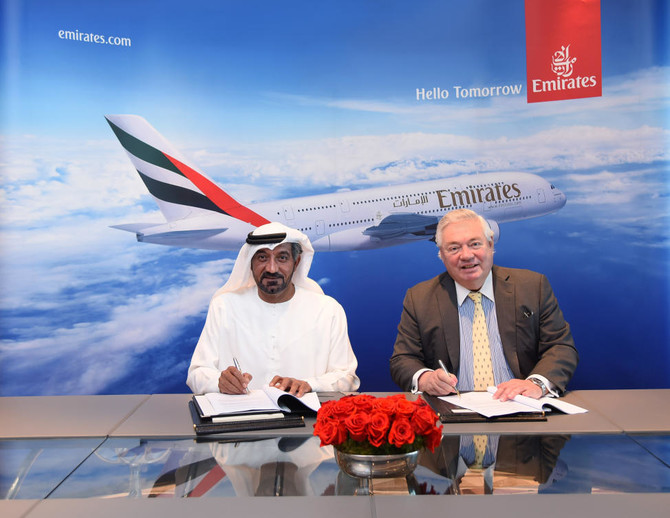
LONDON: Emirates has secured the future of the Airbus A380 — at least for now — with an order for 36 of the superjumbos, it emerged on Thursday.
But only 20 are firm orders and the European aircraft maker will likely get “significantly” less than the list price of $16 billion, analysts told Arab News.
Tim Coombs, airlines specialist at Aviation Economics, said Airbus “had been quite clear that the production line would have closed without an order from Emirates.”
That in itself would have markedly increased the Gulf carrier’s bargaining position.
When asked if the discount could have been struck at or below 40 percent, Chris Tarry, airlines analyst at CTAIRA, told Arab News: “I wouldn’t disabuse you of that.”
Discounts for orders from Airbus and Boeing are not uncommon, but the size of concessions are rarely disclosed.
Tarry said: “I am sure Emirates was able to secure a particularly attractive price for the additional aircraft.”
A dearth of orders had cast doubts on the future of the A380 program with Chief Operating Officer John Leahy saying a few days ago that production would have ceased without a further commitment from Emirates. The airline is by far Airbus’s largest customer for A380s, with 101 deliveries in the past 10 years.
With the latest deal, the A380 could continue now for “at least another 10 years,” said Leahy in an Airbus statement on Thursday.
A major issue for the future of the four-engined A380 has been that twin-engined aircraft have been getting bigger and flying further. Instead of airlines flying to hubs such as Dubai, there is a greater choice of jets to carry travelers direct to their destinations, said Coombs.
Chris Bryant, Berlin-based columnist for Bloomberg, wrote on the news organization’s website that the A380 had always seemed the ideal solution to the problem of increasingly congested airports.
“Yet, in reality, airlines are increasingly shunning the big hubs and flying point-to-point instead, thanks in part to a new generation of fuel-efficient jets,” said Bryant.
The latest Emirates/A380 contract comes in the form of a memorandum of understanding that allows a buyer to pull out under certain conditions, and is often not legally binding.
Some of the new A380s, which will begin to be delivered from 2020, will be replacements for the oldest of the wide-bodied aircraft, Emirates said in a statement.
It is not known if these new orders will encompass an upgraded version of the superjumbo — dubbed the A380plus — which adds fuel-saving winglets and room for 80 more passengers.
“I’m personally convinced more orders will follow Emirates’ example and that this great aircraft will be built well into the 2030s,” said Leahy.
Already by far the biggest A380 customer, Emirates has repeatedly stalled on a deal, putting the aircraft’s future in doubt after Airbus failed to win new orders for two years.
There were gasps at the Dubai Air Show in November when Emirates unveiled a provisional $15.1 billion order for 40 of Boeing’s mid-sized wide-body 787-10 jetliners instead of announcing an expected deal with Airbus for more A380s.
Airbus had warned in 2016 that 10 years after entering service, its A380 production line would have dwindled to 12 a year in 2018, and eight in 2019.
After Thursday’s deal, continued production is secured for the time being, but analysts cautioned that further big orders were unlikely. Tarry commented: “Should we expect lots more orders in the near term? Certainly not,” he said.
Emirates Chairman Sheikh Ahmed bin Saeed Al-Maktoum said: “Some of the new A380s we’ve just ordered will be used as fleet replacements. This order will provide stability to the A380 production line.”
He added: “We will continue to work closely with Airbus to further enhance the aircraft and onboard product, so as to offer our passengers the best possible experience. The beauty of this aircraft is that the technology and real estate on board gives us plenty of room to do something different with the interiors.”
Emirates said the A380 is an essential part of the solution to sustainable growth, alleviating traffic congestion at busy airports by transporting more passengers with fewer flights. The carrier was said to be the best way to capture growing world air traffic, which doubles every 15 years. The A380 flies 8,200 nautical miles (15,200 kilometers) non-stop and can accommodate 575 passengers in four classes.
Leahy said: “This aircraft has contributed enormously to Emirates’ growth and success since 2008 and we are delighted that it will continue to do so.”


![]()
Emirates throws A380 a lifeline with $16bn order at eleventh hour
Emirates throws A380 a lifeline with $16bn order at eleventh hour

Latest updates


© 2026 SAUDI RESEARCH & PUBLISHING COMPANY, All Rights Reserved And subject to Terms of Use Agreement.