Nobody should be forcibly returned to Libya, says HRW

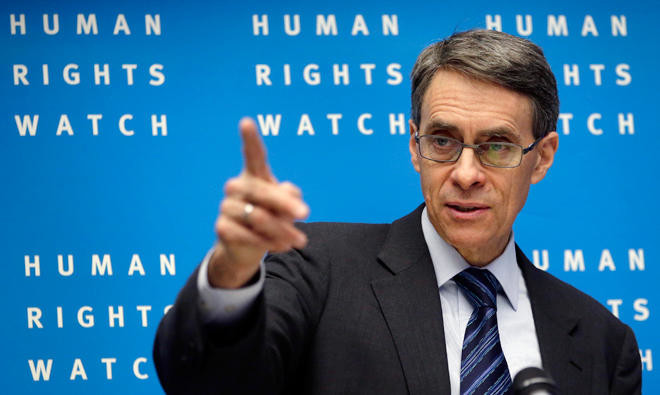
Human Rights Watch chief Kenneth Roth
Updated 18 January 2018
Follow

Nobody should be forcibly returned to Libya, says HRW

PARIS: European authorities should not be sending migrants trying to reach the continent back to Libya until the security situation there has stabilized, the chief of Human Rights Watch (HRW) said.
“The way migrants are treated in Libya is horrendous, where we hear over and over stories of forced labor, forced sexual abuse, torture,” Kenneth Roth said in an interview as the group released its annual report on risks around the globe.
While acknowledging Europe’s right to restrict immigration after hundreds of thousands have poured into member states in recent years, Roth criticized a Brussels-backed deal that helps Libya block migrants from trying to reach Europe.
“The International Organization for Migration (IOM) has said that more migrants are dying inside Libya than die once they get in a boat to cross the Mediterranean. So that gives you a sense of how bad things are,” Roth said.
At least 3,100 migrants died or disappeared trying to cross to Europe last year, the IOM has said, though attempts have slowed since the deal by Libya and Italy, the main destination, to halt the flow.
Shocking images last year of black Africans being sold in Libya have led European officials to stop returning migrants to the country, Roth said.
“But they’re trying to do indirectly what they can’t do directly by building up and training the Libyan coast guard so that the Libyans on their own can simply return people back to the traffickers,” he said.
“You can help them return home if that’s what they want, but nobody should be forcibly returned to Libya.”
Roth, a 62-year-old former lawyer, also underscored the risks as more populist leaders come to power around the world, while criticizing Western governments for not pushing hard enough against leaders accused of rights abuses in their own countries.
While he qualified the arrival of US President Donald Trump as “a moment of despair,” he was also critical of his predecessor Barack Obama over failing to close the Guantanamo prison or take stronger action against Syria’s Bashar Assad.
“I admire President Obama,” Roth said, but “he wasn’t willing to pay the political price to actually close Guantanamo ... He wasn’t really willing to do anything to stop Assad committing mass atrocities in Syria.”
HRW, which publishes about 100 reports on dozens of countries each year, has seen its prominence grow over the past two decades, becoming a multinational advocacy group employing some 425 people.
It is backed by private donations from individuals and foundations, including that of US billionaire George Soros.
“Everybody likes to pretend that they respect human rights; When we’re able to show that they fall short, it’s embarrassing,” Roth said.


Lawsuit challenges Trump administration’s ending of protections for Somalis

Updated 8 sec ago
Follow

Lawsuit challenges Trump administration’s ending of protections for Somalis

  • The lawsuit cites a series of statements Trump has made describing Somalis as “garbage” and “low IQ people” who “contribute nothing.”

BOSTON: Immigrant rights advocates filed a lawsuit on Monday seeking to stop US President Donald Trump’s administration from next ​week ending legal protections that allow nearly 1,100 Somalis to live and work in the United States. The lawsuit, brought by four Somalis and two advocacy groups, challenges the US Department of Homeland Security’s decision to end Temporary Protected Status for Somali immigrants, whom Trump has derided in public remarks. Outgoing Homeland Security Secretary Kristi Noem in January announced that TPS for Somalis would end on March 17, arguing that Somalia’s conditions had improved, despite fighting continuing between Somali forces and Al-Shabab militants. The plaintiffs, who ‌include the groups ‌African Communities Together and Partnership for the Advancement ​of ‌New ⁠Americans, in the ​lawsuit filed ⁠in Boston federal court argue the move was procedurally flawed and driven by a discriminatory, predetermined agenda.
The lawsuit cites a series of statements Trump has made describing Somalis as “garbage” and “low IQ people” who “contribute nothing.”
The plaintiffs said the administration is ending TPS for Somalia and other countries due to unconstitutional bias against non-white immigrants, not based on objective assessments of country conditions.
“The termination of TPS for Somalia is racism masking as immigration policy,” ⁠Omar Farah, executive director at the legal group Muslim Advocates, said ‌in a statement.
DHS did not respond to ‌a request for comment. It has previously said TPS ​was “never intended to be a de ‌facto amnesty program.”
TPS is a form of humanitarian immigration protection that shields eligible migrants ‌from deportation and allows them to work. Under Noem, DHS has moved to end TPS for a dozen countries, sparking legal challenges. The administration on Saturday announced plans to pursue an appeal at the US Supreme Court in order to end TPS for over 350,000 Haitians. It ‌also wants the high court to allow it to end TPS for about 6,000 Syrians.

SOMALI COMMUNITY TARGETED
Somalia was first designated ⁠for TPS in ⁠1991, with its latest extension in 2024. About 1,082 Somalis currently hold TPS, and 1,383 more have pending applications, according to DHS. Somalis in Minnesota in recent months had become a target of Trump’s immigration crackdown, with officials pointing to a fraud scandal in which many people charged come from the state’s large Somali community. The Trump administration cited those fraud allegations as a basis for a months-long immigration enforcement surge in Democratic-led Minnesota, during which about 3,000 immigration agents were deployed, spurring protests and leading to the killing of two US citizens by federal agents.
In November, Trump announced he would end TPS for Somalis in Minnesota, and a month later said ​he wanted them sent “back to where they ​came from.”
The US Department of State advises against traveling to Somalia, citing crime and civil unrest among numerous factors.