Warnings over ‘devastating’ US decision to freeze Palestinian refugee funding

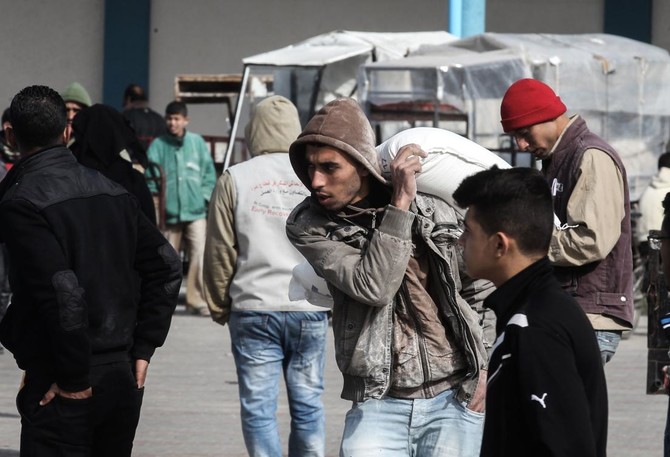
A Palestinian man carries a sacs of food aid provided by the UN agency for Palestinian refugees, UNWRA, at the Rafah refugee camp in the southern Gaza Strip. The UN agency for Palestinian refugees faces its worst funding crisis ever. (AFP)
Updated 17 January 2018
Follow

Warnings over ‘devastating’ US decision to freeze Palestinian refugee funding

LONDON: The Arab League and aid agencies on Wednesday warned of the devastating consequences of a US decision to freeze $65 million of Palestinian refugee funding.
The outcry came as the Palestinian president Mahmoud Abbas again blasted Donald Trump’s “sinful” decision to recognise Jerusalem as Israel’s capital.
Washington said on Tuesday it would provide $60 million to the UN Relief and Welfare Agency but would hold back a further $65 million. The US State Department said UNRWA needed to make unspecified reforms.
Both the head of the Arab League and the chief of the UN agency warned that holding back the money would exacerbate hardship, and effect education and health for some of the region’s most vulnerable people.
More than half a million boys and girls in 700 UNRWA schools could be affected by the fund cut, as well as Palestinian access to primary health care.
The cut in funding will effect Gaza in particular, where UNRWA helps much of its population of 2 million.
UNRWA’s Commissioner-General Pierre Krähenbühl said he would appeal to other donor nations for money and launch "a global fundraising campaign" aimed at keeping the agency's schools and clinics for refugees open through 2018 and beyond.
"At stake is the dignity and human security of millions of Palestine refugees, in need of emergency food assistance and other support in Jordan, Lebanon, Syria, and the West Bank and Gaza Strip," Krähenbühl said.
He also warned that the move risks further instability in the region by contributing to the conditions that feed extremist ideologies.
In a Twitter post earlier this month, Trump said that Washington gives the Palestinians "HUNDRED OF MILLIONS OF DOLLARS a year and get no appreciation or respect.”
Trump added that "with the Palestinians no longer willing to talk peace, why should we make any of these massive future payments to them?"
The US State Department said Washington had been UNRWA’s single largest donor for decades and insisted the decision to freeze the funding was taken to encourage other countries to help pay for and reform the agency.
Some US official had wanted to cut all aid to Palestinians while others were concerned about the humanitarian and diplomatic fallout.
Arab League chief Ahmed Aboul Gheit said halting the money was aimed at wiping out the whole Palestinian refugee issue.
"This decision affects the education and health of Palestinians and aims to eradicate the question of refugees," he said.
Hanan Ashrawi, a senior official in the Palestine Liberation Organization said the White House was "targeting the most vulnerable segment of the Palestinian people".
Israeli Prime Minister Benjamin Netanyahu, who has called for a gradual cut in UNRWA funding and transferring its responsibilities to the UN global refugee agency, said he supported the move.
The freeze comes aid outrage among Palestinians over Trump’s decisions to recognise Jerusalem as Israel’s capital. Palestinians want the city to be the capital of their future state and east Jerusalem has been illegally occupied by Israel since 1967.
"Jerusalem will be a gate for peace only if it is Palestine's capital, and it will be a gate of war, fear and the absence of security and stability, God forbid, if it is not," a furious Mahmoud Abbas said at a conference in Cairo on Wednesday.
The Palestinian president, who initially described the decision as a "slap of the century," said the US has disqualified itself from continuing as a broker in any Israeli-Palestinian negotiations.
Netanyahu threw fuel on the fire on Wednesday by saying he was certain the US Embassy in Israel would be moved to Jerusalem sometime this year.
Moving the embassy was a key Trump foreign policy election pledge but US officials have said it is unlikely it would move from Tel Aviv before the end of the end his term in office.
The Cairo conference was organized by Al-Azhar, the primary seat of learning for the world's Sunni Muslims.
Earlier, Al-Azhar's grand imam and Egypt's top Muslim cleric, Sheikh Ahmed Al-Tayeb, described Trump's Jerusalem decision as “unjust”. He said it must be countered by a revival of awareness of the Palestinian question.
— With AP, AFP and Reuters


Gaza ceasefire enters phase two despite unresolved issues

Updated 8 sec ago
Follow

Gaza ceasefire enters phase two despite unresolved issues

  • Under the second phase, Gaza is to be administered by a 15-member Palestinian technocratic committee operating under the supervision of a so-called “Board of Peace,” to be chaired by Trump

JERUSALEM: A US-backed plan to end the war in Gaza has entered its second phase despite unresolved disputes between Israel and Hamas over alleged ceasefire violations and issues unaddressed in the first stage.
The most contentious questions remain Hamas’s refusal to publicly commit to full disarmament, a non-negotiable demand from Israel, and Israel’s lack of clarity over whether it will fully withdraw its forces from Gaza.
The creation of a Palestinian technocratic committee, announced on Wednesday, is intended to manage day-to-day governance in post-war Gaza, but it leaves unresolved broader political and security questions.
Below is a breakdown of developments from phase one to the newly launched second stage.

Gains and gaps in phase one

The first phase of the plan, part of a 20-point proposal unveiled by US President Donald Trump, began on October 10 and aimed primarily to stop the fighting in the Gaza Strip, allow in aid and secure the return of all remaining living and deceased hostages held by Hamas and allied Palestinian militant groups.
All hostages have since been returned, except for the remains of one Israeli, Ran Gvili.
Israel has accused Hamas of delaying the handover of Gvili’s body, while Hamas has said widespread destruction in Gaza made locating the remains difficult.
Gvili’s family had urged mediators to delay the transition to phase two.
“Moving on breaks my heart. Have we given up? Ran did not give up on anyone,” his sister, Shira Gvili, said after mediators announced the move.
Israeli Prime Minister Benjamin Netanyahu said efforts to recover Gvili’s remains would continue but has not publicly commented on the launch of phase two.
Hamas has accused Israel of repeated ceasefire violations, including air strikes, firing on civilians and advancing the so-called “Yellow Line,” an informal boundary separating areas under Israeli military control from those under Hamas authority.
Gaza’s Hamas-run health ministry said Israeli forces had killed 451 people since the ceasefire took effect.
Israel’s military said it had targeted suspected militants who crossed into restricted zones near the Yellow Line, adding that three Israeli soldiers were also killed by militants during the same period.
Aid agencies say Israel has not allowed the volume of humanitarian assistance envisaged under phase one, a claim Israel rejects.
Gaza, whose borders and access points remain under Israeli control, continues to face severe shortages of food, clean water, medicine and fuel.
Israel and the United Nations have repeatedly disputed figures on the number of aid trucks permitted to enter the Palestinian territory.

Disarmament, governance in phase two

Under the second phase, Gaza is to be administered by a 15-member Palestinian technocratic committee operating under the supervision of a so-called “Board of Peace,” to be chaired by Trump.
“The ball is now in the court of the mediators, the American guarantor and the international community to empower the committee,” Bassem Naim, a senior Hamas leader, said in a statement on Thursday.
Trump on Thursday announced the board of peace had been formed and its members would be announced “shortly.”
Mediators Egypt, Turkiye and Qatar said Ali Shaath, a former deputy minister in the Ramallah-based Palestinian Authority, had been appointed to lead the committee.
Later on Thursday, Egyptian state television reported that all members of the committee had “arrived in Egypt and begun their meetings in preparation for entering the territory.”
Al-Qahera News, which is close to Egypt’s state intelligence services, said the members’ arrival followed US Middle East envoy Steve Witkoff’s announcement on Wednesday “of the start of the second phase and what was agreed upon at the meeting of Palestinian factions in Cairo yesterday.”
Shaath, in a recent interview, said the committee would rely on “brains rather than weapons” and would not coordinate with armed groups.
On Wednesday, Witkoff said phase two aims for the “full demilitarization and reconstruction of Gaza,” including the disarmament of all unauthorized armed factions.
Witkoff said Washington expected Hamas to fulfil its remaining obligations, including the return of Gvili’s body, warning that failure to do so would bring “serious consequences.”
The plan also calls for the deployment of an International Stabilization Force to help secure Gaza and train vetted Palestinian police units.
For Palestinians, the central issue remains Israel’s full military withdrawal from Gaza — a step included in the framework but for which no detailed timetable has been announced.
With fundamental disagreements persisting over disarmament, withdrawal and governance, diplomats say the success of phase two will depend on sustained pressure from mediators and whether both sides are willing — or able — to move beyond long-standing red lines.