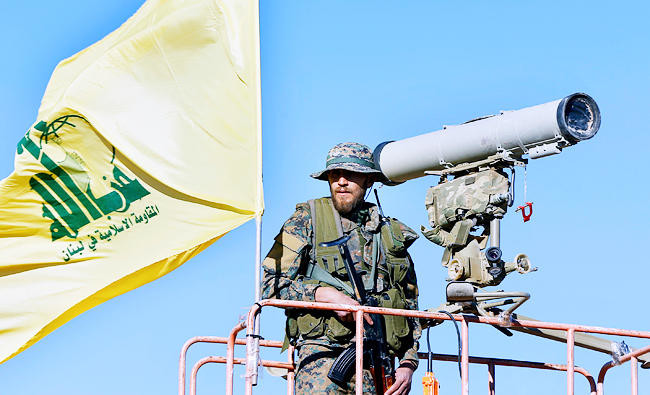
LONDON: Calls for the UK to re-classify Hezbollah as a terrorist organization in its entirety are intensifying, following demands from both UK MPs and US President Donald Trump to outlaw the organization.
UK politicians have secured a cross-party parliamentary debate to take place on Jan. 25 with the aim of ramping up pressure on the government to completely ban the Lebanon-based group “without further delay or excuses,” Jennifer Gerber, director of the Labour Friends of Israel (LFI), said.
“Hezbollah is a terrorist organization, driven by an anti-Semitic ideology, which seeks the destruction of Israel. The British government has repeatedly failed to take action to ban it in its entirety.”
The upcoming debate was secured by the LFI chairperson and Labour MP Joan Ryan.
Trump also demanded all US allies to designate all of Hezbollah as a terrorist organization in a speech on Jan. 12 where he called Iran “the world’s leading state sponsor of terror,” which has enabled organizations such as Hezbollah “to sow chaos and kill innocent people.”
Hezbollah, which is funded and armed by Iran, is among 60 groups defined as foreign terrorist organizations by the US State Department.
The UK only categorizes Hezbollah’s military wing as a terrorist organization, excluding the group’s political wing. It made that proscription in 2001 and extended the ban to Hezbollah’s Jihad Council in 2008.
The EU also names the military arm of Hezbollah on its list of terror groups, but does not include the political arm. The EU designated Hezbollah’s military arm as a terrorist entity in 2013 after a bus of Israeli tourists in the Bulgarian city of Burgas was bombed.
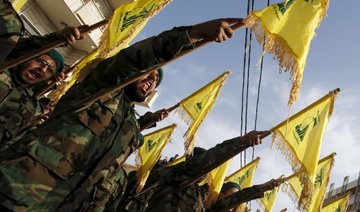
“This false distinction means that Hezbollah flags can be flown on the streets of Britain,” LFI said in a statement last week, referring to the flags seen in the Al Quds Day parade held in London in June last year. Al Quds Day is an annual event first established by Iran to encourage people to march in support of Palestine and against Israel.
The parliamentary debate has been welcomed by many groups eager for the government to crack down on Hezbollah and its presence on the streets of the UK.
“On June 4, 2017, the day after the London Bridge terror attack, Prime Minister Theresa May said that the UK was too tolerant of extremism. Two weeks later, people walked down the streets of London waving Hezbollah flags,” said Michael McCann, director at the Israel Britain Alliance.
“Hezbollah is a genocidal terror organization that operates on the orders of Iran. It illustrates the prime minister’s point perfectly. On Jan. 25, MPs can send a message to the British government — our country stands against terror in all its forms,” he said.
McCann’s comments are echoed by David Ibsen, the executive director of the Counter-Extremism Project, a US-based non-government organization.
“The UK and the EU must recognize the semantic fallacy of a difference between the military and political wings of Hezbollah,” he said.
“There is only one Hezbollah, a terrorist organization founded by and heavily funded by Iran. Even Hezbollah’s top officials brazenly acknowledge that the same leaders who ordered attacks against British soldiers in Iraq direct Hezbollah’s work in the Lebanese Parliament.
Ibsen said it was time for the UK and the EU to join countries such as the Netherlands, the Arab League, Canada and the US that have banned the group in its entirety.
While the distinction between the political and military arms may not even be recognized by Hezbollah itself, Filippo Dionigi, lecturer of politics and International relations at the University of Bristol, said it could be useful in supporting the UK’s diplomatic relations with Lebanon.
“This distinction (however artificial) allows to those states and institutions that adopt it (including the EU) to implement measures against Hezbollah’s militant activity, but avoids the condemnation of Hezbollah’s political activity which is important, given that this group plays an influential role also within the Lebanese government and institutions,” he said.
He said that the UK government would need to weigh its foreign policy priorities before making a decision to reclassify Hezbollah.
“It will depend on the government’s priorities and interests whether to adopt a more comprehensive ban on Hezbollah or not.
“Doing so will signal greater amenability to President’s Trump demands (and those of Israeli nationalist groups), but may have the effect of rendering relations with Lebanon more unstable given that the president of the country enjoys Hezbollah’s support and the government is partly composed by Hezbollah-supported members,” he said.
While the focus of the UK debate will probably be on Israel, Hezbollah’s actions in other countries like Syria, where it has provided a crucial military buttress to Bashar Assad, will also be under scrutiny.
“Hezbollah’s current crimes against Syrian civilians should be our most urgent concern,” a spokesperson for opposition group Syria Solidarity UK, said.
“In particular, Hezbollah is directly responsible for besieging and forcibly displacing several civilian communities, blocking food and medical aid, and killing civilians.”
The group called for a full ban on Hezbollah by the UK.


![]()
Calls for UK to follow US crackdown on Hezbollah
Calls for UK to follow US crackdown on Hezbollah

Latest updates


Recommended



© 2026 SAUDI RESEARCH & PUBLISHING COMPANY, All Rights Reserved And subject to Terms of Use Agreement.