BAGHDAD: Iraq’s influential cleric Muqtada Al-Sadr has withdrawn his support for Prime Minister Haider Abadi because of his alliance with the Popular Mobilization Unit (PMU) factions.
Abadi’s alliance “paves the way for the return of the corrupt,” Al-Sadr declared on Sunday.
Hours earlier, Abadi formally signed an agreement with the leaders of the PMU to form a wide joint electoral alliance called “The Victory of Iraq” to participate in the parliamentary and provincial election scheduled to be held in May.
Al-Sadr has expressed his support for Abadi more than once and said he would back his candidacy for a second term. But the deal made on Saturday between Abadi and the commanders of pro-Iranian armed factions including Asaib Ahl Al-Haq, Kataib Hezbollah and Badr Organization, has upset him.
Al-Sadr has called them “shameless militias” and considers the deal signifies a return to sectarian confinement.
“I condolence my people … due to the abhorrent political agreements … which pave the way for the return of the corrupt again (to the government),” Al-Sadr said.
“We were offered to join them (Abadi’s alliance) and we totally refused this. I am surprised by the attitude of the brother-in-law, who we thought was the first patriotic preacher and advocate of reform.
The “Victory of Iraq Alliance” which, headed by Abadi, consists of at least 28 political and armed factions including the most powerful Shiite groups in addition to the Sunni, Christian, Yazidi, Shabak and Turkmen armed factions, fought Daesh for the past three years under the umbrella of the PMU.
Al-Sadr, however, controls millions of votes, and represents the parliamentary power broker, which favors any candidate for prime minister in any government.
Gaining the backup of the PMU factions is crucial for Abadi to form a comfortable parliamentary majority to form the next government and avoid any serious security problems that the undisciplined armed factions could carry out to embarrass him.
Al-Sadr was planning to run for the election in a joint electoral alliance and was pushing Abadi to leave Da’awa Party, but Abadi has decided to join with the PMU groups and killed any hope of Al-Sadr backup.
“This (allying with the PMU) struck the (Al-Sadr and Abadi’s) project. We were saying that we are looking to build a patriotic project ... to establish a civil state, but see now what has happened,” a senior Sadrist leader and one of Al-Sadr negotiators told Arab News on condition of anonymity.
“All those (the leaders of the PMU) are thieves and killers. Where will this country head? How do we call to establish a civil state while it (the country) is led by armed factions?”


![]()
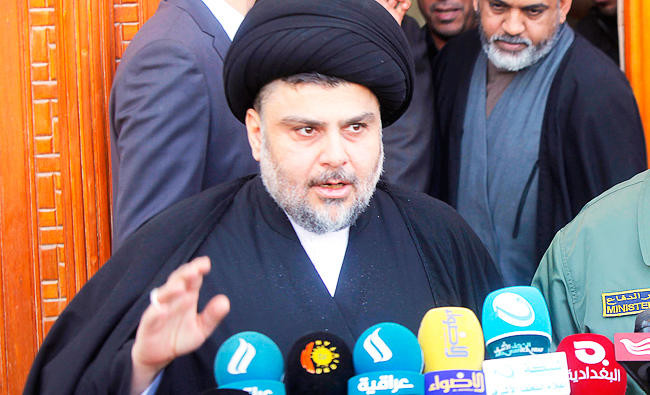
Al-Sadr withdraws support from Abadi and his alliance
Al-Sadr withdraws support from Abadi and his alliance


Latest updates


© 2026 SAUDI RESEARCH & PUBLISHING COMPANY, All Rights Reserved And subject to Terms of Use Agreement.