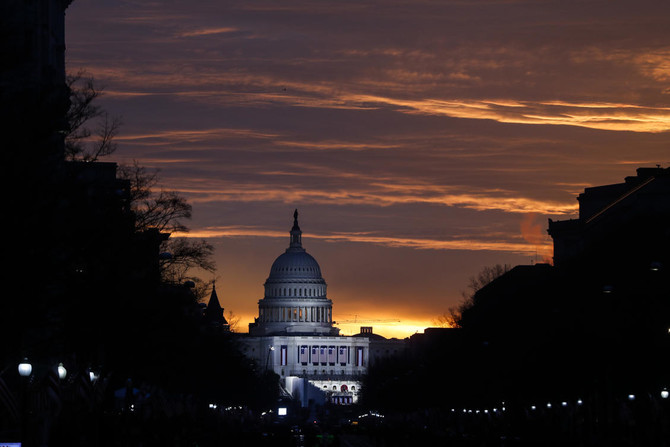
PARIS: The same Russian government-aligned hackers who penetrated the Democratic Party have spent the past few months laying the groundwork for an espionage campaign against the US Senate, a cybersecurity firm said Friday.
The revelation suggests the group often nicknamed Fancy Bear, whose hacking campaign scrambled the 2016 US electoral contest, is still busy trying to gather the emails of America’s political elite.
“They’re still very active — in making preparations at least — to influence public opinion again,” said Feike Hacquebord, a security researcher at Trend Micro Inc., which published the report. “They are looking for information they might leak later.”
The Senate Sergeant at Arms office, which is responsible for the upper house’s security, declined to comment.
Hacquebord said he based his report on the discovery of a clutch of suspicious-looking websites dressed up to look like the US Senate’s internal email system. He then cross-referenced digital fingerprints associated with those sites to ones used almost exclusively by Fancy Bear, which his Tokyo-based firm dubs “Pawn Storm.”
Trend Micro previously drew international attention when it used an identical technique to uncover a set of decoy websites apparently set up to harvest emails from the French presidential candidate Emmanuel Macron’s campaign in April 2017. The sites’ discovery was followed two months later by a still-unexplained publication of private emails from several Macron staffers in the final days of the race.
Hacquebord said the rogue Senate sites — which were set up in June and September of 2017 — matched their French counterparts.
“That is exactly the way they attacked the Macron campaign in France,” he said.
Attribution is extremely tricky in the world of cybersecurity, where hackers routinely use misdirection and red herrings to fool their adversaries. But Tend Micro, which has followed Fancy Bear for years, said there could be no doubt.
“We are 100 percent sure that it can attributed to the Pawn Storm group,” said Rik Ferguson, one of the Hacquebord’s colleagues.
Like many cybersecurity companies, Trend Micro refuses to speculate publicly on who is behind such groups, referring to Pawn Storm only as having “Russia-related interests.” But the US intelligence community alleges that Russia’s military intelligence service pulls the hackers’ strings and a months-long Associated Press investigation into the group, drawing on a vast database of targets supplied by the cybersecurity firm Secureworks, has determined that the group is closely attuned to the Kremlin’s objectives.
If Fancy Bear has targeted the Senate over the past few months, it wouldn’t be the first time. An AP analysis of Secureworks’ list shows that several staffers there were targeted between 2015 and 2016.
Among them: Robert Zarate, now the national security adviser to Florida Senator Marco Rubio; Josh Holmes, a former chief of staff to Senate Majority Leader Mitch McConnell who now runs a Washington consultancy; and Jason Thielman, the chief of staff to Montana Senator Steve Daines. A Congressional researcher specializing in national security issues was also targeted.
Fancy Bear’s interests aren’t limited to US politics; the group also appears to have the Olympics in mind.
Trend Micro’s report said the group had set up infrastructure aimed at collecting emails from a series of Olympic winter sports federations, including the International Ski Federation, the International Ice Hockey Federation, the International Bobsleigh & Skeleton Federation, the International Luge Federation and the International Biathlon Union.
The targeting of Olympic groups comes as relations between Russia and the International Olympic Committee are particularly fraught. Russian athletes are being forced to compete under a neutral flag in the upcoming Pyeongchang Olympics following an extraordinary doping scandal that has seen 43 athletes and several Russian officials banned for life. Amid speculation that Russia could retaliate by orchestrating the leak of prominent Olympic officials’ emails, cybersecurity firms including McAfee and ThreatConnect have picked up on signs that state-backed hackers are making moves against winter sports staff and anti-doping officials.
On Wednesday, a group that has brazenly adopted the Fancy Bear nickname began publishing what appeared to be Olympics and doping-related emails from between September 2016 and March 2017. The contents were largely unremarkable but their publication was covered extensively by Russian state media and some read the leak as a warning to Olympic officials not to press Moscow too hard over the doping scandal.
Whether any Senate emails could be published in such a way isn’t clear. Previous warnings that German lawmakers’ correspondence might be leaked by Fancy Bear ahead of last year’s election there appear to have come to nothing.
On the other hand, the group has previously dumped at least one US legislator’s correspondence onto the web.
One of the targets on Secureworks’ list was Colorado State Senator Andy Kerr, who said thousands of his emails were posted to an obscure section of the website DCLeaks — a web portal better known for publishing emails belonging to retired Gen. Colin Powell and various members of Hillary Clinton’s campaign — in late 2016.
Kerr said he was still bewildered as to why he was targeted. He said that while he supported transparency, “there should be some process and some system to it.
“It shouldn’t be up to a foreign government or some hacker to say what gets released and what shouldn’t.”


![]()
Russian hackers laying groundwork to spy on US Senate: Cybersecurity firm
Russian hackers laying groundwork to spy on US Senate: Cybersecurity firm



Latest updates


Recommended


© 2026 SAUDI RESEARCH & PUBLISHING COMPANY, All Rights Reserved And subject to Terms of Use Agreement.