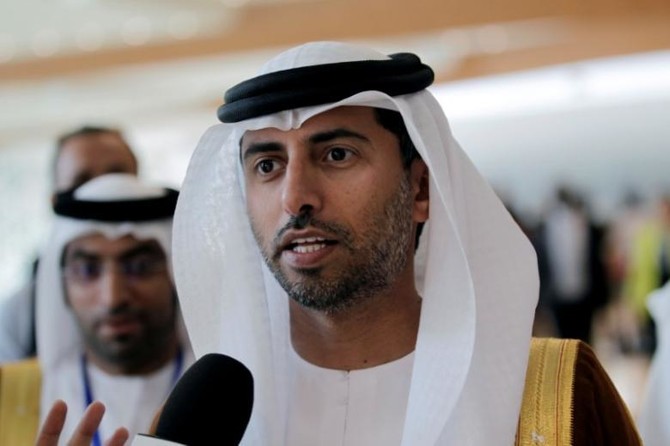
ABU DHABI: Oil-producing countries should remain committed to current production limits for the rest of 2018, or even consider further cuts, until the global market reaches balance, according to Suhail Al-Mazrouei, the UAE energy minister.
He was speaking for the first time in his capacity as president of OPEC.
“I have no doubt that the market needs further correction. We still have more than 100 million barrels that needs to be taken care of,” he said at the UAE Energy Forum in Abu Dhabi.
“There is positive market sentiment we are seeing today. The market is balancing, but the issue is timing and how long it will take,” he said.
Last year OPEC and 10 other oil exporters agreed to continue output limits into 2018, with a commitment to review the deal in June.
“But this is not ‘mission accomplished.’ OPEC is committed to the deal for a full year,” Al-Mazrouei insisted.
He was confident that OPEC and other oil exporters — led by Russia, the world’s biggest oil producer — could maintain the alliance that has helped the oil price recover from the big declines of 2014.
The price of Brent crude rose marginally as he was speaking, at $69.32 per barrel just slightly below the psychologically important $70 level.
“This group (the OPEC and non-OPEC alliance) started something never attempted before, and I believe compliance will continue this year. OPEC will continue to be a strong organization. The phenomenon of getting others to join is something that is of increasing interest. Many other countries have expressed interest in joining OPEC,” he added.
Some analysts have recently forecast that geopolitical shocks could force the oil price to spike above $80 a barrel, but Al-Mazrouei said he was not worried about the effects of short-term shocks from producers like Venezuela and Iran.
“We can always help each other. For example, when Libya was experiencing problems a few years ago we came together. We will be responsive to countries that are experiencing exceptional problems,” he said.
On the US shale industry, which some experts predict will ramp up production as the price recovers and the US economy gets fiscal stimulus from President Trump’s tax reform, he said: “The American people chose their president and we respect that. The US market has been supportive of the oil industry. The only issues with shale oil is the pace of production.”
Al-Mazrouei added that US investors were increasingly looking at the economics of the shale industry, rather than simply increasing production.
“Investors are seeking a good return,” he said.
Asked if he thought Saudi Aramco would complete its initial public offering in 2018, as Saudi Arabian policymakers have pledged, he said: “I trust what the leadership in Saudi Arabia says it will do. They committed to raise fuel prices and bring in VAT, and they have done it. The Vision 2030 is a reality, people are excited about it.”
The forum, organized by the Gulf Intelligence information firm and attended by 200 industry experts, agreed that the Aramco IPO would take place this year. In an electronic poll, 65 percent said that it would happen in 2018.
In a similar vote, 62 percent of participants predicted that the average price of oil would be in the $60-70 range this year, with 20 percent saying it would be more than $70.


![]()
Oil producers should commit to cuts until market reaches balance says OPEC president
Oil producers should commit to cuts until market reaches balance says OPEC president

Latest updates


© 2026 SAUDI RESEARCH & PUBLISHING COMPANY, All Rights Reserved And subject to Terms of Use Agreement.