JEDDAH/ANKARA: Syrian President Bashar Assad’s regime is the “main contributor to terrorism in Syria and the main user and manipulator of terrorism as a pretext to kill Syrians,” Yahya Al-Aridi, Syrian opposition spokesman, told Arab News on Tuesday.
Al-Aridi was reacting to Turkish Foreign Minister Mevlut Cavusoglu’s comment that Assad’s forces were attacking the moderate opposition forces in Idlib province under the pretext that they were fighting hard-line militant group Al-Nusra “and this was undermining efforts to reach a political solution to the war in Syria.”
Anti-Assad fighters under siege near Damascus have resorted to talks with regime ally Russia, sometimes meeting in no-man’s land, as they seek to hang on to their enclave, underlining Moscow’s increasing influence on Syria’s future.
Asked why the international community is unable to take Moscow to task over its pro-Assad policy, Al-Aridi said: “Russia is a permanent member of the UN Security Council with the power of veto to block any condemnation of the Assad regime’s brutality and crimes.”
He added that the world in general, and the US in particular, “have turned a blind eye to the Syrian plight” and expressed his belief that America’s relationship with Israel and with the Syrian regime was “an obstructing factor in finding any solution for the Syrian tragedy.”
“Russia is benefiting from all these factors to continue its savage policies in Syria without any accountability,” Al-Aridi pointed out.
Opposition fighters have gained little from negotiations so far, but Al-Aridi stressed that they have little choice but to continue with them.
“What other options have they got? The world has denied them any support to defend themselves and their people,” he said.
The fighters believe Russia, whose air force all but won the war for the regime, will have the final say on Syria’s fate.
Al-Aridi agrees, to a point. “For the time being maybe,” he said. “But in the long run, Syrians have no choice but to defend themselves; and they know all their enemies who denied them the right to be free. As such, the Russians, as well as the Iranians, may be in for tough times.”
Turkey summoned on Tuesday the ambassadors of Russia and Iran to complain about the regime advances, which it said are in violation of a “de-escalation” agreement in Idlib reached by Ankara, Moscow and Tehran.
Meanwhile, the Syrian Negotiation Commission (SNC), during its meetings with the UN in New York, has warned that the UN-led Syrian peace process in Geneva risks being undermined by a “parallel process” — the Russia-led talks, the next meeting of which is due to take place in Sochi.
The SNC called for international pressure on the regime to negotiate in Geneva, said Al-Aridi.
In a separate development, thousands of refugees are fleeing north from Syria’s Idlib province toward the Turkish border in the wake of prolonged airstrikes by the Syrian regime.
Kerem Kinik, president of the Turkish Red Crescent Society, told Arab News that, over the last two weeks, roughly 64,000 Syrians have traveled from the south of Idlib toward the north.
“The majority of these people were settled next to their parents, while some have remained homeless,” he said. “We are doing our best to accommodate them in our camp between Idlib and Turkey’s southern border.”
Omar Kadkoy, a research associate at the Ankara-based think tank TEPAV, said Idlib province is a unique case in the context of the Syrian war, as it is already home to around 1.1 million people internally displaced from other Syrian provinces.
Kadkoy warned of a “new wave” of displaced people whom he expects will settle on the border strip between Idlib and the Hatay.
“Turkey’s border with Syria has been shut for two years,” he told Arab News. “But Ankara has not abandoned the Syrian refugees; a safe-haven strip emerged between Idlib and Hatay where 700,000 Syrians live in around 400 camps.”


![]()
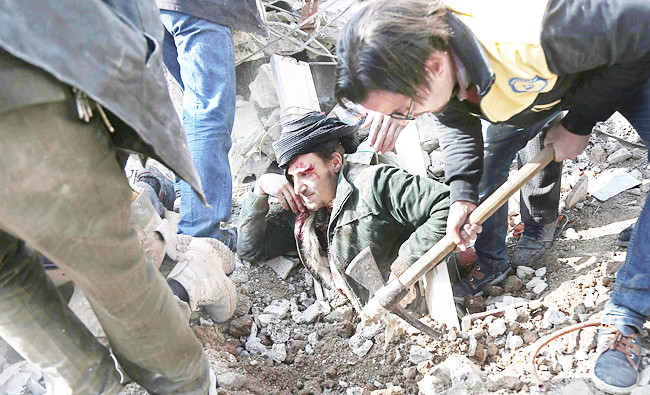
Syrian opposition calls Assad ‘main contributor’ to terror
Syrian opposition calls Assad ‘main contributor’ to terror

Latest updates


© 2026 SAUDI RESEARCH & PUBLISHING COMPANY, All Rights Reserved And subject to Terms of Use Agreement.