TUNIS: Tunisia’s main opposition party on Tuesday called for protests to continue until the government scraps its “unjust” 2018 budget including price and tax hikes, a day after one demonstrator was killed in clashes.
Protests erupted in more than 10 towns across Tunisia on Monday against the price and tax increases imposed by the government to reduce its ballooning deficit and satisfy its international lenders. One protester was killed in Tebourba, a town 40 km (25 miles) west of the capital Tunis.
On Tuesday, hundreds protested on central Tunis’ Avenue Habib Bourguiba, scene of the mass protests that ousted Zine El-Abidine Ben Ali in 2011, with people chanting: “No fear” and “Prices have shot up.”
There were no clashes in the capital, but a crowd tried to set a police station on fire in the central city of Jelma, the Interior Ministry said.
While Tunisia is widely seen as the only democratic success story among the “Arab Spring” nations where revolts took place in 2011, it has had nine governments since then and none of them have been able to tackle the growing economic problems.
Late last year, the government agreed to a four-year loan program with the International Monetary Fund (IMF) worth about $2.8 billion in return for economic reforms.
Public anger has been building since Jan. 1, when the government raised the prices of petrol and other items and hiked taxes on cars, phone calls, internet usage and hotel accommodation as part of those economic reforms.
“Today, we have a meeting with the opposition parties to coordinate our movements, but we will stay on the street and we will increase the pace of the protests until the unjust financial law is dropped,” Popular Front leader Hamma Hammami told reporters.
He said the government was unfairly targeting the poor and middle classes.
Prime Minister Youssef Chahed called for calm, saying the economy would improve this year. Chahed heads a coalition of Islamist and secular parties but has been under constant pressure from labor unions.
“People have to understand that the situation is extraordinary and their country is having difficulties, but we believe that 2018 will be the last difficult year for the Tunisians,” Chahed said.
The 2011 uprising and two major militant attacks in Tunisia in 2015 damaged foreign investment and tourism, which accounts for 8 percent of its economic activity.
The trade deficit expanded by a quarter in the first 11 months of 2017 to a record $5.8 billion, data showed in December, and the dinar currency weakened to more than 3 per euro for the first time ever on Monday.
Europe is concerned about stability in Tunisia, partly because unemployment there has forced many young Tunisians to go abroad, while the number of boats smuggling migrants to Italy has risen and Tunisia has also produced the largest number of jihadists heading for battlefields in Iraq, Syria and Libya.
Khelifa Chibani, a spokesman for the Interior Ministry, said 44 people had been arrested for carrying weapons such as knives, setting government buildings on fire and looting shops.
The demonstrations have so far been much smaller than previous protests since the overthrow of autocrat ruler Zine El-Abidine Ben Ali in 2011.
But those confrontations between the government, labor unions, Islamists and secular forces also started on a small scale before escalating.
Analysts said Chahed could amend some of his reforms to calm social tensions. Under pressure from unions, officials have already agreed to increase public sector salaries this year and to avoid compulsory lay-offs, which could provoke protests.
The government said it wants to cut the public sector wage bill to 12.5 percent of gross domestic product in 2020 from about 15 percent now by offering voluntary redundancies.
But it is also trying to impose higher petrol prices and contributions to social security, which are tough for many people to swallow after years of hardship.
“At the time of Ben Ali, which we did not like, I filled my stand with vegetables, fruits and other items with 10 dinars, and now 50 dinars do not fill this gap. The situation has worsened dramatically,” said Fatma, a market woman in a Tunis district where protests took place on Monday.
“The government is sacrificing the poor and the middle class by raising prices and ignoring tax evaders and businessmen,” she said.
Separately, a judge ordered the arrest of a finance ministry official on suspicion of graft, another judge said on Tuesday, the first such move against a senior official since Chahed announced a crackdown last year.
“The judge... ordered the jailing of the director-general of taxes in the Finance Ministry on suspicion of financial corruption and embezzlement of funds,” Judge Sofian Sliti said, without giving more details.
The country’s anti-corruption committee said graft is widespread. The committee has said it has presented cases against 50 senior state officials believed to be involved in corruption.


![]()
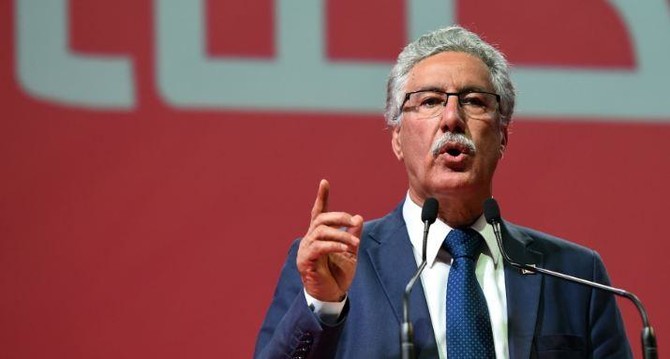
Tunisia’s opposition calls for more protests until govt drops austerity measures
Tunisia’s opposition calls for more protests until govt drops austerity measures


Latest updates



Recommended


© 2026 SAUDI RESEARCH & PUBLISHING COMPANY, All Rights Reserved And subject to Terms of Use Agreement.