BEIJING: Lashing winds, high waves and toxic gases are hindering dozens of rescue boats struggling to locate missing sailors from a stricken oil tanker in the East China Sea and to extinguish a fire that has burned for the past three days on the ship.
The poor conditions, with strong winds, rain and waves as high as 3 meters (10 feet), frustrated efforts to tame the fire and search for the 31 remaining tanker crewmen, the Ministry of Transport said in a statement on Tuesday.
The flames were forcing the South Korean Coast Guard’s search and rescue team to stay as far as 3 miles (4.8 km) away from the tanker, two South Korean officials told Reuters.
The body of a crewman was found on Monday in the water near the tanker, China’s Transport Ministry said. It had been handed over to the civil affairs bureau.
Concerns were growing that the tanker may explode and sink while a flotilla of 13 search and rescue vessels comb a 900-square-nautical-mile (3,100 sq. km) area around the ship for the crew. The tanker hit a freight ship on Saturday night in the East China Sea, burst into flames and has been spilling oil.
The tanker Sanchi, run by Iran’s top oil shipping operator, National Iranian Tanker Co., collided with the CF Crystal, carrying grain from the US, about 160 nautical miles (300 km) off China’s coast near Shanghai and the mouth of the Yangtze River Delta.
The Sanchi was carrying 136,000 tons of condensate, an ultra-light crude oil that becomes highly volatile when exposed to air and water, to South Korea.
The size of the oil spill from the ship and the extent of the environmental harm were not known, but the disaster has the potential to be the worst since 1991 when 260,000 tons of oil leaked off the Angolan coast.
“We can’t grasp the level of oil contamination at this moment. The cargo is still on fire, so it is hard to figure out if oil is being spilled,” Park Sung-dong, an official from South Korea’s Ministry of Oceans and Fisheries, told Reuters.
Chinese state media CCTV showed footage on Monday of boats dousing the flames with water as plumes of thick dark smoke continued to billow from the tanker.
The crew of the Sanchi are all Iranian nationals except for two Bangladeshi citizens. The CF Crystal suffered limited damage and the 21 crewmen, all Chinese nationals, were rescued.
The freighter has been taken to a port near Shanghai where investigators will start work on assessing the cause of the disaster.
China’s Transport Ministry warned that toxic gas from the tanker was harmful to the rescue workers and that protective clothing and gas testing equipment was being dispatched to the emergency teams.
When condensate meets water, it evaporates quickly and can cause a large-scale explosion as it reacts with air and turns into a flammable gas, the ministry said on Monday.
Trying to contain a spill of condensate, which is extremely low in density, highly toxic and much more explosive than normal crude oil, may be difficult.


Iranian oil tanker burns for 3rd day as winds, high waves lash rescuers
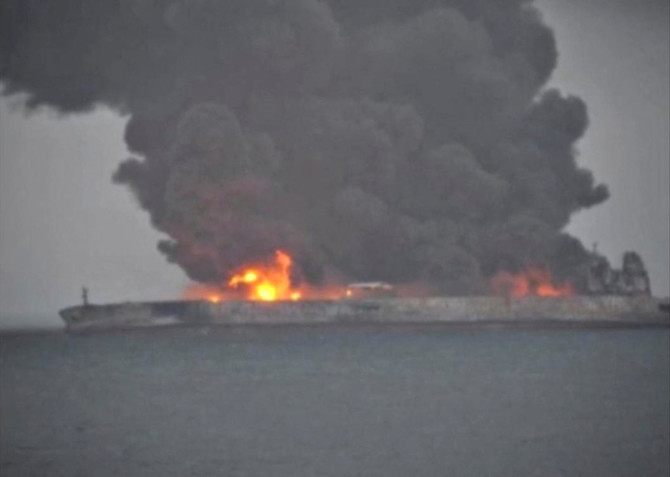
Iranian oil tanker burns for 3rd day as winds, high waves lash rescuers

Afghanistan says it thwarted Pakistani airstrike on Bagram Air Base as fighting enters fourth day
- The fighting has been the most severe between the neighbors for years
- Pakistan accuses Taliban government of harboring militant groups that stage attacks against it
KABUL: Afghanistan thwarted attempted airstrikes on Bagram Air Base, the former US military base north of Kabul, authorities said Sunday, while cross-border fighting between Pakistan and Afghanistan stretched into a fourth day.
The fighting has been the most severe between the neighbors for years, with Pakistan declaring that it’s in “open war” with Afghanistan.
The conflict has alarmed the international community, particularly as the area is one where other militant organizations, including Al-Qaeda and the Daesh group, still have a presence and have been trying to resurface.
Pakistan accuses Afghanistan’s Taliban government of harboring militant groups that stage attacks against it and also of allying with its archrival India.
Border clashes in October killed dozens of soldiers, civilians and suspected militants until a Qatari-mediated ceasefire ended the intense fighting. But several rounds of peace talks in Turkiye in November failed to produce a lasting agreement, and the two sides have occasionally traded fire since then.
On Sunday, the police headquarters of Parwan province, where Bagram is located, said in a statement that several Pakistani military jets had entered Afghan airspace “and attempted to bomb Bagram Air Base” at around 5 a.m.
The statement said Afghan forces responded with “anti-aircraft and missile defense systems” and had managed to thwart the attack.
There was no immediate response from Pakistan’s military or government regarding Kabul’s claim of attempted airstrikes on Bagram or the ongoing fighting.
Bagram was the United States’ largest military base in Afghanistan. It was taken over by the Taliban as they swept across the country and took control in the wake of the chaotic US withdrawal from the country in 2021. Last year, US President Donald Trump suggested he wanted to reestablish a US presence at the base.
The current fighting began when Afghanistan launched a broad cross-border attack on Thursday night, saying it was in retaliation for Pakistani airstrikes the previous Sunday.
Pakistan had said its airstrike had targeted the outlawed Pakistani Taliban, also known as Tehreek-e-Taliban Pakistan, or TTP. Afghanistan had said only civilians were killed.
The TTP militant group, which is separate but closely allied with Afghanistan’s ruling Taliban, operates inside Pakistan, where it has been blamed for hundreds of deaths in bombings and other attacks over the years.
Pakistan accuses Afghanistan’s Taliban government of providing a safe haven within Afghanistan for the TTP, an accusation that Afghanistan denies.
After Thursday’s Afghan attack, Pakistani Defense Minister Khawaja Mohammad Asif declared that “our patience has now run out. Now it is open war between us.”
In the ongoing fighting, each side claims to have killed hundreds of the other side’s forces — and both governments put their own casualties at drastically lower numbers.
Two Pakistani security officials said that Pakistani ground forces were still in control on Sunday of a key Afghan post and a 32-square-kilometer area in the southern Zhob sector near Kandahar province, after having seized it during fighting Friday. The captured post and surrounding area remain under Pakistani control, they added. The officials spoke on condition of anonymity, because they weren’t authorized to speak publicly.
In Kabul, the Afghan government rejected Pakistan’s claims. Deputy government spokesman Hamdullah Fitrat called the reports “baseless.”
Afghan officials said that fighting had continued overnight and into Sunday in the border areas.
The police command spokesman for Nangarhar province, Said Tayyeb Hammad, said that anti-aircraft missiles were used from the provincial capital, Jalalabad, and surrounding areas on Pakistani fighter jets flying overhead Sunday morning.
Defense Ministry spokesman Enayatulah Khowarazmi said that Afghan forces had launched counterattacks with snipers across the border from Nangarhar, Paktia, Khost and Kandahar provinces overnight. He said that two Pakistani drones had been shot down and dozens of Pakistani soldiers had been killed.
Fitrat said that Pakistani drone attacks hit civilian homes in Nangarhar province late Saturday, killing a woman and a child, while mortar fire killed another civilian when it hit a home in Paktia province.
There was no immediate response to the claims from Pakistani officials.


