

Five things we learned from Sydney Ashes Test

1 / 5
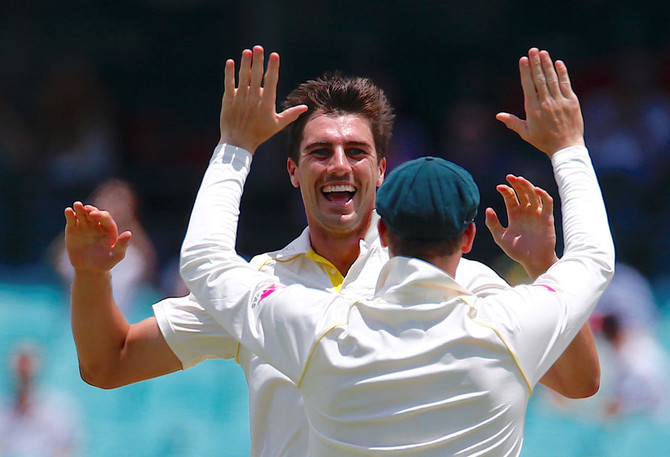
Throughout this Ashes summer, Pat Cummins has been the enforcer, with an assortment of short-pitched deliveries designed to weaken resolve and then dismiss tail-enders. (REUTERS)
2 / 5
In a series where the other main seamers, Stuart Broad and Chris Woakes, averaged nearly 50, Jimmy Anderson’s bowling was the only consolation. (AP)
3 / 5
At the precise moment that England slumped to a fourth defeat of the series — to go with a 4-0 defeat in India 13 months ago — Joe Root, the captain, was sleeping on the job. Literally. (REUTERS)
4 / 5
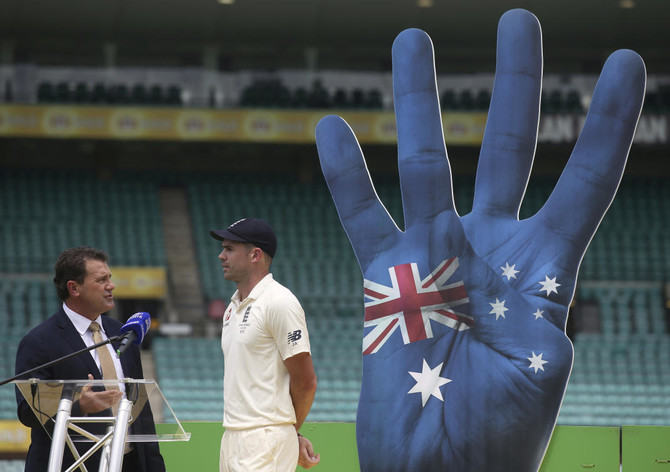
England's James Anderson, right, is interviewed by for Australian captain Mark Taylor and at the end the last day of their Ashes cricket test match against Australia in Sydney, Monday, Jan. 8, 2018. Australia win the series 4-0. (AP)
5 / 5
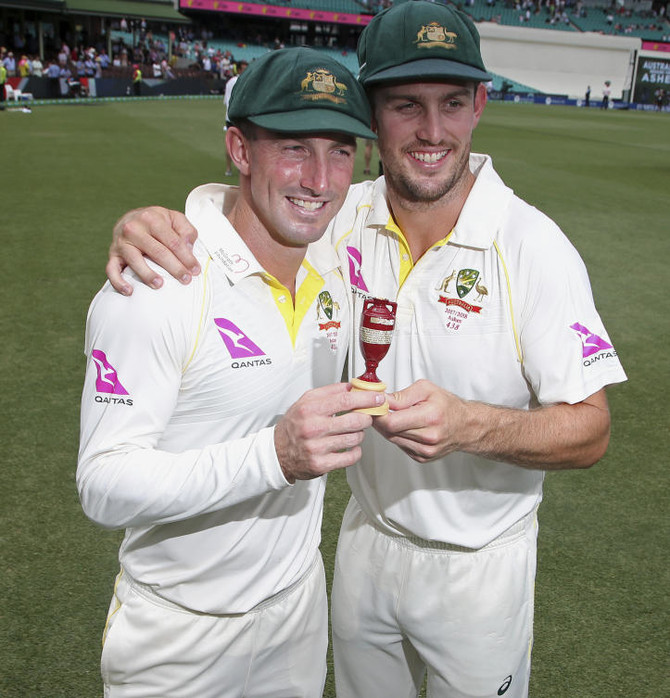
Australian brothers Shaun, left, and Mitchell Marsh hold the replica Ashes urn as they celebrate in Sydney. (AP)
Updated 08 January 2018
Follow

Five things we learned from Sydney Ashes Test

LONDON: An ill Joe Root was unable to resume his innings as Australia wrapped up a 4-0 Ashes win with an emphatic innings victory at the Sydney Cricket Ground. Here are the five things we learned from the Pink Test.

EXPRESS DELIVERY
Off the field, Pat Cummins is as amiable as Postman Pat. With ball in hand though, there’s unmistakable menace. Throughout this Ashes summer, Cummins has been the enforcer, with an assortment of short-pitched deliveries designed to weaken resolve and then dismiss tail-enders. Before the Sydney Test, he had not quite got the rewards his relentlessly hostile and skilful bowling deserved. But on a flat pancake of a pitch, he was at the forefront of a dominant Australian display. His four for 80 reined in England’s first innings, and the four for 39 in the second blew away the last vestiges of resistance after lunch on the final day. Jonny Bairstow was beaten for pace and trapped in front, Stuart Broad fended one behind to avoid being decapitated, and Mason Crane was lucky his thumb was not shattered as he followed in similar fashion. With Mitchell Starc and Josh Hazlewood a little short of their best, Cummins finally had the limelight he deserved.
 
YEOMAN JIMMY
Each of Australia’s four-man attack took at least 21 wickets in the series. No other Englishman came close to matching Anderson’s tally of 17. In a series where the other main seamers, Broad and Chris Woakes, averaged nearly 50, Anderson’s bowling was the only consolation. He will be the first to admit that he did not get it right when England bowled first with the pink ball in Adelaide — perhaps a series-defining passage of play — but he was otherwise at the heart of England’s best moments on the field. The economy rate of 2.11 was the best on either side, and he did not lose his discipline and control even once the series was lost. The final act, however, would have been sickeningly familiar — Anderson in the middle, the home crowd baying for closure, and bouncers whizzing past his helmet. In his last act as a Test cricketer in Australia, Anderson was one of very few players not to let his skipper down.
 
SLEEPING ON THE JOB
At the precise moment that England slumped to a fourth defeat of the series — to go with a 4-0 defeat in India 13 months ago — Joe Root, the captain, was sleeping on the job. Literally. Only, it was extreme exhaustion rather than laziness or ennui that was responsible. Having batted heroically in blast-furnace heat to reach 42 at stumps on the fourth day, Root spent part of the final morning in hospital, suffering from a gastrointestinal virus. He came back out at the fall of Moeen Ali’s wicket, and pinged a few more off the middle of the bat before fatigue kept him in the dressing room after lunch. Root’s series — crossing 50 five times, with a highest score of 83 — was a microcosm of England’s woes. Decent, but nowhere near good enough. Steve Smith, his counterpart, had scores of 76 and 83 to stand alongside epic innings of 141 not out, 239 and 102 not out.
 
STAY CLASSY CRICKET AUSTRALIA
A total of 182,349 watched the Sydney Test, in a summer that served as a reminder that an age-old rivalry draws crowds just as much as an evenly matched contest. A significant number of those fans were from the Barmy Army, whose support remained steadfast even as the team’s fortunes nosedived. That even the Australian team went to applaud them says much about how they contributed to the atmosphere at all the games. Sadly, that sporting spirit was nowhere to be seen in the appalling backdrop for the series presentation. It featured an Australian hand with four fingers (presumably for the wins), and a clenched English fist. It was kitschy and disrespectful, prompting Bryce McGain, who played one Test for Australia, to tweet: “Huge congratulations to our Australian Test Team @CricketAus led by the sublime @stevesmith49 To the marketing team #StayClassy ”  
 
THEY CALLED IT
Trevor Hohns and his selection panel were pilloried before the first Test for some of their choices. Shaun Marsh finished with 445 runs at 74.16. Tim Paine kept beautifully — 25 catches and a stumping — and averaged 48 with the bat. Mitchell Marsh, drafted in before Perth, struck two fluent hundreds in three Tests. Usman Khawaja rewarded the group’s faith with 171 in the final Test. Only Cameron Bancroft, who struggled after the first Test, ended the series with questions hanging over his future. By backing their hunches, the selectors went a long way toward winning back the Ashes.

‘Papaya’s not going anywhere’: How McLaren banished the wilderness years on and off the track

Updated 16 December 2025
Follow

‘Papaya’s not going anywhere’: How McLaren banished the wilderness years on and off the track

  • On-track success of 2 constructors’ championships and Lando Norris’s title win matched by a rebrand attracting a new generation of fans to the British F1 team

ABU DHABI: It’s been just over a week since Lando Norris claimed his first Formula One championship title, but for McLaren’s growing army of supporters the party continues.

When the British driver crossed the finish line at Abu Dhabi’s Yas Marina Circuit in third place to confirm his title victory, you could be forgiven for thinking the post-race celebrations had a familiar look to others in recent years at the season-closing Grand Prix in the UAE’s capital.

This time however, the celebrating fans were sporting the orange of McLaren’s distinctive “papaya” livery, rather than the orange of Max Verstappen’s native Netherlands.

The resurgence of the British team in recent years has been nothing short of remarkable. On the track, their overwhelming supremacy has been secured by a superior car and two gifted drivers in Norris and Australia’s Oscar Piastri. Off it, they deployed one of motor sport’s most successful rebranding campaigns, as a result of which McLaren’s main color now rivals Ferrari’s red as the most iconic in F1.

“You know, it was the fans’ choice to bring papaya back,” Matt Dennington, co-chief commercial officer at McLaren, told Arab News.

“Back in, I think it was 2016, we went out to our fans and it was an overwhelming ‘yes’ that they wanted to see our heritage come back into the team. It’s a key brand asset for us.”

Speaking during a “Live Your Fandom” event at Yas Island in Abu Dhabi, co-hosted with Velo, a team sponsor since 2019, he said: “For us, the fans are the lifeblood of our sport. We don’t go racing without them, and to be able to celebrate our fans and our partners together has been awesome.”

Norris’s success in Abu Dhabi was a crowning moment for the team, but the development on the track has been clear and dramatic for several years.

In 2017, the team finished a lowly ninth out of 10 in the constructors’ championship. Improvements to the car, particularly after switching to a Mercedes engine, helped the team move up to become a fixture in the “mid-field” F1 grid. Then, in 2024, came the giant leap forward as McLaren won the team title and then retained it this year.

In tandem with those successes, the commercial work that has taken place off the track has helped McLaren, in large part thanks to return of its papaya colors, develop one of the strongest brand identities in all of sports.

“Obviously, the on-track performance has been a great boost for that,” Dennington said. “You know, the other areas that have helped progress our fandom, and the sport, is the work that Liberty Media have done in the schedule.”

Liberty, an American mass media company, acquired Formula One Group from CVC Partners in 2017 for $4.4 billion. The popularity of the sport has skyrocketed since then thanks to huge engagement across media channels — including a certain Netflix show.

“More races, more races in the US, ‘Drive to Survive’ (on Netflix, and) we had the F1 movie,” Dennington said. “So there’s some great media platforms really driving the audience growth and the diversity of the audience.

“As a team, we’ve been pushing ourselves to be more sophisticated in the way in which we engage and communicate with our teams, but also looking at the partners we work with to give our fans the access to the McLaren brand and access to racing culture.”

The team’s portfolio now boasts more than 50 sponsors, among them Google, Mastercard and British American Tobacco. Dennington highlighted a number of campaigns that caught the public’s imagination.

“Some good examples of that is the work that we’ve done with Reiss and Abercrombie & Fitch — we bought our first women’s line of fashion through those organizations; the work we’re doing with Lego in capturing those sort of youth consumers into the brand; and also the work we’ve done with Tumi over the last few years in the luggage category.

“So we’re trying to extend the brand, we’re trying to create more access.”

In August, McLaren and Velo launched the “Live Your Fandom” campaign, offering nine superfans from the UK, Romania, the Czech Republic, Mexico and other places a “golden ticket” F1 experience in the form of a full day at the McLaren Technology Centre in Woking, England.

The chosen fans enjoyed a behind-the-scenes tour, shared their memories of the team directly with McLaren Racing CEO Zak Brown, and took part in a surprise Q&A session with Norris.

One high-profile result of their special day was the graphical contributions they made to the team’s 2025 Abu Dhabi livery design, unveiled just days before Norris claimed the title, which featured art they helped create inspired by their most defining McLaren moments.

The livery features a series of bespoke images, including the “Papaya Family” representing the community spirit among McLaren F1 fans around the world; a “Forever Forward” friendship bracelet; and “Home Wins,” symbolizing the team’s victories this season in its home country at the British Grand Prix at Silverstone, and at the Bahrain Grand Prix, which is considered the team’s second home.

Other images celebrated the back-to-back constructors’ championship victories; 200 race wins; 50 top-two race finishes; and the fastest pitstop of the 2025 season (1.91 seconds).

Louise McEwen, McLaren Racing’s chief marketing officer, said: “Our fans are at the heart of everything we do, and this special livery is another way of showing our appreciation.

“Through the ‘Live Your Fandom’ campaign with Velo we’ve been able to celebrate their passion and creativity in a way that truly brings the Papaya Family together.”

Such efforts by McLaren to bring more fans even closer to the action will continue, Dennington said.

“Less than 1 percent of all fans in Formula One over their lifetime get to go to a race,” he added. “So I think it’s up to us as a sport, as teams, to be able to create more opportunities for them (and) to connect with our fans.”

As for the image and identity of the team moving forward, he had a reassuring message for fans: “Papaya’s not going anywhere and you’ll continue to see that into the future.”