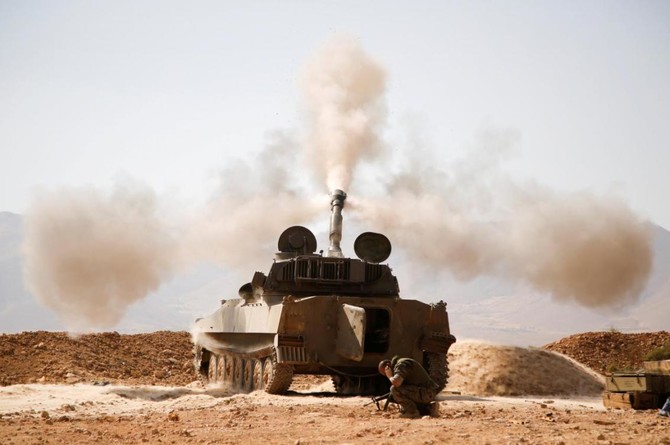
BEIRUT: Syrian regime forces and allied militiamen are advancing on the largest remaining opposition-held territory in the country’s north, forcing thousands of civilians to flee toward the border with Turkey in freezing winter temperatures.
The offensive on Idlib was expected after the defeat of Daesh late last year. The Idlib offensive carries significant risks. The province bordering Turkey is home to more than 2.6 million Syrians, according to the UN, including more than 1.1 million who fled fighting elsewhere in the country. A full-blown government offensive could cause large-scale destruction and massive displacement.
Turkey, a supporter of the opposition, has deployed military observers in the province as part of a de-escalation deal with Iran and Russia, but that has not stopped the fighting on the ground or Russian airstrikes against the opposition.
It is not clear how far the current offensive aims to reach, and recapturing the entire province is expected to be a long and bloody process. Opposition activists said the main target for now appears to be the sprawling opposition-held air base of Abu Zuhour, on the southeastern edge of the province, and securing the Damascus-Aleppo road that cuts through Idlib.
On Sunday, government forces recaptured the town of Sinjar, removing a key obstacle to its march toward the air base, according to reports by the state-affiliated Al-Ikhbariya TV. The town of Sinjar is located about 19 kilometers (12 miles) south of Abu Zuhour.
Over the past two months, troops backed by Russian airstrikes have captured more than 80 towns and villages in the northern parts of the nearby Hama province and breached Idlib itself for the first time since mid-2015.
The offensive gained more intensity on Christmas Day, when one of President Bashar Assad’s most trusted and experienced officers took command of the operation to extend the government’s presence toward Idlib and boost security for the road that links the capital, Damascus, with Aleppo, Syria’s largest city.
Brig. Gen. Suheil Al-Hassan, also known among his troops as “Tiger,” has been credited most recently with the defeat of Daesh in much of eastern Syria, including the months-long battle for the city of Deir Ezzor.
“Conditions on the ground are wretched for the opposition,” said an opposition activist based in northern Syria who asked to be identified by his first name, Hassan, for fear of reprisals.
Another opposition activist based in Hama province, Mohammed Al-Ali, said the Russians and the Syrian regime are “carpet bombing” villages before pushing into them.
“The Russian airstrikes, weak fortifications and Daesh attacks in Hama” have all helped regime forces, he said by telephone.
Hassan and Al-Ali said it is highly unlikely that regime forces would march toward the provincial capital, also named Idlib, because it would set up a costly battle with highly experienced and well-armed Al-Qaeda-linked insurgents. The province is dominated by the Levant Liberation Committee, which claims to have severed ties with Al-Qaeda but is widely believed to still be affiliated with it.
Al-Hassan’s chief mission for now appears to be securing the Damascus-Aleppo road.
In December 2016, Assad’s forces captured rebel-held parts of the city of Aleppo, marking the government’s biggest victory since the conflict began. The main road to the capital remained perilous, however, with insurgents attacking it from the west and Daesh from the east. The troops have since driven Daesh back, but the western side remains exposed.
Four days after Al-Hassan took over operational command, troops managed to break through the militants’ heavy defenses and capture the town of Abu Dali, a link between Hama, Idlib and Aleppo.
Since then, thousands of people have been fleeing with their belongings amid harsh cold weather toward safer areas further north, including Idlib city and areas near the border with Turkey. Pro-opposition media said that more than 5,000 families have fled the violence over the past two weeks, some renting homes or staying in tents in open fields, others left homeless.
Last week, government forces advanced to within around 12 km of Khan Sheikhoun, where a sarin nerve gas attack killed more than 90 people last year, prompting the US to launch a missile attack on Assad’s troops. Experts from the UN and other monitoring groups blamed the chemical attack on the government, which denied responsibility.
The Britain-based Syrian Observatory for Human Rights, which monitors the fighting through a network of activists, said that some 43 civilians, 57 militants and 46 pro-government forces have been killed since the offensive led by Al-Hassan began on Dec. 25.
“The regime wants to take the eastern part of Idlib province,” said the Observatory’s chief, Rami Abdurrahman. “Their aim is to remove any threat to the road” between Damascus and Aleppo, he said.


![]()
Battle looms for Idlib after Daesh defeat
Battle looms for Idlib after Daesh defeat


Latest updates


© 2026 SAUDI RESEARCH & PUBLISHING COMPANY, All Rights Reserved And subject to Terms of Use Agreement.