Zimbabwe’s Mnangagwa rules out forming coalition government

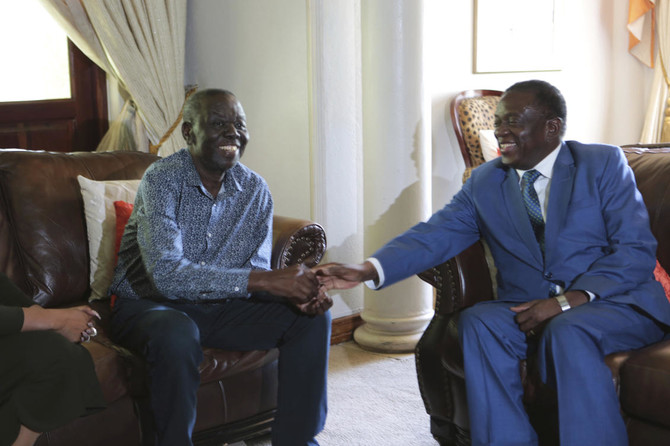
Zimbabwean President Emmerson Mnangagwa, right, talks to Morgan Tsvangirai, the main opposition leader in Zimbabwe, during a visit to his residence in Harare, Jan. 5, 2018. (AP)
Updated 05 January 2018
Follow

Zimbabwe’s Mnangagwa rules out forming coalition government

HARARE: Zimbabwe’s President Emmerson Mnangagwa has ruled out forming a coalition government after visiting opposition leader Morgan Tsvangirai on Friday.
Zimbabwe is due to hold elections in 2018 in the first big test of Mnangagwa’s legitimacy after he rose to power in November last year following a de facto military coup which saw veteran leader Robert Mugabe reluctantly cede power.
Mnangagwa has previously indicated polls could be held as early as March, and is under pressure from civil society, would-be investors and opposition parties to implement political reforms following Mugabe’s 37-year grip on power.
“Currently there is no need,” Mnangagwa told reporters, referring to the possibility of forming a coalition with Tsvangirai’s Movement for Democratic Change (MDC).
Mnangagwa’s ZANU-PF party and the MDC were partners in a government of national unity for five years until 2013, eventually breaking down as acrimony between the parties re-emerged.
Tsvangirai, who is due to challenge Mnangagwa in national elections, has been receiving treatment for colon cancer since 2016 but says he is in good health.
“He is fine, he is recuperating very well and says he will soon again be having a medical check-up in South Africa,” said Mnangagwa after visiting Tsvangirai at his home.


Trump Maritime Action Plan eyes levies on China goods to resurrect US shipbuilding

Updated 52 min 50 sec ago
Follow

Trump Maritime Action Plan eyes levies on China goods to resurrect US shipbuilding

  • US shipbuilding has shrunk since World War II and now severely lags China and other nations
  • Endorsing the plan, Republican Senator Todd Young said: “It’s time to make American ships again” 

WASHINGTON: The ​Trump administration on Friday released its plan to rebuild US shipbuilding and other maritime businesses, paid for in part by port fees on cargo delivered to the United States on ships made in China — levies the US and China agreed to pause for one year.
The Maritime Action Plan offers a road map for the revival of US shipbuilding, which has shrunk since World War Two and now severely lags China and other nations.
Coming in at ‌more than ‌30 pages, the plan calls for establishing maritime ​prosperity ‌zones ⁠to bolster ​investment, reforming ⁠workforce training and education, expanding the fleet of US-built and US-flagged commercial ships, establishing a dedicated funding stream through a Maritime Security Trust Fund and reducing regulations.
The Trump administration early last year announced plans to levy fees on China-linked ships to loosen the country’s grip on the global maritime industry and help pay for a US shipbuilding renaissance. The so-called Section 301 penalties followed a US probe that ⁠concluded China uses unfair policies and practices to dominate ‌global shipping.
The fees, which sparked intense pushback ‌from the global shipping industry and intensified tensions between ​the world’s two largest economies, hit ‌on October 14 and were expected to generate an estimated $3.2 billion annually ‌from Chinese-built vessels sailing to US ports.
But China retaliated with its own port fees on US-linked ships and the tit-for-tat fees disrupted global shipping. Soon after, the two sides struck a deal to put the levies on hold for 12 months.
On Friday, ‌Shipyard owners, investors and the bipartisan sponsors of the Shipbuilding and Harbor Infrastructure for Prosperity and Security (SHIPS) for America ⁠Act welcomed President Donald ⁠Trump’s maritime plan, which landed months later than hoped.
US Senator Todd Young, a Republican from Indiana, said there is substantial overlap between Trump’s vision and the plan in that proposed law, which he reintroduced last year with Democratic Senator Mark Kelly of Arizona and other lawmakers.
Importantly, the SHIPS Act would establish a Maritime Security Trust Fund to reinvest port fee proceeds into maritime security and infrastructure projects such as shipyard revitalization. It has rare backing from both Democratic and Republican lawmakers in Washington, but has not made swift progress.
“The announcement today should serve as a wake-up call for Congress to act quickly ​on this bill in order ​to provide the legal authorities and resources necessary to make this plan a reality,” Young said. “It’s time to make American ships again.”