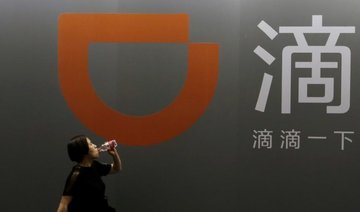
China’s Didi Chuxing buys control of Brazil’s 99 ride-hailing app

Cheng Wei, founder and chief executive of Didi Chuxing, said in Wednesday’s statement that “globalization is a top strategic priority for Didi.” (Reuters)
Updated 04 January 2018
Follow

China’s Didi Chuxing buys control of Brazil’s 99 ride-hailing app

BRASILIA/SAO PAULO: China’s ride-hailing application Didi Chuxing has agreed to acquire control of Brazil’s 99, the companies said in a statement on Wednesday, potentially creating a formidable rival to Uber in Latin America’s largest economy.
The companies did not disclose the stake acquired nor the value, but two people familiar with the deal told Reuters that the transaction would value 99 at over $1 billion (SR3.75 billion) and that Didi would hold a ‘significant majority’ of the Brazilian firm.
The Chinese company bought out investors such as Riverwood Capital, Monashees, Qualcomm Ventures, Tiger Global Management and SoftBank Group, said one of the people.
Brazilian newspaper Valor Econômico earlier reported the valuation of the deal and the investors involved.
The acquisition intensifies Didi’s global rivalry with Uber Technologies, especially in Latin America. Reuters reported in December that Didi planned to enter Mexico this year.
It has previously partnered with overseas ride-hailing companies to offer reciprocal services in other countries, but Didi is now looking to launch its own services overseas.
Didi’s Mexico entry represents the 4-year-old firm’s first move to deploy drivers under its own brand outside of China.
Cheng Wei, founder and chief executive of Didi, said in Wednesday’s statement that “globalization is a top strategic priority for Didi.”
Didi first invested $100 million in 99 in January 2017, getting a stake and management rights in the Brazilian app.
One source with knowledge of the matter said the funds selling their stakes in 99 started looking for a buyer several months ago, in mid-2017.
Riverwood, Monashees, Tiger Global, and SoftBank did not reply to requests for comment.
Didi has made no secret of its desire to expand beyond China, particularly in light of the growing number of Chinese customers who travel overseas.
The firm sealed its dominance in the Chinese market after buying out Uber’s local China business in 2016, ending an expensive subsidy war that cost the US firm roughly $2 billion.
In December, Didi raised $4 billion from investors, in part to fund global expansion, following on from a $5.5 billion fundraising in April.


European gas prices soar almost 50% as Iran conflict halts Qatar LNG output

Updated 21 sec ago
Follow

European gas prices soar almost 50% as Iran conflict halts Qatar LNG output

  • Analysts warn prolonged disruption could push prices higher
  • Some shipments of oil, LNG through Strait of Hormuz suspended
  • Benchmark Asian LNG price up almost 39 percent

LONDON: ​Benchmark Dutch and British wholesale gas prices soared by almost 50 percent on Monday, after major liquefied natural gas exporter Qatar Energy said it had halted production due to attacks in the Middle East.

Qatar, soon to cement its role as the world’s second largest LNG exporter after the US, plays a major role in balancing both Asian and European markets’ demand of LNG.

Most tanker owners, oil majors and ‌trading houses ‌have suspended crude oil, fuel and liquefied natural ​gas shipments ‌via ⁠the ​Strait of ⁠Hormuz, trade sources said, after Tehran warned ships against moving through the waterway.

Europe has increased imports of LNG over the past few years as it seeks to phase out Russian gas following Russia’s invasion of Ukraine.

Around 20 percent of the world’s LNG transits through the Strait of Hormuz and a prolonged suspension or full closure would increase global competition for other ⁠sources of the gas, driving up prices internationally.

“Disruptions to ‌LNG flows would reignite competition between ‌Asia and Europe for available cargoes,” said ​Massimo Di Odoardo, vice president, gas ‌and LNG research at Wood Mackenzie.

The Dutch front-month contract at the ‌TTF hub, seen as a benchmark price for Europe, was up €14.56 at €46.52 per megawatt hour, or around $15.92/mmBtu, by 12:55 p.m. GMT, ICE data showed.

Prices were already some 25 percent higher earlier in the day but extended gains ‌after QatarEnergy’s production halt.

Benchmark Asian LNG prices jumped almost 39 percent on Monday morning with the S&P Global ⁠Energy Japan-Korea-Marker, widely used ⁠as an Asian LNG benchmark, at $15.068 per million British thermal units, Platts data showed.

“If LNG/gas markets start to price in an extended period of losses to Qatari LNG supply, TTF could potentially spike to 80-100 euros/MWh ($28-35/mmBtu),” Warren Patterson, head of commodities strategy at ING, said. The British April contract was up 40.83 pence at 119.40 pence per therm, ICE data showed.

Europe is also relying on LNG imports to help fill its gas storage sites which have been depleted over the winter and are currently around 30 percent full, the latest data from Gas Infrastructure ​Europe showed. In the European carbon ​market, the benchmark contract was down €1.10 at €69.17 a tonne