

What’s happening with Iran’s ongoing protests?

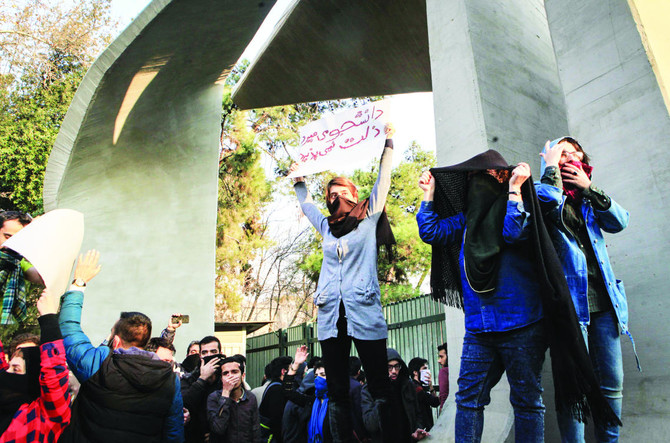
Iranian students stage a protest at the University of Tehran on Dec. 30. (AFP)
Updated 02 January 2018
Follow

What’s happening with Iran’s ongoing protests?

DUBAI: Iran has seen its largest anti-government protests since the disputed presidential election in 2009, with thousands taking to the streets in several cities in recent days.
Travel restrictions and moves by the government to shut down social media networks have limited the ability of journalists to cover the ongoing unrest, which Iranian state television says has killed 12 people.

Here’s what we know so far:

How did the protests start?
The demonstrations began on Thursday in Mashhad, Iran’s second-largest city and the home of a famous shrine. The city is a conservative bastion and a stronghold of Ebrahim Raisi, a cleric who unsuccessfully challenged President Hassan Rouhani in last year’s election. Analysts suggest conservatives began the protests there as a means to pressure Rouhani. The protests then rapidly spread throughout the rest of the country of 80 million people.

What do protesters want?
Demonstrators initially focused on Iran’s flagging economy. Despite now being able to sell oil on the international market after the 2015 nuclear deal, Iran faces rising inflation and high unemployment. A recent increase in egg and poultry prices by as much as 40 percent, which a government spokesman has blamed on a cull over avian flu fears, appears to have sparked the protests. Protesters have chanted against Rouhani as well as Supreme Leader Ayatollah Ali Khamenei. Some have criticized Iran’s military support of Syrian President Bashar Assad, while others have praised the US-backed shah, who fled into exile in 1979 and died of cancer the following year.
Who is leading the protests?
So far, no central leadership has emerged. That’s in contrast to the 2009 Green Movement demonstrations, which protested hard-line President Mahmoud Ahmadinejad’s re-election amid widespread allegations of voter fraud. Those protests, Iran’s biggest since 1979, prompted a crackdown by Iran’s paramilitary Revolutionary Guard and its affiliates that saw thousands detained, dozens killed and others tortured. Its leaders remain under house arrest years later. While leaderless, these new protests have been fanned in part by an exiled journalist named Roohallah Zam using a mobile phone messaging app called Telegram .

How has the regime responded?
Iran says it temporarily shut down access to both Telegram and the photo-sharing app Instagram to “maintain peace,” limiting protesters’ ability to share images and publicize rallies. Facebook and Twitter are already banned. Uniformed and plainclothes police are in the streets, as are motorcycle-riding members of the Basij, a volunteer force under the Revolutionary Guard that helped carry out the 2009 crackdown. Rouhani himself has said Iran allows protests, and authorities often tolerate smaller, limited demonstrations and labor strikes. But Rouhani and other officials have warned that the government won’t hesitate to crack down on those it considers lawbreakers.

Has there been violence?
At least 12 people have been reported killed so far. Iranian state television said on Monday that security forces repelled “armed protesters” who tried to take over police stations and military bases, without elaborating. Pictures published by semi-official Iranian news agencies have shown water cannons being used on protesters in Tehran, as well as damage done by demonstrators to public property. Several hundred people reportedly have been arrested, though police say they’ve released many. Some videos circulated online show protesters welcoming police officers and demonstrating peacefully.
How has the world reacted?
US President Donald Trump has tweeted several times in support of the protests. The State Department has accused Iran’s leaders of turning “a wealthy country with a rich history and culture into an economically depleted rogue state whose chief exports are violence, bloodshed and chaos.” Rouhani has dismissed Trump’s criticisms, while many Iranians remain angry with the American president over his travel bans barring them from getting US visas, as well as his refusal to re-certify the nuclear deal.

Is Iran a democracy?
Elected representatives pass laws and govern on behalf of their constituencies. However, the supreme leader has the final say on all state matters. The Guardian Council, a 12-member panel half selected by the supreme leader and half nominated by the judiciary and approved by parliament, must approve all laws. The council also approves all presidential and parliamentary candidates, barring anyone who challenges the political system itself or advocates dramatic reform. Security forces answering only to the supreme leader, like the Revolutionary Guard, routinely arrest dual nationals and foreigners, using them as pawns in international negotiations.

What will happen next?
Demonstrators have called for more protests in the days ahead. While Rouhani has said the regime allows demonstrations, all so far have been held without police permission, which is illegal. Ultimately, the supreme leader will decide how to respond. As Cliff Kupchan at the Eurasia Group wrote in an analysis on Sunday: “When it comes to the regime’s survival, Khamenei calls the shots. And he’s got a lot of loyal and ruthless troops at his disposal.”


Syrian church marks Christmas and reaffirms faith months after deadly attack

Updated 15 min 26 sec ago
Follow

Syrian church marks Christmas and reaffirms faith months after deadly attack

  • The June attack was blamed on a Daesh cell, which authorities said had also planned to target a Shiite shrine

DWEIL’A: At a church in Syria where a suicide attack killed 25 people in June, hundreds of worshippers gathered before Christmas to remember those they lost and reaffirm their faith.
With a small detail of security forces standing guard outside, members of Mar Elias Church held Mass on Tuesday evening and lit an image of Christmas tree made of neon lights on the wall of the courtyard outside. The tree was hung with pictures of those who were killed in the attack.
They include three men the congregation hails as heroes for tackling the bomber, potentially averting a much higher death toll in the June 22 attack.
A man opened fire then detonated an explosive vest inside the Greek Orthodox church in Dweil’a on the outskirts of Damascus as it was filled with people praying on a Sunday.
Before he detonated the vest, brothers Boutros and Gergis Bechara and another congregant, Milad Haddad, tackled the shooter and pushed him out of the center of the church, congregants said.
“If it weren’t for the three of them, maybe not one person would remain out of 400 people,” said Imad Haddad, the brother of Milad Haddad, who attended Tuesday’s Christmas tree lighting.
He hasn’t decorated for Christmas or put up a tree at home, but gathering at the church was “is a message of peace and love” and a message that “we are believers and we are strong and we are steadfast in spite of everything,” he said.
Thana Al-Masoud, the widow of Boutros Bechara, recalled searching frantically for her husband after the explosion but she never found him, alive or dead. His body had been ripped apart by the blast.
“There’s no holiday, neither this year nor next year nor the one after it,” she said.
She takes comfort in the belief that her husband and the two other men who confronted the attacker are martyrs for their faith.
“Our Lord chose them to be saints and to spread His word to all the world,” she said. “But the separation is difficult.”
Attack stoked Christian fears
The attack on the church was the first of its kind in Syria in years and came as a new Sunni militant- dominated government in Damascus sought to win the confidence of religious minorities following the ouster of former President Bashar Assad.
Interim President Ahmad Al-Sharaa has struggled to exert authority across the country, even in the ranks of allied groups. There have been several deadly outbreaks of sectarian violence in the country in the past year.
While the new government has condemned attacks on minorities, many accuse it of failing to act to control the armed factions it is trying to absorb into the new state army and security forces.
The June attack was blamed on a Daesh cell, which authorities said had also planned to target a Shiite shrine. Daesh did not claim responsibility for the attack, while a little-known group called Saraya Ansar Al-Sunna said one of its members had carried out the attack. The government said the group was a cover for Daesh.
Christians made up about 10 percent of Syria’s population of 23 million before mass anti-government protests in 2011 were met by a brutal government crackdown and spiraled into a brutal 14-year civil war that saw the rise of IS and other extremist groups.
Hundreds of thousands of Christians fled during the war, during which there were sectarian attacks on Christians including the kidnapping of nuns and priests and destruction of churches. Now many are once again seeking to leave.
Solidifying faith and seeking peace
Since losing her husband in the church attack, Juliette Alkashi feels numb.
The couple had been sweethearts before she left Syria with her mother and brother to emigrate to Venezuela. In 2018, when Emile Bechara asked her to marry him, Alkashi moved back to Syria even though it was still in the midst of a civil war.
“Whatever is going to happen will happen, and I’ve surrendered to it,” she said. “If one goes to pray and dies in the church — whatever God has written is what will be.”
The only thing that matters now, Alkashi said, is that she and her 3-year-old son remain together.
Some congregants said the attack only strengthened their faith.
“I saw a column of smoke rising from the ground to the ceiling, and I heard a voice saying, ‘I will not forsake you and I will not leave you,’” said Hadi Kindarji, who described an intense spiritual experience in the moment of the explosion.
He believes today that even the seemingly senseless violence was part of God’s plan.
“Our God is present, and He was present in the church,” he said.
Yohanna Shehadeh, the priest of Mar Elias church, acknowledged many in the congregation are afraid of more deadly violence.
“Fear is a natural state. I’m not going to tell you there is no fear, and I’m not only talking about the Christians but about all the Syrian people, from all sects,” Shehadeh said.
As Christmas approaches, he said, they are praying for peace.